Blind rescue dachshund goes viral for chasing her foster siblings by sound
Doges Editorial · 2026-06-20 · 4 min read
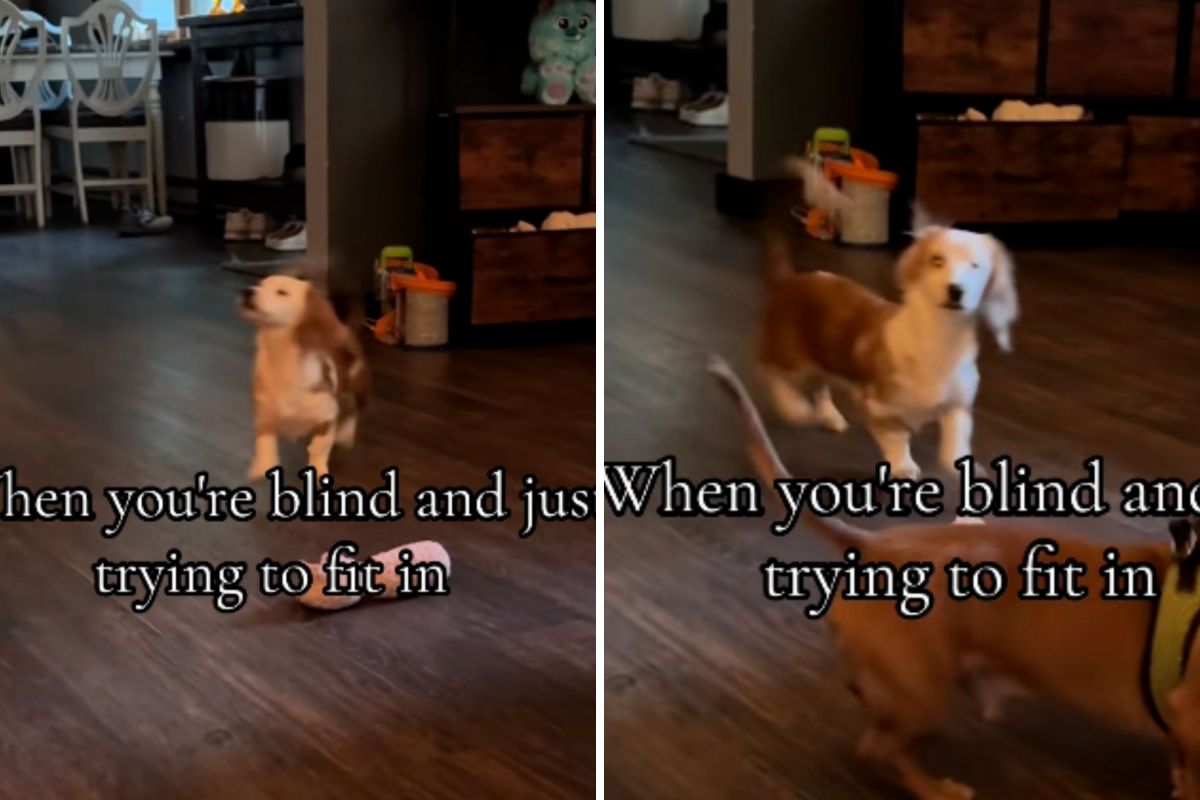
A blind rescue dachshund named Wren went viral this month after a TikTok video captured her running toward the sound of her foster siblings, bumping into furniture, pivoting and trying again. Five million people watched.
The video lasts less than a minute. Wren, a small tan dachshund, comes careening around a corner, head up, ears forward, tail wagging in the particular way that says she knows something is happening and she intends to be part of it. The other dogs are somewhere in the house. She can hear them. She cannot see them. She runs toward where she thinks they are.
She gets the direction slightly wrong. The other dogs streak past her in the opposite direction, and she pivots on the spot, reorients herself and sets off again. At one point she lifts both front paws onto the coffee table, just in case the others had gone up, just to cover her options. She doesn't stop. She doesn't sit down and wait to be found. The video caption from @wrenspov, posted to TikTok on June 2, reads simply: "She loves when foster siblings come to play."
More than five million people have watched it.
Where Wren came from
Four months ago, Wren was on an animal shelter's euthanasia list. She and her sister were pulled together by the same person, who took them both home. Wren cannot see because she is a double dapple dachshund, a dog born from two dapple-patterned parents.
Dapple coloring in dachshunds is produced by the merle gene, the same gene responsible for the marbled, spotted patterns found in Australian Shepherds and some Collies. It is a dominant gene, meaning a single copy produces the dapple coat. When two dapple dachshunds are bred together, their offspring have a chance of inheriting two copies of the merle gene. Those double-merle puppies are called double dapples, and the consequences are well-documented: elevated risk of blindness, deafness and microphthalmia (abnormally small or absent eyes).
Wren is blind. She is not deaf. She was placed on the euthanasia list, pulled and given a home. That home had foster siblings. She had opinions about joining in.
The genetics behind double dapple
Responsible dachshund breeders avoid mating two dapple dogs together. The double dapple coat, white with patches of brown and black and often with blue or differently-colored eyes, has historically driven demand for these puppies among buyers who did not understand what the coloring signals. Animal welfare organizations and dachshund breed clubs have spent years educating against the practice, with limited success.
Dogs like Wren are the result. They are not rare. They end up in shelters with some frequency, often because owners were not prepared for the care a blind or deaf animal requires. Some are adopted quickly. Others end up on euthanasia lists.
While double dapples are known for their distinctive markings, they are also at a higher risk of genetic health issues, including blindness and deafness.
— Dogster, cited by Newsweek, June 2026
The numbers from peer-reviewed research are specific. A 2009 study in the Journal of Veterinary Internal Medicine found that among single merle dogs, 3.5% had hearing impairment (2.7% unilateral, 0.9% bilateral); among double merle dogs, 25% had hearing impairment (10% unilateral, 15% bilateral). [1] Wren's hearing is intact. She navigates by it entirely. Her blindness reflects how the same genetic disruption that causes deafness in other double dapples landed instead in her eyes, impairing the pigment-producing cells that would normally form functional retinas during gestation.
How a blind dog navigates a house full of dogs
Wren's approach to the living room, running hard, pivoting at sounds, checking the coffee table, is navigation. Blind dogs rely primarily on smell and hearing to map the world around them, and they build those maps over time through exactly the kind of repetition Wren is engaged in: moving through a space, bumping into things, remembering where things are.
The American Kennel Club notes that blind dogs adapt remarkably well when given consistent environments and routines. Moving furniture, rearranging rooms or introducing new objects without warning disrupts the internal map a sightless dog has built. A stable home, with the same corners and the same couch and the same smell of the same other dogs, becomes navigable over time.
Maintaining a consistent environment and routine can help visually impaired dogs thrive, allowing them to continue participating in everyday activities such as training, exercise and social interactions with other pets.
— American Kennel Club, cited by Newsweek, June 2026
Toys that squeak or rattle matter more than toys that look interesting. Verbal cues matter more than hand signals. The sounds and smells of other dogs become a kind of sensory GPS. That is what Wren is doing when she runs: she is using the other dogs to locate herself in space.
What the video shows
Wren keeps her head up throughout, listening, processing. Her tail does not stop. When she loses track of where the others went, she pauses for about half a second, orients and picks a direction.
The coffee table moment is the one that gets people. It is a specific piece of problem-solving: she doesn't know if the others jumped up, so she checks. She puts her front paws up, confirms there's no dog up there, and gets back down. Then she keeps looking.
How blind dogs adapt
Wren does not appear to be grieving her vision. She appears to be extremely busy looking for the other dogs. Animal behaviorists find this pattern consistently: sightless dogs adapt readily, and most show no measurable reduction in play behavior, social engagement or apparent quality of life. The things they want (company, movement, novelty, the smell of another dog around the next corner) remain accessible.
A 2020 peer-reviewed study by Sophie Savel and colleagues [2] directly tested the popular assumptions about congenitally impaired dogs, that they are prone to aggression, unpredictable biting when startled and anxiety that makes them unsuited to domestic life. The researchers surveyed owners of dogs with congenital hearing and/or vision impairment and compared responses with matched owners of sensory-normal dogs, examining health, behavior, communication and daily activities. The assumptions were found to lack scientific grounding: the impaired dogs did not show significantly higher rates of aggression or behavioral problems. What blind dogs need is a stable physical environment, verbal cues in place of hand signals and owners who understand that their map of the house is built through sound and smell, not sight, exactly what Wren, in her four months of foster care, has already begun constructing.
She loves when foster siblings come to play.
— @wrenspov, TikTok, June 2026
Someone pulled Wren from the euthanasia list. She does not know that. What she knows is that somewhere in the house there are other dogs making sounds, and that with enough pivoting and trying again, she can find them.
References
[1] Strain GM et al. Prevalence of Deafness in Dogs Heterozygous or Homozygous for the Merle Allele. Journal of Veterinary Internal Medicine, 2009. https://onlinelibrary.wiley.com/doi/full/10.1111/j.1939-1676.2008.0257.x
[2] Savel S, Sombé P. Are dogs with congenital hearing and/or vision impairments so different from sensory normal dogs? PLoS One, 2020. https://pmc.ncbi.nlm.nih.gov/articles/PMC7473589