When training a dog trains you too
Doges Editorial · 2026-06-11 · 5 min read
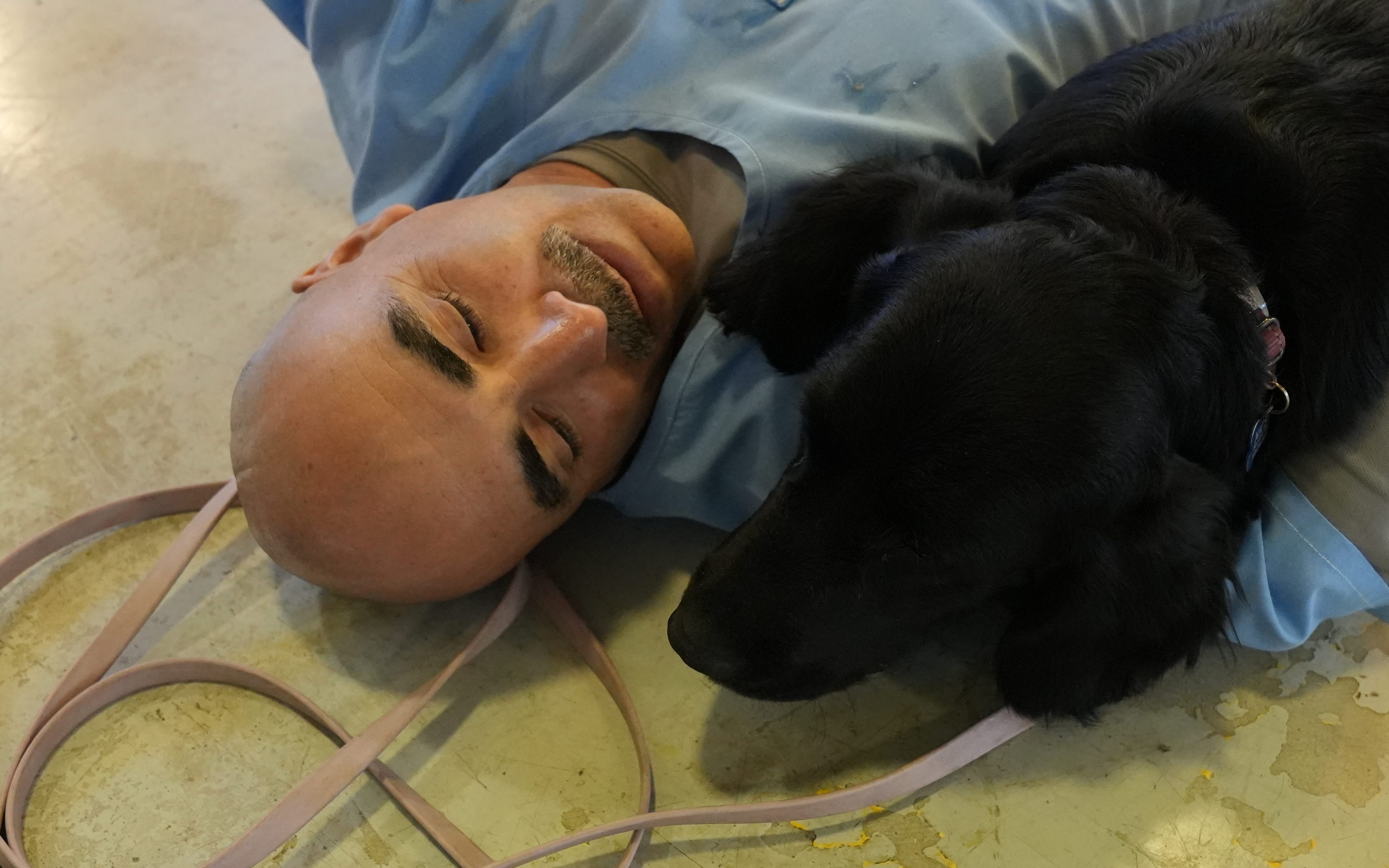
At California State Prison-Solano, incarcerated men are preparing rescue dogs to become service animals — living with them around the clock, learning patience through practice, and finding, along the way, something they hadn't expected to find.
Inside the housing unit at California State Prison-Solano, a man named Francisco is kneeling on the concrete floor. In front of him, a rescue dog is paying close attention — head tilted slightly, watching the hand. Francisco's palm moves in a deliberate downward gesture. The dog's hindquarters lower. Sit. Francisco reaches for the treat, and somewhere in the room, something small and important is working.
The Paws on a Mission program at CSP-Solano, documented in a video story published by Inside CDCR on June 9, 2026 (https://www.cdcr.ca.gov/insidecdcr/2026/06/09/watch-paws-on-a-mission-finds-meaning-in-training), places incarcerated men in charge of training rescue dogs for eventual careers as service animals. The program is a collaboration between the California Department of Corrections and Rehabilitation, California State Prison-Solano, and the National Institute of Canine Service and Training.
What distinguishes this program from a standard dog training course is the intensity of contact it requires. Each dog is assigned two or three trainers. Those trainers live with the dog in their housing unit, with canine access available around the clock. There is no dropping off the dog in the evening. The dog is there when they wake up. It is there when the lights go out. For the months of the program, it is, essentially, their responsibility.
Twelve weeks before the first leash
No one handles a dog on day one. Before any participant is permitted to work with an animal, they must complete a twelve-week course covering canine behavior, body language, psychology, and handling methods. Then come two assessments: a written test and a hands-on evaluation. Only after passing both can a trainer begin.
Once certified, trainers meet with Paws on a Mission instructors twice weekly to develop individualized training frameworks for each dog in the program. No two dogs get the same plan — the guidelines are tailored to that animal's history, temperament, and specific skill gaps. The work moves in stages, from basic obedience through socialization and eventually into advanced service dog skills.
The dogs entering the program are rescue animals. Many carry the behavioral histories you'd expect: anxiety, poor socialization, wariness around strangers or unfamiliar environments. Teaching them to trust — and then to work — requires patience above almost everything else. Patience is not a skill most people arrive at automatically. It has to be learned, and in this program, the curriculum is constant.
What a dog does to an angry room
Mark Ruefenacht, the Paws on a Mission program director, has watched men enter the program wound tight and leave it changed. He's careful about how he describes this — not sentimental, not overselling. He simply reports what he has observed over time.
I never in my life imagined (seeing) the difference in these men than I have seen over this period of time.
— Mark Ruefenacht, Paws on a Mission program director
"Short-tempers and anger have changed," Ruefenacht said, "because now they're working with a dog in which they had to learn patience." This is a consistent finding in the research on prison animal programs. A dog doesn't respond to anger or yield to status. It responds to calm, consistency, and care — and if you haven't got those, you'll get nothing done. In a setting where certain habits of self-presentation can calcify badly, an animal that simply needs you to show up calm and keep trying is doing something that workshops and coursework can't always replicate. Patience either worked just now, or it didn't.
The moment hands touch the leash
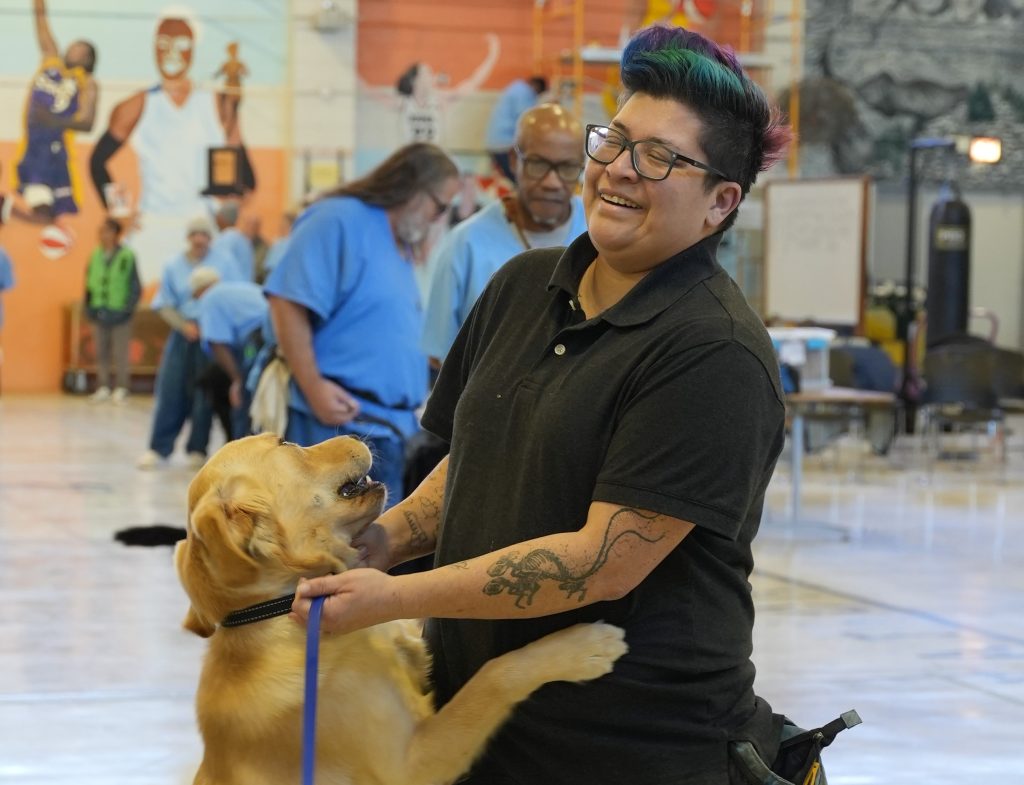
Hayley Sevilla, the lead trainer with Paws on a Mission, describes the first time a participant puts hands on a dog as something she has watched dozens of times and still pays attention to.
When they put their hands on the dog, there's a sense of pride and responsibility, feeling like they are worth something. You start to see the care, the sense of responsibility, the sense of pride in the program, in themselves.
— Hayley Sevilla, lead trainer, Paws on a Mission
Sevilla is careful not to overstate the arc. The program is demanding, the tests are real, and not everyone completes it. But for those who do, she says, the dog does something that is difficult to engineer through other means: it needs something specific from you, and you are the one who has to figure out how to provide it. The dog cannot be convinced by performance. It needs the actual thing.
Francisco's reason
Francisco — identified in the CDCR video only by his first name — explains his commitment to the program with a clarity worth quoting directly. "The most rewarding part of this program," he says, "is having to train a dog for someone out there on the streets. That's why I commit a lot to this program. I feel a sense of purpose, of meaning."
This is worth pausing on. The gratification Francisco describes isn't only about the dog in front of him. It's about the unknown person who will one day hold that leash. Someone with a disability who needs a reliable working partner. Someone whose daily movements through the world will become more possible because a man in a California prison taught this animal, carefully and over many months, how to do their job.
There's a strange doubling in it: the rescue dog being trained for a person outside. The trainer inside doing the work. Both of them, in their different circumstances, learning how to become useful. Both of them being changed by the relationship in ways the program probably didn't set out to quantify.
What the leash teaches
Prison canine programs now operate in all 50 states. The evidence base has grown specific. A study of nearly 182,000 inmates released from Florida prisons between 2004 and 2011 found that participation in dog training programs led to significant reductions in prison misconduct and in the likelihood and timing of re-arrest (Well-Being International Studies Repository: https://www.wellbeingintlstudiesrepository.org/cgi/viewcontent.cgi?article=1000&context=papbiblio). In Washington state, the average three-year recidivism rate is 28 percent — and just 5 percent among inmates who completed a dog training program (Corrections1: https://www.corrections1.com/re-entry-and-recidivism/articles/how-dog-training-programs-can-improve-prison-rehabilitation-TrGWk4TFdcSpSJoU). In programs focused on service dog preparation like this one, two transformations happen for the price of one training curriculum.
A 2020 systematic review of peer-reviewed prison dog program research found consistent effects across multiple countries: reduced self-reported depression and state anxiety, lower infraction rates, and improved sleep among participants (Briones-Buixassa et al., PMC: https://pmc.ncbi.nlm.nih.gov/articles/PMC7697666). The mechanism proposed is consistent with what Ruefenacht observed directly: an animal that cannot be impressed by performance, that will simply wait until you find the quieter version of yourself, is a uniquely honest training environment for self-regulation.
Dogs have always been used as working animals: hunting, herding, detection, rescue. What programs like Paws on a Mission illustrate is that the work flows the other direction too. A dog that asks nothing except consistency — that cannot be cowed by anger, that will wait, patient and attentive — is doing a kind of work that is harder to name but no less real.
Francisco kneels on the concrete. The dog is watching. Somewhere outside these walls, someone is waiting for this animal to be ready — for the moment they can finally move through the world with a partner who knows exactly what they need. For now, there is just this room, this morning, this gesture, and a rescue dog learning that when a hand reaches out, something good is coming.