What happens when a dog gets a smartphone
Doges Editorial · 2026-06-24 · 4 min read
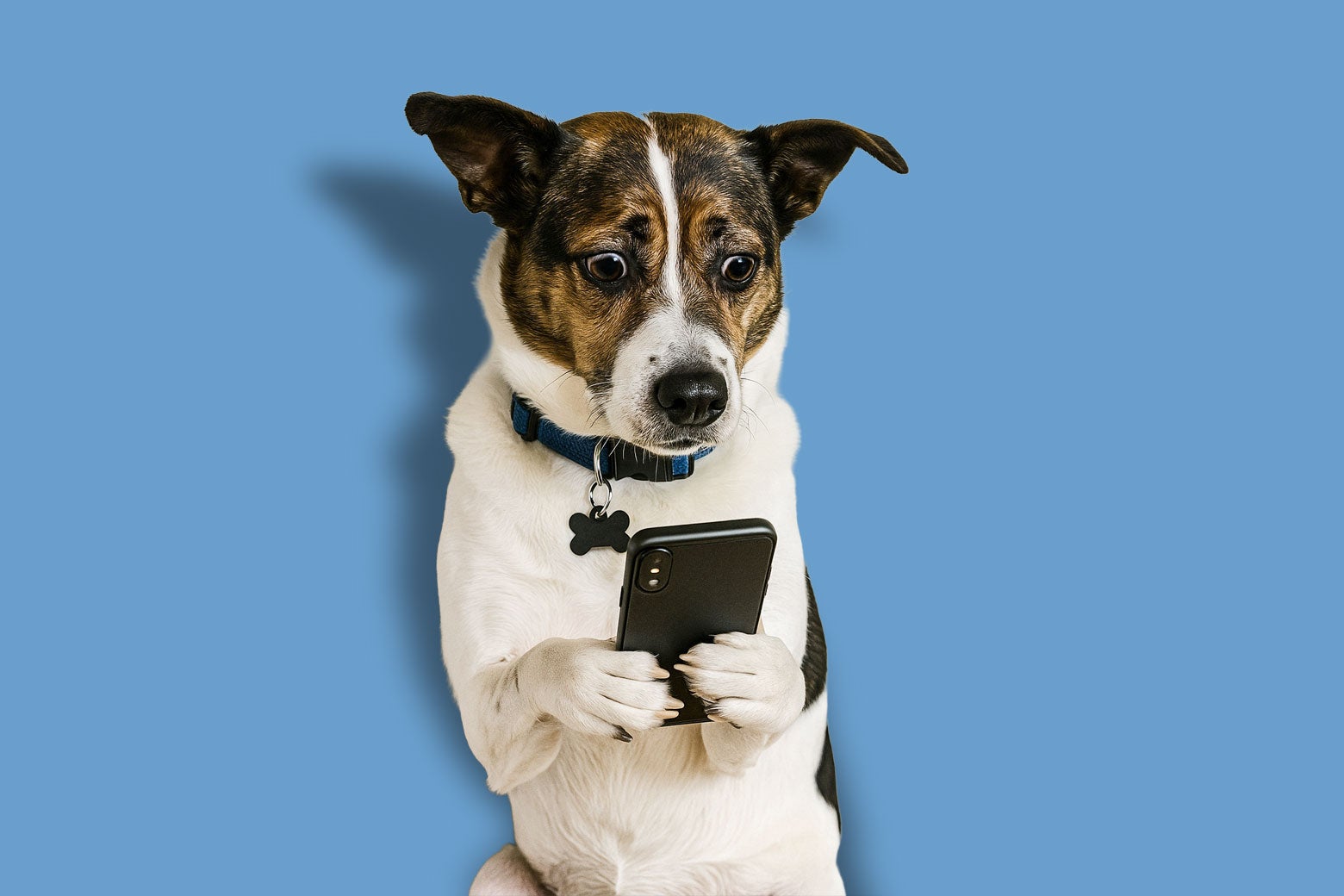
The PetPhone promises GPS tracking, health monitoring, and two-way calling between owners and their pets. Writer Emma Madden gave one to her Cavalier King Charles spaniel for two months — and learned something she hadn't expected about what dogs actually need from us.
The first text message arrived mid-morning. A small photograph appeared on Emma Madden's phone — her Cavalier King Charles spaniel Clover, 2 years and 4 months old, looking pleased with herself — and beside it, four words: "I'm bored. Take me out to play." Madden laughed with genuine delight. She had just received a text from her dog. Then the seventeenth one arrived, and the novelty was wearing off. (This piece draws from Madden's hands-on review in Slate, published June 20, 2026.)
The world's first smartphone for pets
The PetPhone is a device roughly the size of a lip balm tube that clips to a dog's collar and connects to the owner's smartphone via an app. Unveiled this year at Mobile World Congress in Barcelona by the Singapore-based company uCloudlink, it costs $90 and requires a roughly $10-per-month data plan, sold primarily through Chewy. Its headline promise: two-way communication between pets and their owners. The company's founder, Chen Chaohui, described it to Yahoo Finance as "a pet TikTok" — though, as Madden noted, one hopes dogs will be spared the AI-generated content currently plaguing human users.
uCloudlink targeted the U.S. market specifically because American pet spending — across more than 94 million households — is the largest in the world. The PetPhone combines GPS tracking, a health monitor, a speaker, a microphone, and a suite of AI-powered features. At its most ambitious, it promised to let Clover call Madden, and Madden call Clover.
Three jumps in six seconds
The communication requires training. To send an "I'm bored" text, a dog must perform three jumps within six seconds. To signal thirst, a specific tap of the collar. The company told Madden these gestures were chosen with care.
These triggers were selected after extensive testing to ensure that the actions were 'well within a pet's behavioral capabilities' and chosen through 'a blend of behavioral science, data engineering, and practical usability testing.'
— uCloudlink spokesperson, via Slate
Clover, who knows how to twirl, kiss on command, speak, "inside speak," and perform most standard pup party tricks, could not reliably master the jump trigger even after a week of dedicated practice. And when the system did activate, it activated constantly and accidentally: Clover's long, tasseled ears collect grass and debris on walks, and she scratches them regularly. Each scratch registered as a jump sequence. By midafternoon on one testing day, Madden's phone was buzzing in a loop, every notification announcing the same state of affairs.
Calling her collar
The two-way calling function worked — intermittently. When Madden called Clover from home, her voice emerged from the collar speaker. Clover, normally unmoved by horror movie sound effects and every variety of domestic noise, heard her owner's voice coming from her own body and hid under a chair. From a cinema later, Madden tried again; after several automatic reconnection attempts, what came through briefly sounded like screaming before resolving into audio with a distinctly early-2000s mobile quality.
The GPS, by contrast, was genuinely impressive. The PetPhone uses what uCloudlink calls a six-layer hybrid positioning system — combining GPS, assisted GPS, Wi-Fi, Bluetooth, cellular data, and active radar functions — that Madden found held accurate location even in dense urban environments where standard consumer pet trackers frequently wander. For an owner who needs to know exactly where their dog is at any moment across a city, or who takes dogs off-leash in complex terrain, this is the product's strongest argument for itself. Battery life, however, fell well short of advertised expectations, dying after roughly four hours on several occasions.
What communication already looks like
The PetPhone's premise rests on an observation that is genuinely true: it is surprising, given how intimately humans and dogs have coevolved across fifteen thousand years, how little technology exists to facilitate direct communication between the two species. Research into augmentative and alternative communication has shown that some dogs can learn to use physical soundboards — buttons that speak concepts for them — combining ideas in unexpectedly sophisticated ways. The drive to understand what dogs are trying to tell us is legitimate and growing.
The largest systematic effort to study button-based communication is the "They Can Talk" project at UC San Diego's Comparative Cognition Lab, led by cognitive scientist Federico Rossano. The project has enrolled roughly 1,300 pets on commercial soundboards since 2020 — described by KPBS as "the biggest community science project ever done on animal communication." As of 2026, no peer-reviewed results have confirmed that dogs understand the semantic content of button presses rather than trained associations with outcomes they want. (https://cclab.ucsd.edu) What independent research has confirmed over two decades is something quieter: dogs follow human pointing gestures, grasping that a pointed finger refers to an object in the world — a form of communicative understanding shared with great apes but rare outside them. They already know when we mean something. The PetPhone is trying to close the circuit in the other direction.
The PetPhone's understanding of communication can feel narrow, prioritizing human language over pets' physical gestures. That there are really only two options for communication vastly underestimates dogs' communicative potential.
— Emma Madden, Slate
Clover was already communicating with Madden constantly and clearly. There was the cold, entitled stare when she was hungry. The licking Madden batted away, even knowing it was an expression of love. The violent wag and full-body launch at the door that said, unmistakably: you're home. The PetPhone added a layer of human text formatting over a conversation that was already happening — and in doing so, made both of them slightly confused about what they were supposed to be saying.
The language that doesn't need translating
One of the great joys of owning a pet is that you develop your own way of communicating, in a way that widens your vocabulary. I must have over 30 names for Clover — Chepi, Miss Jane, Hosho, to name a few — all of which she responds to.
— Emma Madden, Slate
The PetPhone's GPS is genuinely worth considering, especially for anyone whose dog runs, ranges, or has a history of going missing in complex environments. Knowing where your dog is — precisely, in real time, across a city — is useful in ways that need no further justification. But as a communication device, the product came up against something its engineers hadn't accounted for: the human-dog conversation was already happening, and had been for years, through a mutually invented private language that no app had a field for. Clover hiding under a chair when her collar spoke. Clover sending seventeen boredom notifications in one afternoon. Clover, in the end, doing exactly what she was already doing before any of this started: finding the most direct route to the person she trusted, through whatever means were available, and waiting there.