What half of 40,000 dogs taught us about supplements
Doges Editorial · 2026-06-22 · 5 min read
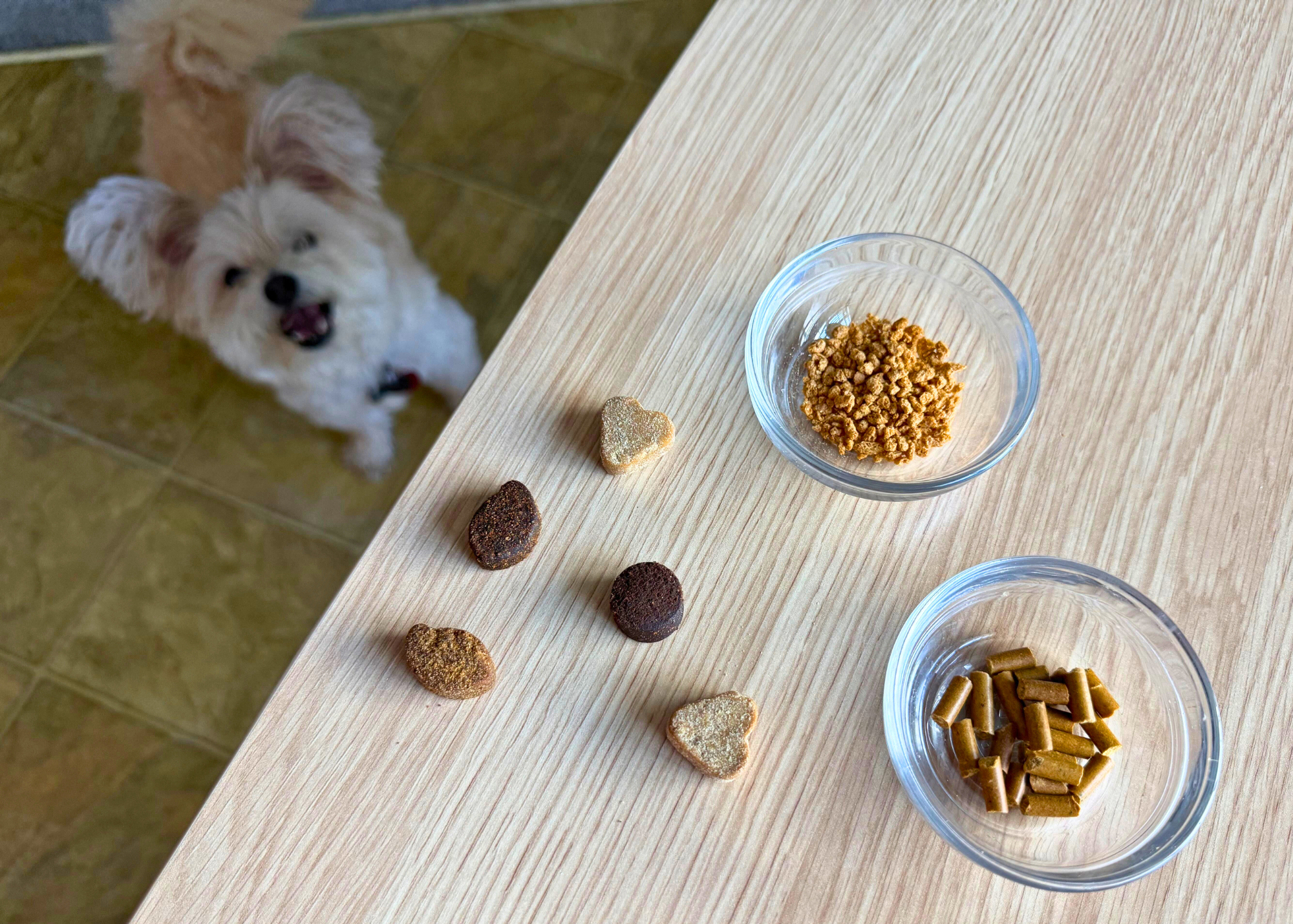
A new Dog Aging Project study found 52% of enrolled dogs were taking supplements — and the patterns about who, what, and why are more revealing than the number alone.
You've stood in front of it. The supplement wall at the pet store — three feet wide, sometimes four, packed with fish oil softgels and hip-and-joint chews and probiotic powders and something called cognitive support that you weren't sure your dog needed but that gave you a moment's pause. You picked something up. You put it back. You may have Googled it in the aisle and felt no more certain afterward. You are, it turns out, in extremely good company.
The biggest snapshot of supplement use ever taken
The Dog Aging Project is a longitudinal study tracking tens of thousands of dogs across the United States with the goal of understanding how dogs age and what influences a long, healthy life. Its new research on supplement use, published in the American Journal of Veterinary Research (Vol. 87, Issue 2, 2026; doi:10.2460/ajvr.25.06.0217), looked at 40,367 enrolled dogs and found that 52 percent of them — exactly 20,993 — were taking at least one dietary supplement. That's not a niche behavior. That's slightly more than half of all the dogs in the largest canine longevity study in history.
If you've ever stood in the pet store staring at a wall of supplements and had no idea what to pick, you're definitely not alone!
— Janice S. O'Brien, Dog Aging Project researcher
Omega-3s and joint support dominate
Among the 20,993 supplemented dogs, the breakdown by type was specific: omega-3 fatty acids led at 57 percent, glucosamine at 56 percent, chondroitin at 45 percent, vitamins at 38 percent, and probiotics at 37 percent. The top two categories aren't there by coincidence. Omega-3s (EPA and DHA) work by reducing inflammatory cytokine production in joint tissue — a mechanism that's been measured in randomized controlled trials, not just owner impressions.
In a 90-day randomized, double-blinded trial published in the Journal of the American Veterinary Medical Association, Roush and colleagues found that 82 percent of dogs fed a fish-oil omega-3 diet showed measurable improvement in peak vertical force — a force-plate measurement of how well a dog bears weight on a limb — compared with 38 percent of controls (Roush et al., JAVMA, 2010; PMID 20043801). A companion study by Fritsch and colleagues found that dogs on the same omega-3 diet were able to reduce their carprofen dosage by the end of the trial, meaning the supplement partially replaced an NSAID pain medication (Fritsch et al., JAVMA, 2010; PMID 20187817). These are clinically meaningful numbers, measured on force plates and in prescription records, not owner surveys.
Glucosamine and chondroitin have a longer history in veterinary medicine with more mixed trial results. The mechanism for glucosamine is not fully characterized; chondroitin is thought to reduce inflammation and slow cartilage degradation. Clinical trials in dogs with osteoarthritis have shown improvement in pain scores and weight-bearing in some studies and no detectable effect in others. The honest summary is that omega-3s have the stronger and more consistent evidence base; joint supplements are worth discussing with your vet, specifically.
It's the dog's health, not the owner's income
One of the more interesting findings is what didn't predict supplement use. The researchers found that a dog's age, size, and health status were much stronger predictors of supplement use than the owner's income, education level, or other demographic factors. This runs counter to a common assumption in pet health research — that supplement use is primarily a product of owner affluence or lifestyle. Instead, the data suggest that owners are responding to their dogs' actual condition.
Dogs with orthopedic conditions showed the strongest association with supplementation. This makes intuitive sense: a dog that limps, slows on stairs, or shows stiffness after rest is giving visible, concrete feedback that something is happening in its joints. That feedback is driving the decision to supplement more than any demographic variable the study could measure.
The conversation most vet visits don't have
The study's authors made a direct recommendation: veterinarians should be talking to their clients about supplements more than they currently do. A significant portion of dog owners are making supplement decisions independently — reading labels in store aisles, following advice from breeder communities, asking in online groups — without much input from a veterinary professional. This gap has consequences. Some supplements have good evidence behind them. Others have almost none. And a few have interactions with medications or conditions that owners wouldn't necessarily know to flag.
Veterinary team professionals should consider spending more time discussing supplement use and efficacy with dog owners, especially for owners of senior pets.
— American Journal of Veterinary Research, 2026
What changes as a dog ages
The study also found that supplement use varied by life stage. Younger, healthy dogs were less likely to receive supplements. Senior dogs and middle-aged dogs with emerging health conditions were more likely. This mirrors human supplement use: we tend to add interventions as the body starts giving us reasons.
One category worth tracking as dogs age is antioxidants, given to 22 percent of supplemented dogs in the DAP data. The reason shows up in the cognitive decline research: studies of canine cognitive dysfunction syndrome have found that roughly 28 percent of dogs aged 11 or 12 show early signs of impairment, a figure that climbs to about 48 percent by age 14 (Neilson et al., J Am Vet Med Assoc, 2001; PMID 11393362). That's the same life stage at which the supplement wall's 'cognitive support' section stops looking abstract. Whether antioxidants meaningfully slow that trajectory is still being studied, but the biology — oxidative stress as a driver of neural aging — gives researchers a plausible mechanism to work with.
For dogs, the translation is often visible on the walk — the dog that used to bound up every curb and now steps down gingerly, the one whose rear end takes a moment to warm up on a cold morning, the one who circles the bed three times before settling like the movement costs something. If you've started noticing those things, the supplement conversation at your next vet appointment is worth having explicitly. Not just 'is it okay if I give this?' but 'given where my dog is right now, what would actually help, and what's the evidence for it?'
Why scale changes what we know
Most research on what dogs eat — including supplements — has been small-scale. A study of 200 dogs, or 500, tells you something. A study of 40,367 dogs tells you something very different. The Dog Aging Project's enrollment represents a genuine cross-section of American dogs: different breeds, different sizes, different regions, different ages, different living situations. When patterns emerge at that scale — when 57 percent of supplemented dogs are getting omega-3s, when orthopedic status predicts supplementation better than owner income — those aren't artifacts of a skewed sample. They're what's actually happening in living rooms and dog beds across the country.
More than half of American dogs may be on supplements right now. Their owners went to the same wall you went to, and most of them picked fish oil or glucosamine, and most of them made that decision without a veterinary recommendation either way. The study doesn't tell you what to give your dog. It tells you that the question deserves a real conversation — one where someone who can look at your specific dog, at your specific life stage, helps you figure out whether the supplement wall has anything genuinely useful for the animal you're walking home every day.