The dog who became medicine
Doges Editorial · 2026-05-25 · 6 min read
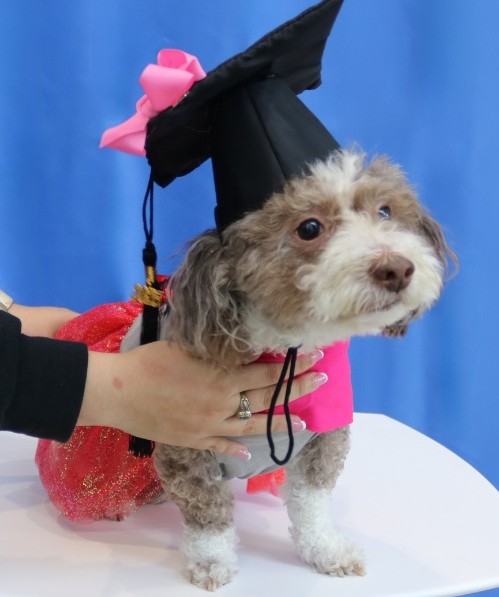
A nine-year-old shih-poo named Bailey walked into a research clinic with a spreading mast cell tumor and walked out eight weeks later cancer-free — and became the first graduate of a program that could reshape cancer treatment for dogs and humans alike.
Karina Rodriguez knew what a cancer diagnosis meant. Bailey was nine years old — a small shih-poo who had been her constant companion — and the mast cell tumor had already spread to her lymph node. "I was terrified of losing her," Karina said. What she didn't know yet was that Bailey was about to become a pioneer.
A Clinic Built on a Different Kind of Logic
At UT Southwestern Medical Center in Dallas, there is a clinic that doesn't serve human patients — at least not directly. The Veterinary Research and Oncology Clinic, known as VROC, opened in May 2025 with a focused mission: treat companion animals with cancer using cutting-edge research tools, and let the data flow in both directions. The animals get care. The researchers get something that human clinical trials can't easily produce.
One in four dogs and one in five cats will develop cancer in their lifetime. These statistics devastate pet owners, but they also represent something that oncology researchers have been slow to fully recognize: a vast, naturally occurring population of cancer patients with biologically similar tumors to those found in humans. Pet animals develop cancer spontaneously, in the context of real immune systems, real aging, real environmental exposures. When a treatment works in a dog, the signal is clean in ways that lab-induced tumors in controlled animal models can never be.
Bailey's Eight Weeks
Bailey entered a clinical trial at VROC with her metastatic mast cell tumor and a monitoring schedule designed to track her response in careful detail. The protocol combined treatment with rigorous data collection — every response, every measurement, every week. Eight weeks later, her imaging showed no evidence of cancer. She became VROC's first graduate: the first patient to complete the program and walk out healthy.
My heart felt a huge sense of relief. Bailey means the world to me, and I am extremely grateful to the entire VROC team for saving her life and giving us more time. She could be a little pioneer. It gives me so much joy to know my sweet girl can one day help human patients, too.
— Karina Rodriguez, Bailey's owner
The phrase "little pioneer" understates it. Bailey's case file — her tumor biology, her immune response, the precise arc of her recovery over those eight weeks — is now part of a dataset that researchers will study for years. Every data point she generated could eventually inform a protocol used on a human patient with a similar diagnosis.
The Win-Win at the Heart of VROC
The logic behind VROC is elegant. Dogs get access to treatments they couldn't otherwise afford or even find outside a major research institution. Researchers get biological data from natural tumors in patients with intact immune systems — something no laboratory model can replicate. The arrangement is straightforward: participation in a clinical trial in exchange for treatment that would otherwise be out of reach.
We do not cure enough people with cancer – we've got to do better. In terms of a translational model for people, there couldn't be a better one than household pets. It's the classic definition of a win-win.
— Dr. Robert Timmerman, Chair of Radiation Oncology, UT Southwestern
The path from Bailey's lymph node to a human patient's treatment plan is indirect — there are years of analysis, replication, and human trials between them. But the path is real, and every patient who enrolls in VROC's trials is helping to build it. What's learned from Bailey's immune response to a mast cell tumor may one day inform how a human oncologist treats the same disease in a different species.
Researchers call this framework "One Health" — the recognition that human, animal, and environmental health are deeply interconnected, and that breakthroughs in one domain feed directly into the others. VROC is one of the most concrete expressions of that idea: a place where treating a dog well and advancing human medicine are not separate goals but the same one, pursued simultaneously with the same data.
The Other Patients
Bailey isn't alone in the clinic. Bubba, a Labrador, is receiving doxorubicin — a chemotherapy drug used in both canine and human oncology. Mia is being treated with radiation for a lung mass. Roman, a five-year-old black Lab, is enrolled in a PULSAR therapy trial. Vespa, a fifteen-year-old cat, is receiving radiation treatment and has become something of a clinic elder.
Each of these animals is receiving genuinely state-of-the-art care — the kind that exists at the frontier of what oncology currently knows how to do. And the willingness of their owners to enroll them in research, to allow careful measurement and documentation of everything that works and doesn't, is building a body of knowledge that will benefit patients who will never know these animals' names.
Not Looking to Make a Profit
LaChandra Wilcox, the clinic's Clinical and Technical Manager, is plain about what VROC is for.
We're not looking to make a profit. We're looking to make a change.
— LaChandra Wilcox, Clinical and Technical Manager, VROC
VROC offers treatments at reduced or no cost to enrolled patients. The exchange is participation in research: allowing the team to observe, measure, and learn from every case. It is a model built on trust — pet owners entrusting researchers with the animals at the center of their lives, and researchers taking that trust seriously enough to build something that outlasts any individual case.
What Bailey Carries Forward
Bailey went home to Karina with a clean bill of health and a story that will take years to fully understand. Somewhere in the data collected during those eight weeks is information that could matter enormously — to a future dog with a spreading mast cell tumor, to a human oncologist looking for a better protocol, to a researcher trying to understand why one patient responds and another doesn't.
She came in with a diagnosis and a frightened owner. She left a pioneer. The clinic where she was treated is one year old; the work it is building could last decades. Bailey's eight weeks are a small chapter in that story — but they are, by any measure, a remarkable one.
For Karina, the experience changed how she thinks about the relationship between loving a pet and contributing to something larger. "She could be a little pioneer" — those words carry more weight than they might first appear to. Every walk, every vet visit, every moment of paying close attention to a dog's health is, in a sense, data. VROC has simply found a way to make that data count.