Twenty-five years of watching dogs change hospital rooms
Doges Editorial · 2026-06-27 · 6 min read
The Center for Human-Animal Interaction at Virginia Commonwealth University has spent 25 years studying what happens when a dog walks into a hospital room. The answer, measured in more than 200 peer-reviewed studies, keeps pointing in the same direction.
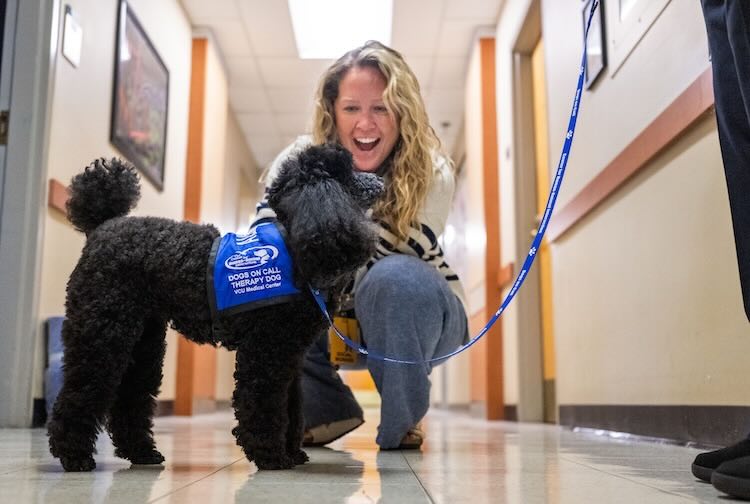
Allie is a black standard poodle who works Tuesdays in a Virginia hospital. She has a handler, a badge, and a schedule. She also has a way of making people forget, for a few minutes, that they are sick. The researchers who have spent twenty-five years trying to measure what Allie does — in precise, repeatable, peer-reviewed terms — have not always found it easy. But they have found it.
A program that changed a field
The Center for Human-Animal Interaction, known as CHAI, was founded at Virginia Commonwealth University's School of Medicine in June 2001. Its founding director was Sandra Barker, Ph.D., a professor of psychiatry who had a straightforward premise: that the presence of a dog in a clinical setting changed something measurable about patient wellbeing. The program she built, Dogs on Call, is now recognized as one of the first hospital-based therapy dog programs in the United States.
In the last five years alone, Dogs on Call's volunteer handler teams logged over 300,000 meaningful interactions with patients and healthcare workers at VCU Health's locations across Virginia. That number covers a lot of ground — cancer wards, psychiatric units, pediatric floors, hallways where someone had just received difficult news and needed a few minutes of something that wasn't medical.
For many patients and their family, the visits offered a small but meaningful break from their harsh reality — a moment where the focus shifted away from illness and treatment to becoming fully present with the dog.
— Lene Høeg Fuglsang-Damgaard, visiting Ph.D. scholar at the Center for Human-Animal Interaction at VCU
What the science has found
In twenty-five years, CHAI researchers have co-authored more than 200 peer-reviewed studies and five books. The findings are consistent. A 2025 randomized controlled trial of 60 psychiatric inpatients at VCU Health, published in Frontiers in Psychiatry, found that 20-minute therapy dog visits produced the largest reductions in loneliness compared to handler-only visits or standard care, with the effect persisting across the three-day intervention period and — for patients who owned dogs — extending to five days. More broadly, the physiological data is similarly concrete: a PLOS One randomized controlled trial measuring salivary cortisol found a large effect size (d=1.39) after a single therapy dog session among children with special educational needs, a result the researchers classified as highly significant. Gee has described loneliness as posing health risks equivalent to smoking 15 cigarettes a day, making these reductions consequential rather than merely comforting.
The center's current director, Nancy Gee, Ph.D., holds a professorship in VCU's Department of Psychiatry and oversees the Dogs on Call program. She has spent years extending the research beyond hospitals — into schools, senior care facilities, and community settings — and collaborating with researchers in Denmark, Singapore, the United Kingdom, and Australia. Different cultures, she has found, interact with animals differently. The beneficial effects appear anyway.
Working with researchers around the world has been an absolute pleasure because they bring unique perspectives to our understanding of human-animal interaction. It's interesting to see how different cultures interact with animals and how we might consider adapting new ways to achieve the best benefit for both humans and animals.
— Nancy Gee, Ph.D., director of the Center for Human-Animal Interaction at VCU
What it looks like from Denmark
In the fall of 2023, a Ph.D. student named Lene Høeg Fuglsang-Damgaard flew to Richmond from Aarhus University in Denmark. She had been studying therapy dog programs and decided CHAI was the place to learn from. She spent months shadowing the Dogs on Call handler teams — walking the hospital corridors with them, observing patient interactions, measuring what changed when a dog came through the door.
Denmark presented a particular challenge. Dogs are not currently approved to work in hospitals there. For Fuglsang-Damgaard, building a case for the program in her home country meant building a scientific argument airtight enough to persuade hospital administrators and health policy makers who had never seen a therapy dog work a psych ward. What she took home from Richmond was more than data.
Seeing Dr. Gee's research firsthand made it clear to me how important strong research is, and how the results can be used as a foundation when persuading healthcare professionals and decision‑makers to implement similar practices.
— Lene Høeg Fuglsang-Damgaard, visiting Ph.D. scholar at VCU
The dog's side of the equation
CHAI recently formalized a partnership with Purdue University's College of Veterinary Medicine Center for the Human-Animal Bond. The partnership reveals something about how the field has matured. Most human-animal interaction programs live in veterinary schools and focus on animal welfare. CHAI is unusual: it sits inside a School of Medicine and focuses primarily on human health outcomes.
The Purdue collaboration is designed to close that gap. If the science on the human side is now deep and credible, the science on the animal side is still catching up. What is the therapy dog actually experiencing? What does a good or bad day look like for a dog working a hospital ward? How do you know when a dog is struggling in a clinical environment, and what do you do about it? Leanne Nieforth, Ph.D., an assistant professor in Purdue's Department of Comparative Pathobiology, works on exactly those questions.
By bringing together both a veterinary school and medical school approach, we have a strong opportunity to close the gap by examining both the human and animal side of the equation.
— Leanne Nieforth, Ph.D., Purdue University College of Veterinary Medicine
What twenty-five years leaves behind
Gee is routinely contacted by people in Singapore, the UK, and Australia who want to build their own programs. She refers them to the books, the studies, the protocols. But she also tells them that the work is never just about the evidence. It is about the relationship between the dog and the handler, the handler and the patients, and the institution and the community it is trying to serve.
When Dogs on Call handler teams finish their shifts, they debrief with Gee's team. They note which rooms the dog stayed in longer, which patients it sat beside without being asked to. Those observations feed back into the research. The program has learned, over twenty-five years, to pay attention to what the dogs are showing it — not just what the humans report.
Throughout the years, we have been able to establish an international reputation for leadership in the field, while fulfilling our mission of improving health and well-being through human-animal interaction. For two and a half decades we have achieved our goals through consistent high-quality research, education and service. I am proud of what we have accomplished and excited about what is yet to come.
— Nancy Gee, Ph.D., director of the Center for Human-Animal Interaction at VCU
There is an informal version of this kind of study happening every morning, in thousands of places, before anyone starts counting. Someone needs to get out of bed. The dog needs to go out. They walk together — cold pavement, gray sky, the specific quiet of early morning before most of the neighborhood is awake. The research on what happens physiologically in those twenty minutes, and why it is different from walking alone, is still being written. But the people who walk know what they already know.