Tsunami's final mission found thirteen survivors
Doges Editorial · 2026-07-01 · 5 min read
)
An 8-year-old Border Collie named Tsunami was pulled from the streets of Caracas as a malnourished, abused puppy. Last week, in what authorities confirmed as his final deployment before retirement, he located thirteen people buried alive in Venezuela's earthquake rubble.
The rescue crews stopped digging and went quiet. In the rubble of a collapsed eight-story apartment building in San Bernardino, a neighborhood in northern Caracas, they waited — all of them watching a single black-and-white Border Collie thread his way through broken concrete and dust. Tsunami had been working since the earthquakes hit. He marked the spot. The humans followed.
Beneath eight stories of concrete and twisted rebar, they found a 60-year-old man who had been trapped for approximately six hours. He was alive.
A dog nobody wanted
Before any of this — before the K-SAR ECID disaster rescue unit, before Turkey and Syria in 2023, before the Venezuelan landslides and the flooded towns — Tsunami was a puppy wandering the La Floresta neighborhood of Caracas, malnourished and alone. He had suffered abandonment and abuse. Whatever his early months had been, they hadn't broken what was essential in him: a relentless focus on whatever was in front of him.
A woman named Anita Vidal found him on the street and gave him the second chance the source article describes. What came next was accident and aptitude in equal measure. A rescue specialist named Jorge Beens noticed something about this Border Collie — his energy, the precision of his attention, the way he tracked scent — and invited him into the K-SAR ECID Disaster Canine Training Center. There, Tsunami learned to do one specific thing: find people buried alive.
What eight years of training looks like
Search-and-rescue certification for a disaster dog takes years and never fully stops. Tsunami trained to locate victims in collapsed structures — to move through rubble that looks impenetrable, hold a scent through dust and smoke, and mark the exact location of a living person before a single shovel of concrete was moved. It is not a skill every dog has, and not a temperament every rescue candidate possesses.
What Tsunami is tracking in that rubble is a plume of compounds every living person continuously sheds: exfoliated skin cells that SAR researchers call skin rafts, volatile organic compounds released by sweat, and gases from skin lipids. These particles drift upward through gaps in collapsed concrete, forming a scent column that can reach the surface even when the person is buried several meters below. A dog's nose carries roughly 300 million olfactory receptors compared to about 5 million in a human, and can detect odor at concentrations as low as parts per trillion — equivalent to a single drop dissolved across 20 Olympic-sized swimming pools. Each person's scent is biochemically unique, a signature precise enough that a trained SAR dog can isolate one individual's odor through dust, decay, and chemical interference.
Border Collies, bred to work all day in wind and open ground, tend to bring the focus and stamina that disaster rescue demands. By 2023, Tsunami was already deploying internationally — sent to Turkey and Syria after the earthquake that killed more than 50,000 people, where international SAR dog teams worked devastated cities for days. Back home, he had worked flood and landslide rescues across Venezuela. When the June 2026 earthquakes struck Caracas and the calls began coming in from across the city, Tsunami was already in position.
Silence in San Bernardino
In San Bernardino, the moment of stillness came after Tsunami marked a precise location in the debris. Rescue crews called for complete silence and crouched into the rubble, listening. Carefully, methodically, they began to dig. The footage that came out of that operation — a compact, fast-moving dog working the rubble, stopping and marking with purpose, the crews clearing a channel where he'd indicated — spread through Venezuelan television and across social media within hours.
For a country watching rescue operations around the clock after the earthquakes, the image of Tsunami working was the kind of moment that stays. Not because it was dramatic, but because it was precise. The dog was not searching in hope. He knew.
Thirteen people
Across the earthquake response, Tsunami helped locate at least thirteen survivors, according to reporting by HOLA! USA. Each rescue was its own operation — different buildings, different depths, different amounts of time elapsed — but Tsunami's method held constant: systematic coverage of the site, return to where the scent of a living person was strongest, mark and hold until the crew moved in.
Tsunami is extremely exhausted, but fortunately has no major health problems. After rest and recovery, the dog will continue rescue activities.
— La Nación, citing K-SAR ECID rescue team updates
Veterinarian Aníbal Hurtado confirmed that the days of continuous work had taken a serious physical toll. Tsunami received hydration, medical supervision, and rest. He was in good overall health — but what came next surprised no one who had been watching how hard he had worked.
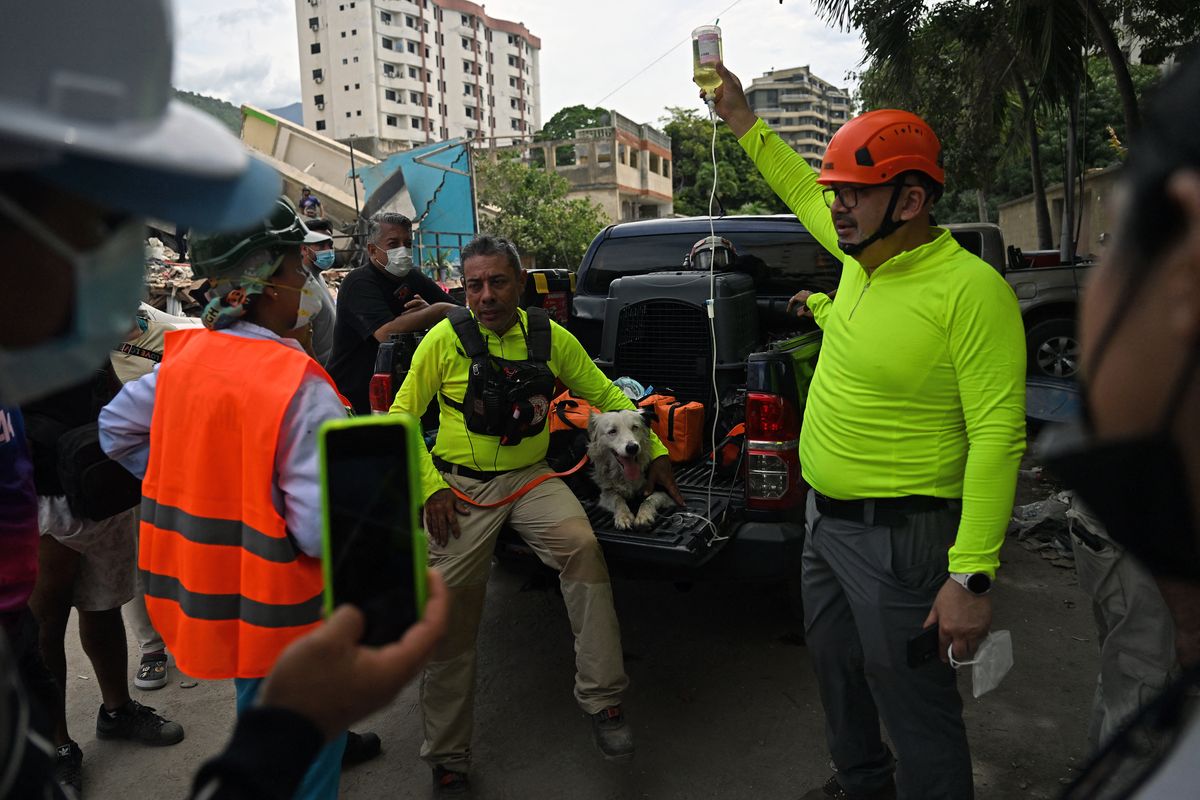
What retirement looks like for a rescue dog
Authorities with the K-SAR ECID unit confirmed that the June 2026 earthquake response marks Tsunami's final official mission. He is retiring. The dog who once wandered La Floresta malnourished and alone — who had survived whatever his early months had done to him — spent the last years of his career locating people who needed to be found in the worst moments of their lives.
Tsunami reminds us of the importance of rescuing and adopting abused animals. A dog that once needed people's help is now saving people.
— Revista Semana, Colombian news outlet
He is retiring with thirteen confirmed survivors, an international record of deployments, and the kind of career that tends to prompt national reflection. In Venezuela, people are already comparing him to Orion, a Rottweiler who became a symbol after the 1999 Vargas tragedy — the catastrophic floods and landslides that killed tens of thousands. Orion rescued dozens in those days and was remembered for decades. Tsunami now carries a version of that same weight.
The street dog who found people underground
He started as a dog nobody wanted. He finished as a national hero. The 60-year-old man in San Bernardino — trapped in the dark, six hours under eight stories of concrete — was brought home because a Border Collie from La Floresta put his nose to the rubble and refused to look away from what he'd found.
Dogs follow scent trails we can't see, map spaces we can't navigate, and return to the thing they've found long after we'd have moved on. Most of what they do with those abilities happens on a morning walk — in the way a dog stops at a storm drain or circles back to the same patch of sidewalk every single Tuesday. Tsunami spent eight years making that instinct count in the most literal way possible.