Ten years beside the amputees of Walter Reed
Doges Editorial · 2026-06-22 · 5 min read
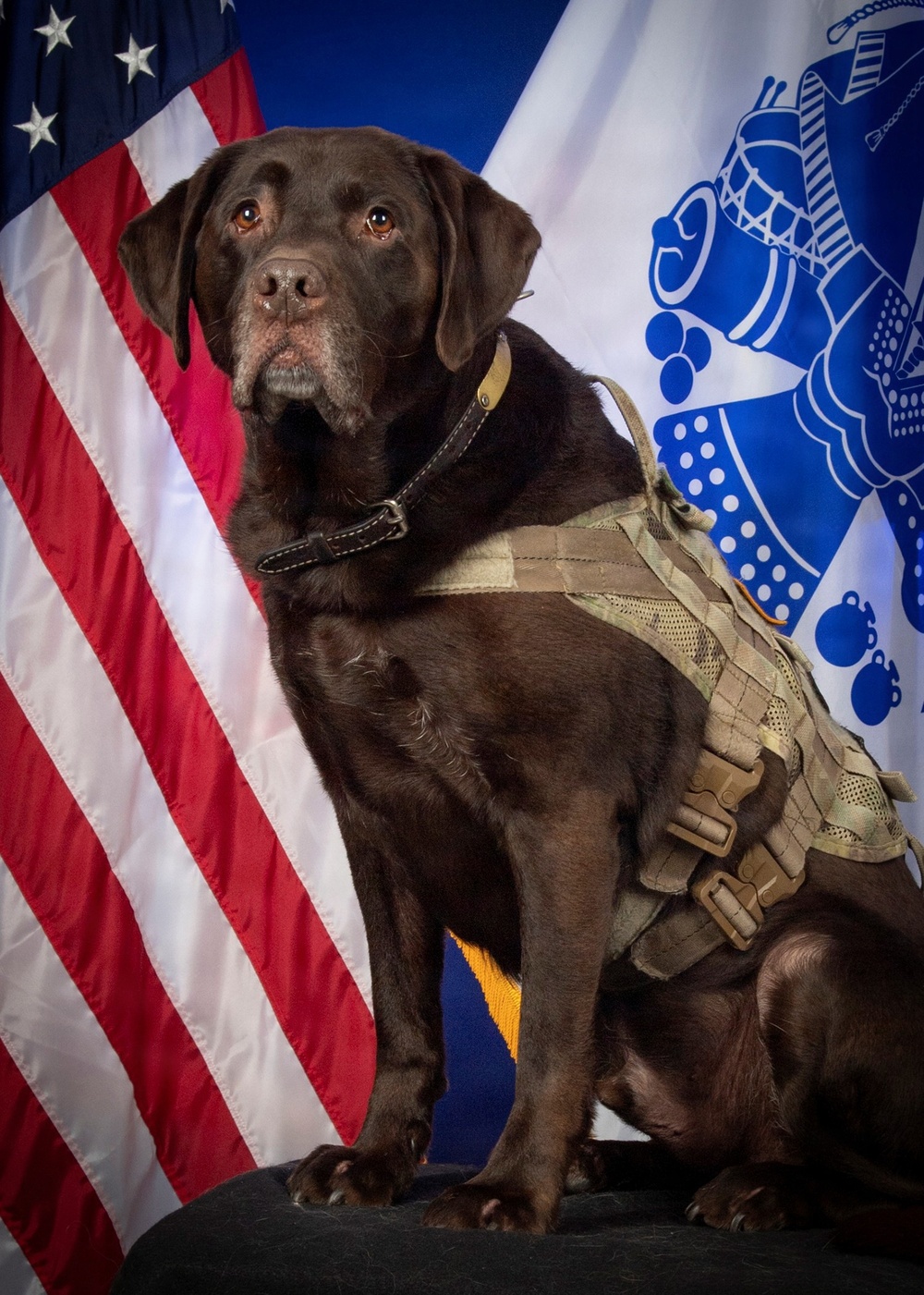
Truman, a chocolate Labrador at Walter Reed's Military Advanced Training Center, died of cancer in May 2026 after a decade of helping wounded warriors through their most difficult recoveries. A Marine with terminal cancer made one final request: that the dog be there when he died.
The week before surgeons removed Michelle Sheedy's right leg, she walked into the Military Advanced Training Center at Walter Reed National Military Medical Center and met a chocolate Labrador with patient, unhurried eyes. Sheedy had spent her career in emergencies that broke other people — as a Coast Guard boatswain's mate, an Army combat medic, a lieutenant commander in the US Public Health Service. She was practiced in the art of not needing things. She had no idea, standing in that hallway in Bethesda, that the dog was about to become part of how she survived.
That dog was Truman. He joined Walter Reed's MATC in January 2016 and spent ten years there, until cancer took him in May 2026. He was a facility dog — a distinction that matters — and for a decade he showed up every morning for soldiers, sailors, and veterans who were learning, often in their forties or fifties, how to inhabit a body that had been fundamentally changed by injury or illness. He did this quietly, with enormous patience, and without asking anything in return.
What a facility dog does
Service dogs work one-to-one. They're trained to help a single individual manage a disability — guiding a blind handler, detecting an oncoming seizure, retrieving dropped objects for someone in a wheelchair. Facility dogs are different. They move through institutions. They belong to a place and the people who flow through it. Amy O'Connor, program manager for Walter Reed's facility dog program, explains that the dogs entering this role have already completed full service dog training before they retrain for something broader.
All the dogs that come into the program were previously trained as service dogs. Once they've career changed to facility dogs, they're no longer working in that capacity with a single individual. So, we get these highly trained dogs whose mission is to increase well-being and decrease stress — and in a place like the MATC, a lot of these men and women are here for a long time. These dogs become part of their family.
— Amy O'Connor, program manager, Walter Reed facility dog program
The numbers O'Connor tracks tell one version of the story. Every hour Truman worked, he reached approximately twelve people. Across a month, those interactions accumulated to around 2,500. That figure is almost too large to hold emotionally, which is part of why the arithmetic of individual stories matters more: the patient who finally let his shoulders drop, the veteran who started talking to the dog before she'd managed a word to anyone else in the building.
The slow work of recovery
The MATC is where intensive rehabilitation happens. Patients recovering from amputations and traumatic injuries come here for months, sometimes longer, working through the painful and meticulous business of relearning how to use a body that has been changed without their consent. The process demands everything — physical effort, psychological resilience, the willingness to fail at something simple in front of other people. Nearly 30 percent of post-9/11 veterans will experience PTSD at some point in their lives, according to the Department of Veterans Affairs — and most of the people flowing through the MATC carry some version of that weight alongside the physical work. Truman had an unusual role in that environment. He made the building feel less clinical, and he did this without any of the social effort that requirement demands of human staff.
Truman's handler, Ricardo Naranjo, watched those effects accumulate across ten years. He saw the patterns: the men and women who had been trained to absorb pain without showing it, who would let the dog come close when they wouldn't let a person. Patients who wouldn't discuss their treatment with a therapist would find language for it while talking to Truman. The dog was, in some precise and unmeasurable way, a neutral party — present, attentive, and without agenda.
One Marine's final wish
The hardest story Naranjo carries involves a former Marine who was being treated for terminal cancer while attending the MATC for physical therapy. Across those months, he and Truman developed the kind of attachment that happens when the stakes are high and time is short. The dog seemed to know when to approach and when to hold back. The Marine, who had been through things that required every form of endurance he had, let himself be gentle with Truman in a way that requires real trust.
When the Marine's treatment neared its end, he made one specific request: he wanted Truman in his hospital room. The request was honored. Despite being nearly unconscious by that point, he knew when the dog came through the door.
After ten years
We're missing Truman now. We're going to get another facility dog, but there will never be another Truman. There will never be another Deuce.
— Ricardo Naranjo, Truman's handler at the MATC
Deuce was the chocolate Lab who preceded Truman — same breed, same coloring, same willingness to be exactly what the building needed. When Deuce died, the MATC mourned him and brought Truman in, and the work continued. Now the cycle turns again. Walter Reed will find a new facility dog, because the need is real and ongoing and too important to leave unfilled. The name will change. The soulful eyes, by design, will not.
What ten years of showing up looks like
The science behind what Truman did in those rooms is now precise. A 2018 crossover trial involving 25 veterans in palliative care, reviewed in a 2021 systematic meta-analysis of 41 animal-assisted intervention studies, found that a 20-minute session with a trained facility dog produced a significant reduction in salivary cortisol (p = 0.007) and a mean drop in heart rate of 3.4 beats per minute (p = 0.005). The mechanism is understood: contact with a dog triggers oxytocin release in both the human and the animal; oxytocin suppresses cortisol production and steadies cardiac rhythm. The body's alarm system steps down. What those numbers cannot capture is what Naranjo and the MATC staff know from a decade in those rooms — that the dog's value wasn't only physiological. It was being witnessed by something that expected nothing in return.
Walk into a room with Truman and you remembered you were a person who once had a dog, or wanted one, or had known one that changed something in you. That kind of memory is involuntary and immediate. For wounded warriors carrying the weight of physical recovery alongside everything else that weight brings — fear, grief, changed identity, the long work of reimagining a future — that moment of involuntary softening might be the first opening in days. Truman, ten years running, provided those openings: 2,500 times a month, for the people who needed them most.
That same physiology — oxytocin rising, cortisol falling, the nervous system stepping back from readiness — runs in any room where a person and their dog are quietly together. The mechanism Truman demonstrated at scale, for people who needed it badly, is the same one available on any ordinary afternoon when a dog lies down beside someone who has had a hard day and both of them go still.
Before his own final months, he showed up for a Marine who was running out of time. That Marine asked for exactly the same thing he had given everyone else in the building. Truman walked through the door. The Marine knew he was there. That was enough, and it was everything.