One Hundred Walks Home
Doges Editorial · 2026-06-07 · 5 min read
DOGES
At a ballpark in southern Illinois, four veterans and four Labradors marked a quiet milestone: the 100th service-dog pairing in fifteen years of This Able Veteran's work.
The Diamond Club at Mountain Dew Park in Marion, Illinois, sits above the infield — the kind of room where minor-league baseball teams celebrate after a big series. On May 29, the celebration was different. Four veterans stood with four Labrador retrievers at their sides, and a crowd watched what This Able Veteran founder Behesha Doan described as watching flowers bloom.
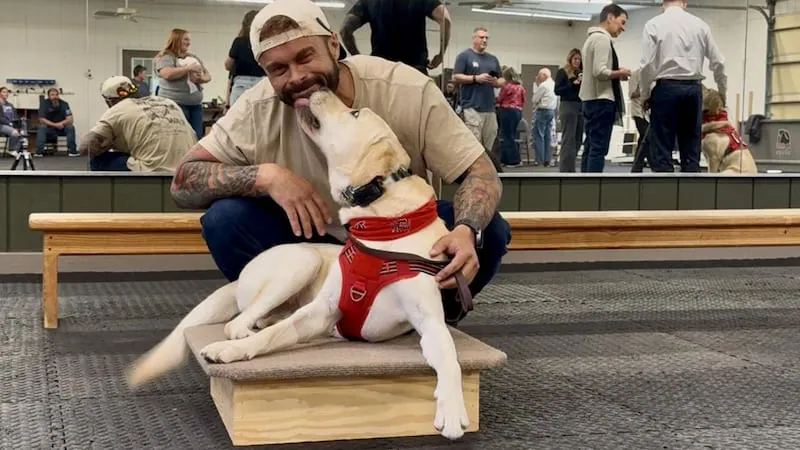
The Marion, Illinois nonprofit had just graduated its 100th veteran-dog pairing since it placed its first dog fifteen years ago. The four pairs: Sean Dwyer with Brave, Clayton Baker with Butters, Blake Richards with Granite, and Eric Beach with Roman. Four dogs, four veterans, and a number — one hundred — that took the better part of two decades to reach.
Eighteen Months in the Making
Every dog that walks across a This Able Veteran graduation stage has spent between eighteen and twenty-four months in training. The curriculum is specific: nightmare interruption, anxiety alerts, deep pressure therapy, crowd management. Labradors are selected partly because of how readily they adapt to these tasks — attuned to people, steady in unpredictable environments, consistent under stress.
Nightmare interruption is exactly what it sounds like. The dog learns to recognize changes in a sleeping person's breathing, movement, and vocal patterns — the particular physiological signature of a nightmare in progress — and to intervene before the person wakes in full distress. A nudge, a paw, a persistent presence. It sounds simple. The reliability required to make it therapeutic takes months.
Anxiety alerts require something more subtle: reading the slow-building signals of a person whose internal state is rising toward crisis, and responding before the human has consciously registered what's happening. The dog becomes, in effect, an early warning system calibrated to a single person.
Executive director Malia Nix frames all of it simply: 'The canine is the partner for the journey back home.'
The Better Man in the Mirror
Clayton Baker, paired with Butters, found words for something that veterans often describe but seldom articulate so precisely.
He's my best friend. I can face myself in the mirror and know that I'm a better man.
— Clayton Baker, veteran, Class of 2026
The mirror is an image that keeps returning when veterans talk about this work. Not vanity — something closer to self-recognition. The capacity to look at yourself clearly, without flinching. Baker found that in a yellow Labrador named Butters.
For Sean Dwyer, paired with Brave, the bond carried something different: the particular closeness of people who have shared difficult days. 'Finding that bond and that brotherhood,' he said, gesturing at something veterans often describe missing after service — the sense that someone beside you understands, without explanation, what the hard days feel like.
What a Medical Device Looks Like
The organization's medical director offered a phrase during the ceremony that lands differently once you've seen the training: these dogs, he said, are essentially medical devices. Not in a clinical, depersonalizing sense. In the sense that their work is measurable, repeatable, and therapeutic in ways that conventional medicine has struggled to match for the particular cluster of symptoms many combat veterans carry home.
PTSD is not a single experience. The nightmares look different from the hypervigilance, which looks different from the dissociation, which looks different from the difficulty in crowded spaces. A well-trained service dog doesn't treat a diagnosis — it responds to a person, specifically, and adjusts to what that person needs on a given day. That specificity is part of what makes the 'medical device' framing feel accurate rather than reductive.
The matching process matters too. This Able Veteran doesn't simply pair any dog with any veteran. The eighteen-to-twenty-four months of training produce a dog with known strengths, tendencies, and responses; the matching tries to align those with the particular veteran's needs, environment, and daily life. Blake Richards was matched with Granite; Eric Beach with Roman. Those aren't arbitrary assignments.
The transition period after graduation — the weeks when a veteran and a new dog are learning each other's patterns — is not a formality. Veterans describe a calibration process: the dog learning the specific rhythms of that particular person's sleep, the particular tells of that person's anxiety. A nightmare-interruption-trained dog knows how to interrupt nightmares in general; learning to interrupt this veteran's nightmares, at this stage of sleep, takes time. The bond Clayton Baker describes didn't arrive at graduation. It arrived sometime in the weeks before it, and it will keep arriving, in smaller and larger ways, for years.
The Arithmetic of Fifteen Years
One hundred pairings over fifteen years works out to just under seven per year. That is a slow, deliberate number — the kind that reflects the cost of doing this carefully rather than quickly. Training a service dog to the standard This Able Veteran requires takes time, money, and the particular knowledge that only accumulates over years of doing this work.
Behesha Doan has been keeping count since the beginning. The way she talks about the dogs who've graduated under her watch bends toward the long view — toward what happens after the ballpark ceremony, after the photographs, after the applause.
By the time the dog lays down at the end of his life, look how far he walked with me.
— Behesha Doan, founder, This Able Veteran
That distance — measured in years and miles and ordinary mornings, not in the dramatic moments that make for graduation speeches — is the actual product of This Able Veteran's work. The ceremony at Mountain Dew Park was the beginning of it.
The Walk That Starts After the Applause
Brave, Butters, Granite, and Roman walked out of the Diamond Club as working dogs. The men beside them walked out as veterans with partners for the years ahead — someone to wake them gently in the dark, someone to notice what the crowd can't see, someone who will still be there when the hard morning comes.
The 101st pairing is already in training somewhere. A Labrador spending its mornings learning to listen, its afternoons learning to stay steady, its evenings learning the particular patience that this work requires. The flowers, as Doan says, are blooming on a slow clock.