The volunteer who walked six dogs a day — then drove two of them home
Doges Editorial · 2026-05-11 · 5 min read
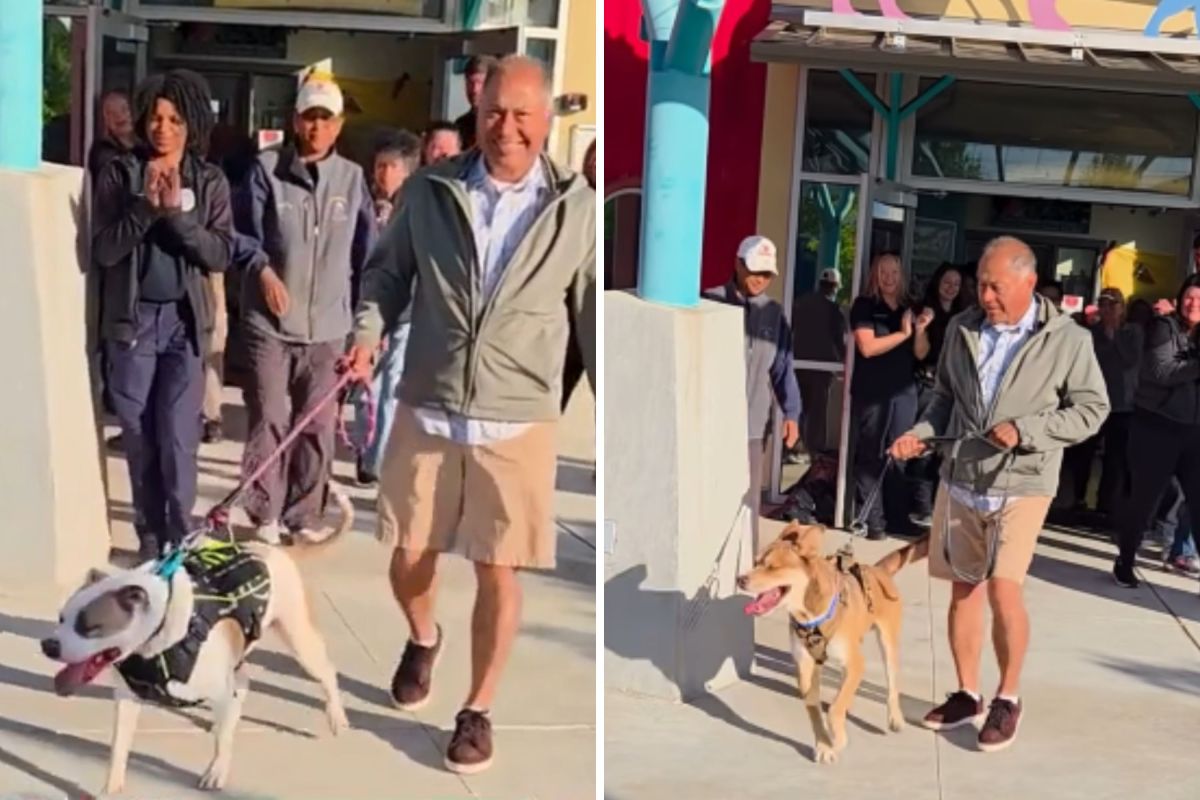
Roberto came to Tracy, California on a temporary work assignment and spent his off-hours walking shelter dogs. When his assignment ended, he left with Clyde — 831 days at the shelter, the longest-staying resident — and his quiet companion Thor.
Roberto had time on his hands. He was in Tracy, California on a temporary work assignment, a long way from home in Indiana, and he found himself one afternoon standing at the front desk of the City of Tracy Animal Services shelter. He wasn't entirely sure why. He went in. That first visit turned into a habit, and the habit turned into six dogs a day, and six dogs a day turned into something nobody — not Roberto, not the shelter staff — had quite seen coming.
Eight hundred and thirty-one days
Clyde had been at the shelter for a long time. A 6-year-old American Staffordshire terrier — broad-chested, patient, with the particular quiet of a dog who has watched many others cycle through — he arrived as a stray and stayed. Eight hundred and thirty-one days. That is more than two years of kennel mornings, food bowls, staff who knew his name, and days that looked a lot like the day before.
JoAnn Ronngren, the shelter's administrative assistant, described him to Newsweek as a dog who would sometimes drift into her office, sit for a while, then grow restless and head back to his kennel. He liked his "doggy day outs" and was predictably delighted by a pup cup. But he didn't press himself on people. He had, over more than two years, settled into his own steady rhythm of waiting.
The man who kept showing up
Roberto showed up the way people sometimes do when they're new somewhere with nowhere to be — with genuine curiosity, and the willingness to repeat themselves. He didn't just walk one dog and call it an afternoon. He walked up to six dogs a day, immersing himself in the shelter's daily routine until he knew which one needed a long warm-up, which one pulled hard for the first block and then settled, which one had a particular attachment to a certain tree halfway down the route.
Over weeks, specific personalities resolved themselves. Among the dogs he kept returning to were Clyde and Thor — a 3-year-old pit bull-husky mix who had spent 280 days at the shelter. Thor was eager on a leash, good with people, comfortable in his kennel. Like Clyde, he didn't advertise himself. He had a self-possession that you only noticed if you came back enough times to distinguish it from passivity.
Volunteering is clearly more than just volunteering. It is inspiring to all of us, especially for Roberto, to come from Indiana to California for a temporary work assignment, and to choose to walk shelter dogs on his downtime.
— JoAnn Ronngren, administrative assistant, City of Tracy Animal Services
Thor's quiet wait
Thor had been at the shelter eight months when Roberto arrived. Younger than Clyde by three years, with the mismatched energy of a husky-pit mix — enthusiastic on a leash, easy to handle, unbothered in a kennel. He moved through his days with a kind of uncomplaining patience: walks were good, people were good, and the rest of the time he waited, without much fuss, for whatever came next.
The two dogs had never met. They occupied different sections of the shelter, running on different schedules through different corridors, connected only by the fact that Roberto had walked them both — had come to know, over dozens of outings, how each one moved, what they were like at the end of a long walk versus the beginning, how they settled afterward. The slow accumulation of small attentions.
A morning in April
Roberto's work assignment was winding down. He had a multi-day drive ahead of him, California to Indiana, and a life to return to. Somewhere in the weeks at the shelter, the dogs had stopped being "dogs at a shelter" and had become something more specific — specific creatures with specific rhythms that he now knew in the particular way you only know something from being alongside it, day after day. He couldn't leave Clyde behind. He couldn't leave Thor either. He filed the adoption paperwork for both.
The City of Tracy Animal Services shared the moment in an April 17 Facebook video that reached 63,000 views and 2,500 reactions. It shows two dogs — separately, but going to the same car — walking toward the vehicle with what the comments unanimously described as giant smiles. First Clyde, eight hundred and thirty-one days behind him, bounding forward without hesitation. Then Thor. Both hopped in like they'd been waiting for exactly this.
I have never seen a dog so happy to jump in a cage like that! It's obvious he knew his new life would be full of love and adventure.
— Commenter on the City of Tracy Animal Services Facebook page
California to Indiana, side by side
The two dogs still hadn't met. Roberto placed their kennels next to each other in the vehicle, and the introduction happened somewhere on the interstate — through walls, through scent, through the low vibration of miles accumulating. They had never shared a corridor, never sniffed each other in the shelter yard. By the time they crossed into Nevada, or Utah, or wherever the road was by then, they were already something: two dogs making the same trip, each quietly aware the other was there.
Ronngren told Newsweek that Roberto had made an impression on the shelter that went beyond the adoption itself. He had given time he didn't have to give, on a schedule that no one asked of him, to dogs who had been waiting for longer than most people would have been able to hold onto hope. He had learned them, slowly, the only way you really can.
He was a special person whom we will never forget.
— JoAnn Ronngren, City of Tracy Animal Services
What walking actually does
Roberto's story is not dramatic in the usual sense. There was no single moment where Clyde pressed his nose against a fence and Roberto just knew. What happened was slower and more ordinary: a man with spare afternoons walked a lot of dogs, and two of them — over many laps around the same blocks, through many ordinary mornings — became impossible to leave behind. That is what walking does, if you do enough of it. It doesn't reveal a dog all at once. It accumulates, one small noticing upon another, until you know them well enough that leaving feels wrong.
Which is something most dog owners recognize from their own daily loop. You know the corner where they always slow down, the smell at the park gate that always triggers a full stop, the way they check back at you on a cold morning to make sure you're still there. The dramatic moments of the human-dog bond get remembered and retold. But the real foundation is the miles — the repetitive, daily, unremarkable miles, walked the same way, at the same hour, until you know each other well enough to trust.