The husky who walked from Mexico to El Paso
Doges Editorial · 2026-06-26 · 5 min read

Bruno the husky slipped out of his owner's home in Ciudad Juárez, Mexico, and somehow made it eleven miles to El Paso, Texas — crossing an international border in the process. Getting him back took a traffic-stopping stranger, two animal shelters, and a handoff on an international bridge.
It was traffic that brought them together, sort of. On a Tuesday afternoon in April, Yvonne Zarate was driving through El Paso, Texas, with her mother when she spotted a large dog running through moving cars — not near traffic, but through it, threading between vehicles on a busy road, ears up, no owner anywhere in sight. He looked like he was going somewhere important. He had no visible plan for getting there.
A stranger stops traffic
Zarate put on her emergency lights and drove slowly behind the dog, creating a moving buffer between him and the cars stacking up behind her. The other drivers understood. Traffic slowed. When she finally managed to pull ahead of him and stop, she did the only sensible thing: she opened her car door.
He approached me right away. When he saw the door of my vehicle open, he jumped inside my car just like that.
— Yvonne Zarate, El Paso resident
In the seat beside her, the dog was friendly in the way huskies tend to be — which is to say, comprehensively and without apology. He didn't respond to English. When Zarate switched to Spanish, he seemed to understand, though his main priority was demanding pets. "I thought he wanted me to pet him, which I did — big mistake," she said. "He never stopped pulling my hand with his paws so I could pet him over and over again." Zarate, it is worth noting here, is allergic to dogs.
Eleven miles from Ciudad Juárez
What Zarate didn't know yet was that this dog — his name was Bruno — had started his day in Ciudad Juárez, Mexico, across the Rio Grande. He lived there with his owner, Beatris Guerta Sanchez. On the evening of the escape, she had come home from work, opened the door, and he was gone. She searched all that night and into the next morning. When she could not find him, she posted his photo on social media and asked her network to share.
I looked for him all night and early the next morning. I was very worried.
— Beatris Guerta Sanchez, Bruno's owner
By then, Bruno had already crossed an international border — traveling approximately eleven miles on foot from his neighborhood to El Paso. He had done this without a passport, without documentation, and apparently without anything slowing him down. The mechanism remains officially unexplained. He has not elaborated.
The investigation
Zarate, now committed to finding Bruno's owner, drove him around El Paso asking neighbors if they recognized the dog. Nobody did. She checked missing-pet websites. She studied him. His fur was clean, his nails trimmed. "I knew he had to belong to someone," she said. "He was very well groomed, his nails were so nicely trimmed and his behavior was perfect." She called El Paso Animal Services, and officers came to collect him.
At the shelter, staff ran their usual checks and kept watch. And then: somewhere in the interconnected network of lost-and-found pet posts, a social media sleuth recognized Bruno from Sanchez's posts and sent her a message. The dog from Ciudad Juárez was at a municipal shelter in Texas. She contacted the shelter immediately. In the words of Michele Anderson, with El Paso Animal Services, Sanchez was "ecstatic" — and then the complication arrived.
The document problem
Sanchez did not have the documents needed to cross into the United States. The reunion that had been building across two countries, several social media platforms, and a stranger's car ride now had a bureaucratic wall in the middle of it. That's when El Paso Animal Services started making calls.
That's when our team came together. We worked with the staff at the (international) bridge to coordinate a time so we could meet at the halfway point, and she didn't have to worry about having to come into El Paso if she wasn't able.
— Michele Anderson, El Paso Animal Services
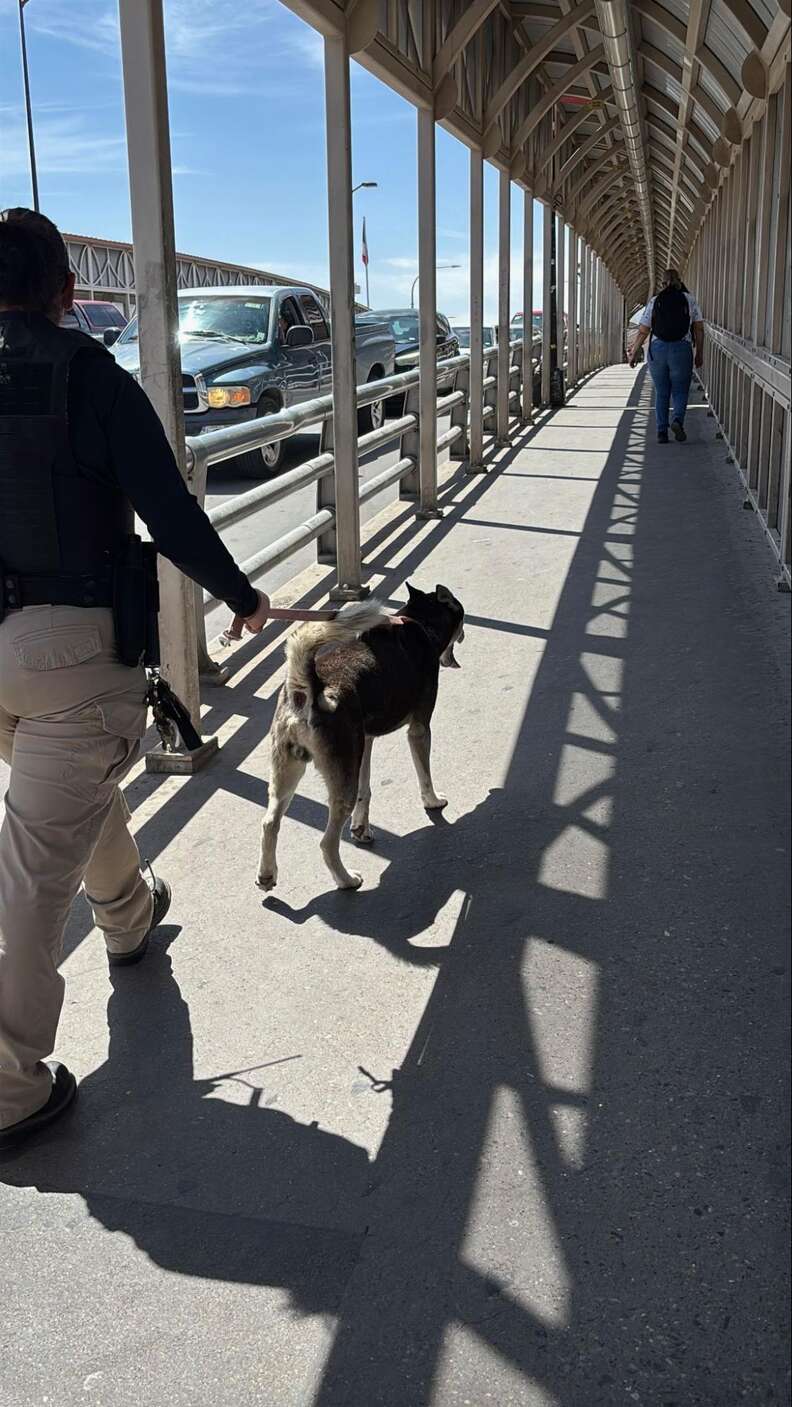
The solution was elegant: the officers would walk Bruno across the bridge to the midpoint. Sanchez would walk out from the Mexican side. They would meet in the middle — somewhere in the liminal geography of international crossings, where neither side has fully claimed anything yet.
Halfway across the bridge
The next day, the team walked Bruno across the bridge on foot. They waited. On the other side, Sanchez saw them — and ran. She reached Bruno and wrapped him in a hug, crying. The shelter posted a video of the moment. It found its way back to Yvonne Zarate, still in El Paso, still allergic to dogs, now watching her former passenger reunite with his family across an international line.
"I saw the video of the reunification, and it made me tear up," Zarate said. "I felt very much relieved and happy."
How he crossed
The question nobody could answer remained officially unresolved. "We can't be sure how he ended up over on this side," Anderson said, "but we do see pets crossing the border. They either just walk across at the port of entry, or they come through the canals. We're really grateful that we were able to get Bruno back home."
The physiology helps explain why eleven miles was no particular feat. Published data on Iditarod racing sled dogs — the sport's elite husky athletes — shows they cover roughly 100 miles per day over the 938-mile Alaska course. Their aerobic capacity (VO₂ max) runs approximately 240 milligrams of oxygen per kilogram of body weight, nearly three times that of a human Olympic marathon runner. Siberian huskies were developed by the Chukchi people of northeastern Siberia specifically to haul loads across hundreds of miles on minimal food. Bruno lives in northern Mexico and was running through El Paso traffic, which is not a sled run across frozen tundra. The physiology doesn't care about that distinction. Breed guides recommend a minimum 6-foot fence for huskies — not because they're aggressive, but because covering ground is what they were built for.
What Bruno's route looked like from his end, nobody knows. He probably didn't understand that he was crossing a national boundary, or that his people would spend a night and a morning searching for him, or that a woman allergic to his species would slow an entire lane of traffic to scoop him off the road. He just ran. And somewhere in that running, enough strangers decided to stop what they were doing and pay attention — and the long way home got a little shorter.