The dog who walked 2,300 miles for peace
Doges Editorial · 2026-06-11 · 5 min read
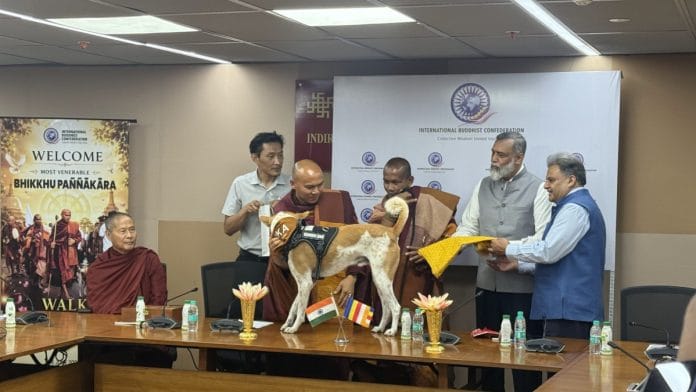
In 2022, an Indian street dog began following Buddhist monks on a pilgrimage — and never stopped. Four years and two continents later, Aloka has completed a 2,300-mile walk across America and come back to where it all began.
It was the sixth day of a 112-day walk when Aloka appeared. A group of about nineteen Buddhist monks were moving through West Bengal in the summer heat of 2022, making their way from Kolkata airport toward Bodh Gaya — the site where the Buddha found enlightenment, deep in the north of India. The road was long, the days were hot, and other dogs had joined the line at various points: strays drawn to the orange-robed procession, the quiet footfalls, the smell of something unhurried. Some followed for an hour. Some stayed a day. Most dropped off when the road curved and the group kept going.
One didn't. He was an Indian Pariah dog — the lean, prick-eared breed that has lived alongside humans on the subcontinent for thousands of years, more comfortable in motion than at rest. Nobody knew his name, his age, or what corner of Kolkata he'd come from. By the end of that first week, he had found his place in the procession: just behind the monks, keeping pace across heat and monsoon-slicked roads, day after day, until the whole 3,400-kilometer journey was behind him. This story was reported by The Print (https://theprint.in/feature/around-town/aloka-dog-global-peace-mascot-buddhist-monks/2954609) on June 9, 2026.
That breed matters to the story. Archaeological evidence places Indian Pariah dogs in the subcontinent for at least 4,500 years: a skull excavated at the Harappan site of Mohenjo-daro and prehistoric rock art at the Bhimbetka shelters depict a dog of essentially the same form Aloka carries today (Wikipedia, Indian pariah dog: https://en.wikipedia.org/wiki/Indian_pariah_dog). They are a landrace shaped by natural selection rather than deliberate breeding — built for endurance, adaptability, and the specific aptitude of keeping pace with humans across difficult terrain. There is, in some ways, no dog better suited to this particular walk.
"Only Aloka stayed with us," Bhikkhu Pannakara, the group's leader, told The Print this week. Pannakara is a former Motorola engineer and University of Texas at Arlington graduate who traded a corporate career for the Theravada monkhood. He has walked thousands of miles across South and Southeast Asia. He had never seen a dog do what this one did.
The name that stayed with him
The monks gave him a name: Aloka, a Pali word meaning "light" or "inner clarity." In Buddhist thought, light suggests both luminosity and the path that cuts through confusion. Here was a dog who had, by some logic they couldn't fully explain, chosen to follow the path — literally, day after day across heat and hard road — when every other animal had turned back. The name felt earned.
After the Bodh Gaya pilgrimage ended, Pannakara was unwilling to leave the dog behind. He arranged for Aloka to travel to the United States, where Pannakara's monastic community, the Hương Đạo Vipassanā Bhavānā Center in Fort Worth, Texas, would become the dog's home base. Aloka arrived in America and settled into a life that still involved long walks. They were, after all, what both the monks and the dog did.
If we slow down, we will find peace. If we look within, we will find peace.
— Bhikkhu Pannakara, Walk for Peace
Twenty miles a day, nine states, 108 days
On October 26, 2025, the monks left Fort Worth on foot. Their destination was Washington, D.C. — 2,300 miles away, through nine American states, along backroads and highway shoulders in the autumn cold. Aloka walked with them. Every day. Through Texas and into the South, north through Virginia and Maryland, covering approximately twenty miles each day. Not jogged, not hiked — walked, mindfully, as part of a Walk for Peace designed to carry a simple message: make today your peaceful day.
The procession drew crowds in some places and bewildered stares in others. At Hong Kong City Mall in Houston, hundreds came out to greet them in November. On rural backroads in the interior of the country, passing trucks slowed. Aloka, often photographed wearing a small orange vest that matched the monks' robes, accumulated his own devoted following online — a dog whose daily walk reports made the morning rounds on Instagram alongside the monks' dharma talks.
January: the knee, the knife, the ten-minute walks
On day 77, in January 2026, Aloka went lame. Veterinarians diagnosed a torn cranial cruciate ligament — the canine equivalent of an ACL tear, common in dogs who put sustained stress on their joints. Around 50 percent of dogs who rupture one CCL will tear the other leg's ligament within two years of the first injury; about 90 percent return to near-normal function within months of surgery (Nashville Veterinary Specialists: https://www.nashvillevetspecialists.com/canine-cranial-cruciate-ligament-rupture). He required surgery. The monks paused the walk. The operation, planned for three hours, took one. He woke up intact and noisy about it.
His recovery protocol was cruelly modest for a dog used to twenty-mile days: ten-minute walks, six times daily. Followers tracking the journey wrote about this moment with something close to grief. One observer noted that when they put Aloka in a car on a bitter January morning to take him for care, "he made noises the entire time. He wanted to be outside walking with the monks."
He recovered. He rejoined the walk. On February 10, 2026 — 108 days after leaving Texas, through subzero temperatures and snowstorms and hundreds of miles of American road — the monks and Aloka arrived in Washington, D.C. The walk was complete. Aloka had covered every mile.
From Washington to Bangkok to New Delhi
The journey didn't stop there. In June 2026, the group traveled to Thailand, where they received the Ashoka Pillar Moral Leadership Award 2026 at Rajamangala University of Technology Thanyaburi — an honor recognizing exceptional dedication to compassion and selfless service. Then, on June 8, they landed in India.
Aloka arrived in New Delhi to a formal welcome at the Indira Gandhi National Centre for the Arts. Officials from the International Buddhist Confederation joined scholars and guests for a discussion on Buddhism, mindfulness, and compassion in the modern world. For the monks, it was a homecoming of purpose. For Aloka, something more personal: a return to the country whose roads first carried him.
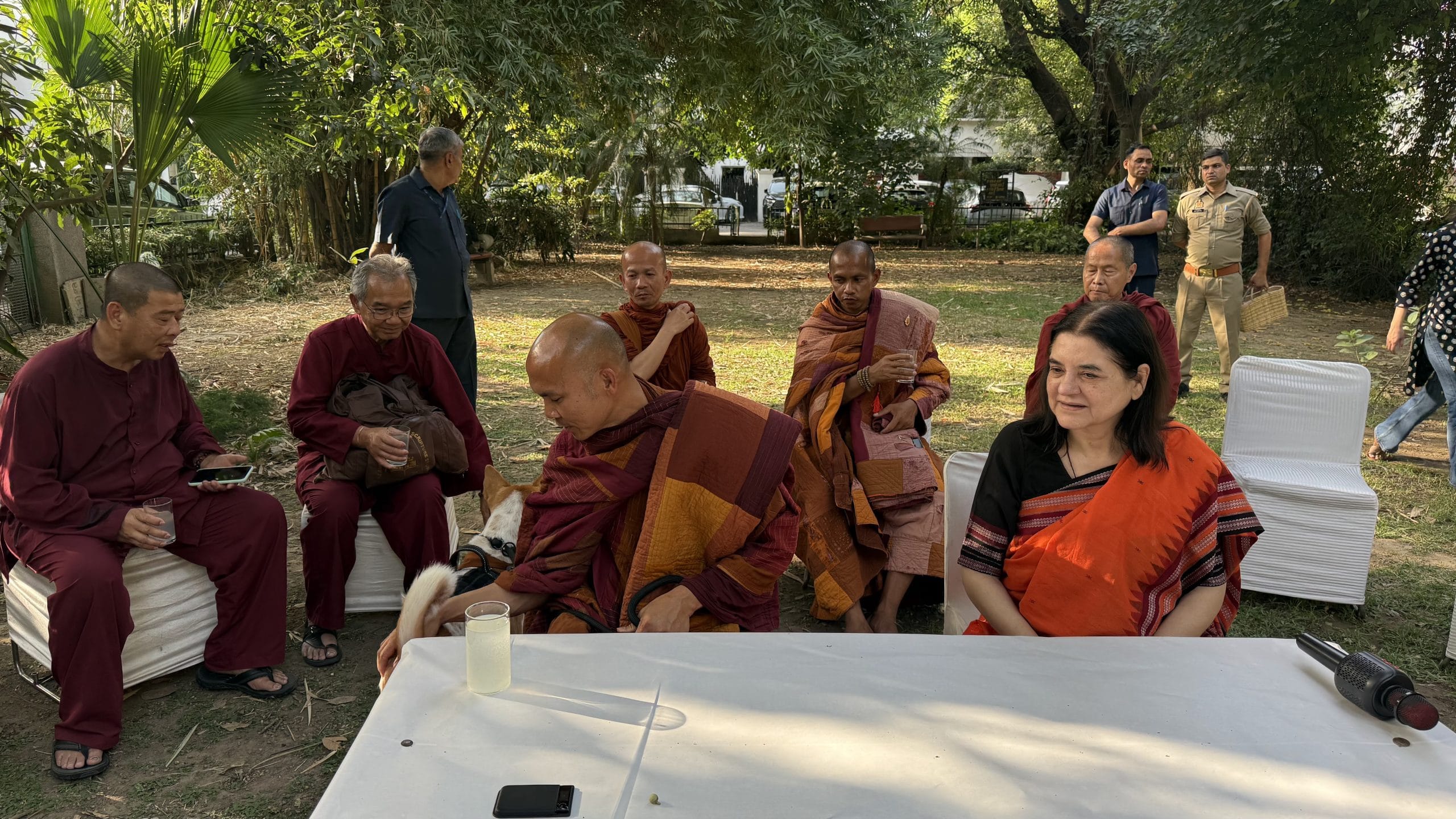
For the monks, the Walk for Peace is a spiritual mission carried out on foot across countries and communities. Aloka, who once followed them along a road in India, now travels with them as a reminder that, in their understanding of Buddhism, compassion does not stop with human beings.
— Tarini Unnikrishnan, The Print, June 9, 2026
What a dog knows about distance
There's a temptation to turn Aloka into a symbol — a teaching dog, a mascot for enlightenment, a lesson on legs. The monks resist this. Pannakara doesn't describe the dog as having made a spiritual choice. He stayed because he stayed. He walked because walking is what dogs do when they find someone worth following.
What the months of walking built between the monks and this dog has a biological dimension. A 2017 study using data from the University of Michigan's Health and Retirement Study found that regular dog walkers had lower BMI, fewer chronic health conditions, and fewer doctor visits than non-dog-walkers — and older adults specifically reported walking faster, farther, and more often with their dog than without (Curl et al., 2017: https://lifestylemedicine.stanford.edu/dogs-taking-humans-for-a-walk-the-surprising-health-benefits-of-our-canine-companions-and-the-human-animal-bond). The study authors noted the dog-owner bond was itself part of the mechanism: not just the miles, but what the miles made.
Whatever Aloka understood about those monks in 2022, he voted with his feet. Four years, two continents, one knee surgery later, he was still voting. The next time you clip the leash and step outside — even for a twenty-minute loop, even in the rain — consider what's being offered. The dog needs to go with you. That's the whole arrangement, and it has been since a dog in West Bengal decided, for no reason anyone can name, to keep going.