4,000 Beagles Are About to See Grass for the First Time
Doges Editorial · 2026-05-07 · 8 min read
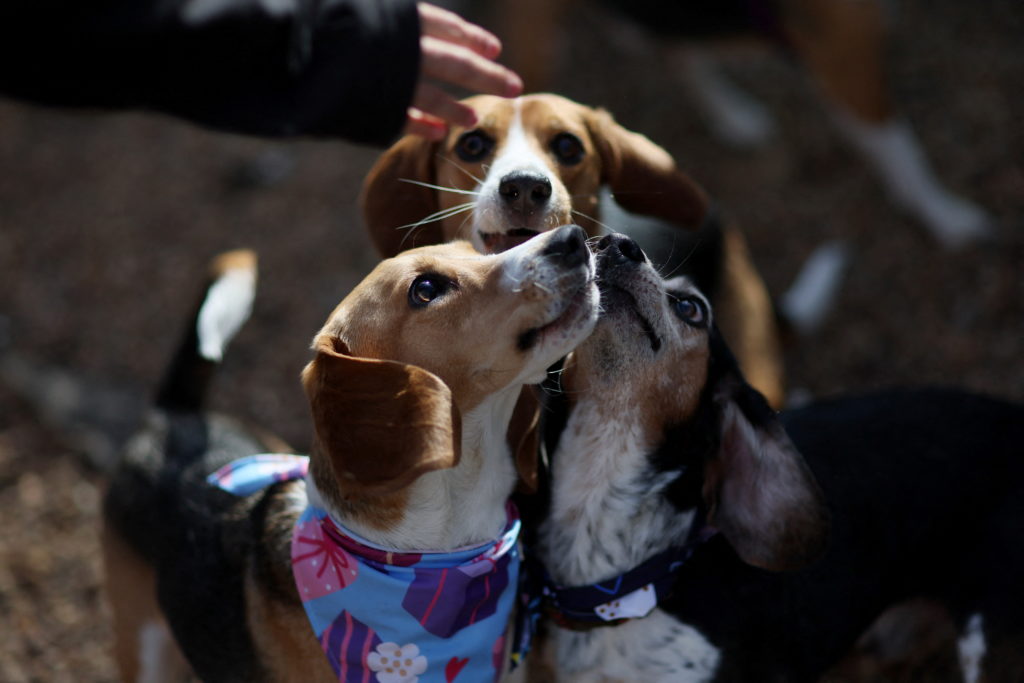
After years inside a research facility in Wisconsin, thousands of beagles are heading toward something they have never known — a backyard, a name, and a human of their own.
The first thing you notice, in the videos circulating this week, is the grass. A beagle steps out of a wire crate onto a patch of lawn. She stops. She looks down at her paws. You can almost see her trying to figure out what this soft, yielding thing is beneath her feet. Then she takes another step, and another, and you realize you are watching something that most dogs experience at around six weeks old — the sensation of solid, unconfined ground, open sky overhead, wind carrying a hundred smells at once. She stands there for a long moment, tail uncertain, nose working. Then she takes one more step and the tail starts moving.
The Ridglan Farms Story
On May 3, 2026, the Associated Press and PBS NewsHour reported that approximately 4,000 beagles from Ridglan Farms — a research breeding facility in Blue Mounds, Wisconsin — would be rehomed following a USDA investigation. The facility had bred dogs for pharmaceutical and medical testing and had been flagged for violations of the Animal Welfare Act. The scale of the operation staggered many who read the initial reports: four thousand dogs, living in rows of kennels, their entire existence organized around the needs of research rather than anything resembling a life.
The effort is not without precedent. In 2023, roughly 4,000 beagles were rescued from the Envigo facility in Cumberland, Virginia — a case that received significant national attention and helped build the infrastructure now being mobilized for Ridglan. The Beagle Freedom Project, which coordinated much of the Envigo placement, is again at the center of the response. But the sheer logistics of placing 4,000 dogs — veterinary assessments, transport across fourteen states, behavioral support, foster matching — means this will take the better part of a year to complete.
What makes beagles the breed of choice for research is a combination of factors: their manageable size, their reliable gentleness, their strong olfactory sensitivity, and, perhaps most of all, their temperament. Beagles do not hold grudges. They do not, as far as anyone studying them can determine, sustain bitterness. The same docility that made them useful in laboratory settings is the same quality that makes watching their first steps outdoors so affecting. They approach the world with curiosity rather than wariness, even when the world is entirely new to them.
A World They Have Never Known
Ridglan beagles have almost certainly never walked on a sidewalk. Never learned what the word "walk" means, or felt the specific electricity that travels from a dog's ears to its paws when someone reaches for a leash. They have lived in controlled environments — metal kennels, fluorescent light, measured feeding schedules — since birth. Their world has been defined by routine and containment. The sky, the wind, the smell of wet pavement after rain — these are things they are about to encounter for the very first time, at ages ranging from a few months to several years old.
Dr. Lindsay Mehrkam, an animal behavior researcher at Monmouth University who has worked with laboratory-rescued dogs, describes the first weeks after placement as a period of perceptual overload. Dogs raised in controlled environments have not developed the associations that help them interpret ordinary sensory input. A carpet is unfamiliar underfoot. A television is an inexplicable noise-making box. A door swinging shut is a sound without context. Each ordinary household event becomes something their nervous system has to process from scratch, building a library of associations that pet dogs accumulate over their first few months of puppyhood.
These dogs are not broken. They are on a completely different developmental timeline. Given space, patience, and consistent positive experience, most of them adapt remarkably well — often within weeks.
— Dr. Lindsay Mehrkam, animal behavior researcher, Monmouth University
The Switch
Foster families who worked with the 2023 Envigo beagles describe a moment they call "the switch." It usually happens somewhere in the first week. The dog who has been moving carefully around the house, pressing against walls, unsure of open space — suddenly just runs. Not away from anything. Just runs, for the physical sensation of it, because the body is discovering what it was built to do. Several fosters have described crying the first time it happened. One foster said she sat down on the kitchen floor because her legs stopped working properly.
Beagles, at their most fundamental level, are scent-driven explorers. The world is something to be catalogued, followed, cross-referenced with yesterday's map. Rescuers consistently report that within days of leaving a kennel environment, even the most hesitant lab beagle has its nose in the grass, building a picture of a world it is only just beginning to understand. The breed's characteristic tracking instinct — the thing that made it useful in the first place — is the same thing that makes its recovery joyful to watch. The dog wants to know things. It was always going to want to know things.
What Adopters Need to Know
The Beagle Freedom Project strongly recommends a securely fenced yard for Ridglan placements. Not because these dogs are aggressive or unpredictable — they are neither — but because a beagle following a scent trail operates on a different cognitive level than a beagle being asked to stay in the yard. The nose overrides almost everything else. Former lab dogs, with no experience of traffic, have no framework for understanding that a road is dangerous. They only understand the smell on the other side of it. A fence is not optional; it is the difference between safety and tragedy.
Lab dogs are often described as easy adopters because they are not reactive or destructive. But they need something equally important: time. Do not rush the first few weeks. Let them come to you, on their schedule.
— Beagle Freedom Project, adoption guidance materials
Fosters from the Envigo rescue have noted that some dogs took weeks to understand what a dog bed was for. A few slept beside the bed rather than in it, because a raised, padded surface was simply not a concept they possessed yet. One adopter described her dog pressing his nose gently against her arm on day three — the first physical contact he had initiated — and said she sat very still for a long time afterward, not wanting to startle him back into caution.
Four Thousand Is a Hard Number to Hold
Four thousand is larger than most small towns. It is roughly the size of a mid-sized university graduating class. If each of those 4,000 beagles ends up in a home — and the organizations involved are cautiously optimistic — it will represent one of the largest coordinated canine rehoming operations in American history. The placement process will involve not just finding homes, but building the behavioral readiness of each dog to be in one. That is not a fast process. It cannot be rushed without harming the dogs.
The organizations involved are specifically asking potential adopters to consider foster-first placements rather than jumping straight to permanent adoption. Many of these dogs need a bridge environment — somewhere quieter and more temporary than a forever home — before they are ready to settle. The best gift a person can give right now, for many of these dogs, is a patient six-to-twelve-week foster experience rather than a permanent commitment they may not yet be equipped for.
After the Camera Moves On
The viral videos — the beagle stepping onto grass, the beagle discovering a stuffed toy, the beagle running in circles on a lawn for what appears to be sheer jubilance — are genuinely moving. Foster applications have surged at Midwest shelters. The internet has, for a few days, turned its full attention to Blue Mounds, Wisconsin. But the real story of these 4,000 dogs moves at a much slower pace than any video. It happens in the two weeks it takes a dog to stop flinching when a door closes. In the moment a dog finally eats from a floor-level bowl without hesitation. In the first time a dog initiates play with a human and then checks to make sure the play was welcome.
People always ask me whether I think he knows he was rescued. I don't know the answer to that. But I know he is happy. You can't fake that.
— Foster parent of an Envigo beagle, adopted 2023
These dogs have a lot of walking ahead of them. A lot of sidewalks to learn, a lot of mornings to greet with their noses already working before their eyes are fully open, a lot of backyards to map in careful olfactory detail. That is not a small thing. For a dog that has spent its whole life in a kennel, a morning walk through a neighborhood — the mulch smell, the neighbor's cat, the kid's bike tire on wet concrete — is not a routine event. It is the whole world, arriving all at once, asking to be understood.