The school dog who sits in on GCSE maths exams
Doges Editorial · 2026-06-02 · 5 min read
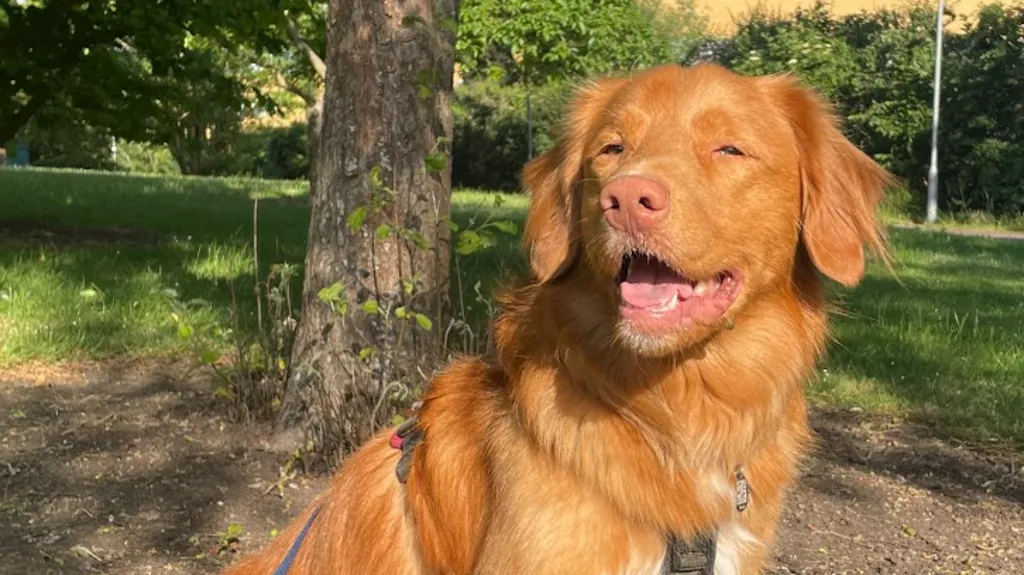
A Nova Scotia duck tolling retriever named Rhubarb has been working at Nescot College in Surrey for four years — sitting in GCSE exams, helping anxious students, and winning School Dog of the Year. His owner, teacher Zoe Latter, says he's "the best buddy" she could ask for.
Before the exam begins, before the papers are handed out, before the first pencil taps nervously on a desk — Rhubarb is already there. He has settled, as he always does, into his spot in the room. His tail is still. His ears, which his owner describes as the best in the world, fold softly at the tips.
For students at Nescot College in Epsom, Surrey, Rhubarb is not a novelty. He is just part of the place — a golden-brown Nova Scotia duck tolling retriever who has been coming to work for four years and whose presence, according to research into assistance animals in educational settings, does something measurable that very few interventions can replicate. Reported by BBC News, May 27, 2026.
Four years at Nescot
Rhubarb belongs to Zoe Latter, who has been teaching for more than thirty years. She brings him to the Surrey campus four days a week — which means that, over the course of his working life, he has been in more classrooms and corridors than most of the humans he works alongside. He was introduced to the college as a puppy, gradually learning the rhythms of the place: when to sit quietly, when to wander the corridors, when to settle beside someone who looks like they need a moment.
This year, the School Dog of the Year Awards confirmed what Nescot students already knew. Rhubarb won. The citation, informal as these things tend to be, noted his temperament, his role in building confidence, and his particular effectiveness with students who were "very shy or a bit anxious."
The stooge dog and the maths exam
Rhubarb's work at the college takes several forms. He walks the corridors, which sounds simple but isn't — a dog in the corridor is a reason to stop, to speak, to make eye contact with someone outside your usual circle. He works one-to-one with students who need a gentler entry point into conversation. And, in a particularly inventive use of a dog's reliable impassivity, he takes part in a classroom exercise where he is trained to choose the wrong answer.
The activity works like this: Rhubarb is presented with a problem and selects an incorrect response. The students must then explain to him why he is wrong — which requires them to understand the material well enough to articulate it, and to do so in a context where the stakes feel low and the audience is non-judgmental. Latter says it shows students that it is "all right to get things wrong, and that's how you learn."
He's so good for our students that perhaps are that little bit more reticent, a little bit shyer, maybe feeling a bit lonely — and then he provides that bridge.
— Zoe Latter, teacher and Rhubarb's owner
Inside the maths exam
The moment that has attracted the most attention is Rhubarb's special permission to sit in GCSE maths exams. This is not a small thing. Exam conditions are rigidly controlled — no phones, no noise, no disturbance. The decision to allow a dog into the room required a formal concession, and the fact that it was granted says something about how seriously the college takes the evidence for animal-assisted interventions in learning environments.
What Rhubarb does in the exam room is, in essence, nothing. He sits quietly. He doesn't pace or distract. But his presence — the warmth of a breathing animal in the corner of a room where students are often at their most anxious — appears to help. The physiological effects of calm dogs on human stress responses have been studied in hospital settings, military environments, and academic contexts: when the outcome matters but the stakes feel less existential, people think more clearly.
Because he's so quiet and very, very gentle, he's ideal — because not everybody wants to be bounced on and breathed on and dribbled on and have toys shoved at them.
— Zoe Latter
The question of what Rhubarb wants
Assistance animals in working environments raise a question that is easy to sidestep but worth asking directly: does the dog want to be there? Zoe Latter appears to have thought carefully about this. Rhubarb undergoes regular assessments to ensure he remains comfortable and engaged with his work. He is also, she points out, a family pet — which means that his time at Nescot is balanced with time at home.
The arrangement is explicitly understood to be on Rhubarb's terms.
If it got to a point where he thought 'actually this is a bit much, I'd rather stay at home in the garden', then that would be fine.
— Zoe Latter
What daily work looks like for a dog
Nova Scotia duck tolling retrievers were originally bred to lure ducks toward hunters by playing at the shoreline — a job that required both energy and a very specific capacity for calm, purposeful engagement with their work. Rhubarb's job at Nescot asks for the same combination in a different register: the energy to be present across four days a week, and the temperament to do it quietly, without wanting anything back.
Most working dogs — search-and-rescue dogs, guide dogs, police dogs — have a clear task and a clear signal when it is done. Rhubarb's task is more diffuse. He is there. He walks the corridor. He settles in the exam room. He picks the wrong answer in the maths class and waits for someone to explain why. The work is cumulative and social, and you would not see it on a scorecard.
"The best floppy ears in the world"
It is easy to reach for the obvious language when writing about therapy and assistance dogs — the language of measurable outcomes, of reduced cortisol, of validated interventions. The research exists and it matters. But Zoe Latter, thirty years of teaching behind her, lands somewhere else.
"He's got the best floppy ears in the world," she said. Which is not a metric and does not appear in any study, but which is, perhaps, the more accurate description of what Rhubarb actually is to the students who walk past him in the corridor and stop, just for a moment, to say hello.
Whatever your own morning walk looks like, there is something in Rhubarb's story about what consistent, unremarkable daily presence can build. The students at Nescot don't think of it as therapy. They just know the dog is there, every Tuesday through Friday, and that the room feels different when he is.