The retired explosives dog who came home to the family that needed her
Doges Editorial · 2026-05-26 · 5 min read
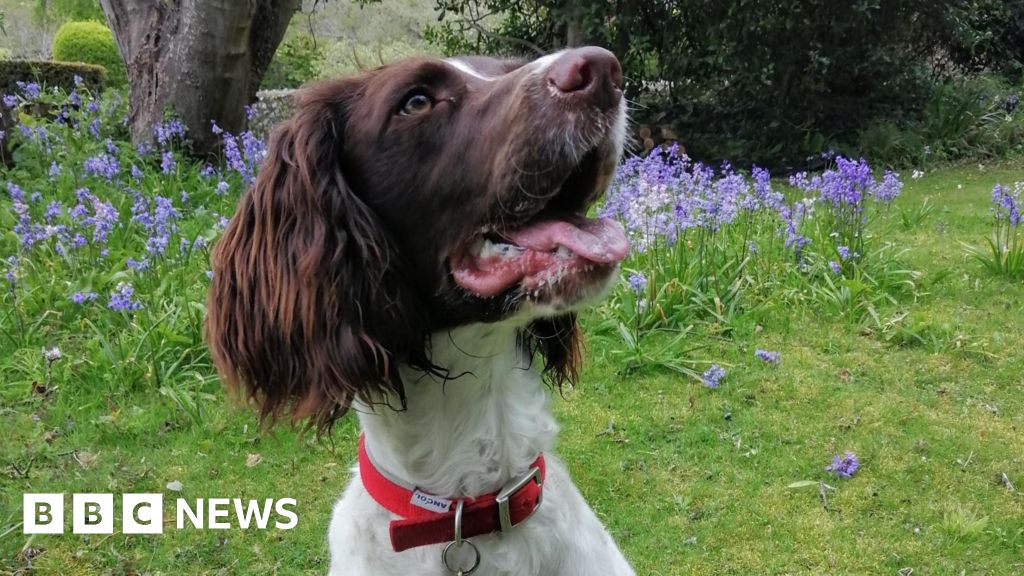
Red spent four years sweeping for explosives at Luton Airport before a fractured elbow ended her career. She was rehomed with the family who fostered her as a puppy — and arrived just in time to help them through grief.
Red is a springer spaniel — brown ears, white coat, the kind of dog who looks like she was born in a meadow somewhere in the English countryside. She spent the first part of her adult life not in a meadow but in the terminals and concourses of London Luton Airport, where she worked as an explosives detection dog for Bedfordshire Police. She was very good at her job. Then in September 2024, she fractured her elbow. She had two operations. By early 2025, Red had been forced to retire from the force. The BBC reported her story on May 18, 2026, and what happened afterward is quieter than the headlines, and considerably more tender.
The family who was waiting
Red's connection to the Sexton family began long before she had a career. In 2020, when Red was just seven weeks old — paws too big for her body, ears drooping almost to the floor — the Sextons' daughter fostered her. Red lived in their Bracknell home for a few months, all puppy chaos and scrambling around kitchen tiles, before she left for police training at around 10 months old.
She was placed with Bedfordshire Police, trained as an explosives specialist, and assigned to Luton Airport. For four years she worked shifts: the long rows of luggage, the crowds moving through the terminal, the controlled intensity of a working dog doing her job with precision. The Sextons knew she was out there. They didn't expect to see her again.
John didn't hesitate
When word reached the family that Red had been injured and was being retired, Elizabeth Sexton's husband John, then 85, heard it and had no uncertainty at all. He offered their home before the conversation was finished.
There was never any doubt that she'd come back to us when we found out what had happened. My husband, John, didn't hesitate to offer her a home for the rest of her life.
— Elizabeth Sexton, Bracknell, UK
Red arrived in early 2025, still recovering. She had repaired elbows and the careful gait of a working dog learning to move differently, calculating each step. John sat with her. He started taking her on what Elizabeth described as "little walks" — measured, slow, probably nothing that would register on any fitness tracker. But they were walks. They were movement. They were two beings — an old man and a dog in rehabilitation — going somewhere together, and coming back.
What slow walks do
It matters, what John did. For a working dog in recovery, the world shrinks down to the body — the joints, the vet appointments, the slow calibration of what's possible. A person who takes the time to walk beside that dog, without rushing, without agenda, is doing something specific. Red was learning that her new life was safe. That movement, which had hurt, could become something she trusted again.
He adored her and spent many hours sitting with her and taking her on little walks as she slowly recovered and regained her strength.
— Elizabeth Sexton
John had a few months with Red before he died in May 2025, aged 85. Red had arrived as he was in the last chapter of his life, without anyone knowing it. She had recovered enough to walk alongside him. He had recovered enough, in whatever way he needed, to have something new to move toward. Then he was gone.
She stayed
What Elizabeth knows is that Red didn't leave when John did. She stayed in the house, in the garden, in whatever rhythm the household had found. Elizabeth, 78, was now navigating grief, and Red was there. She doesn't fully understand what Red understands about that. But the result is the same.
Red has been an absolute blessing and has brought me a lot of comfort and company since losing John. We believe she came back to us for a good reason.
— Elizabeth Sexton
The gap between service and support
Red is now registered with the Thin Blue Paw Foundation, a UK charity that supports retired police dogs. Kieran Stanbridge, the Foundation's chairman, was direct about the reality most retired service dogs face: when they leave the force, they receive no pension, no government funding, no financial assistance toward vet bills. Their care falls entirely to their ex-handler or — when they're fortunate — a family that was already waiting.
"Red gave four years of her life to help police keep staff and passengers at Luton Airport safe," Stanbridge said. "It's a shame her career ended early and that she suffered such a catastrophic injury. It's so lovely that she was reunited with the Sextons — who she already had a bond with — to enjoy her retirement years."
The Foundation says it has helped over 150 retired police dogs across the UK receive veterinary care and rehabilitation support. Many working dogs accumulate injuries over a career. Not all of them retire to a family that has been waiting. Red is one of the lucky ones — though luck seems like the wrong word for something that was, from the very beginning, already a relationship.
A small thing that stays with you
The detail that doesn't let go: John took Red on little walks while she was healing. He was 84 or 85. The walks were probably slow enough that a dog with two repaired elbows had no trouble keeping up. They probably went around the garden, down the lane, back again. Nothing long. But every time they went out and came back, something happened: a retired service dog learned that the world outside was safe again. An old man had a reason to put on his coat.
Elizabeth still takes Red out. Those walks continue now, without John, carrying what they carry. Some walks hold more than distance.