Quantum served Nottinghamshire Police for six years. His vet bills are his problem now.
Doges Editorial · 2026-05-18 · 5 min read
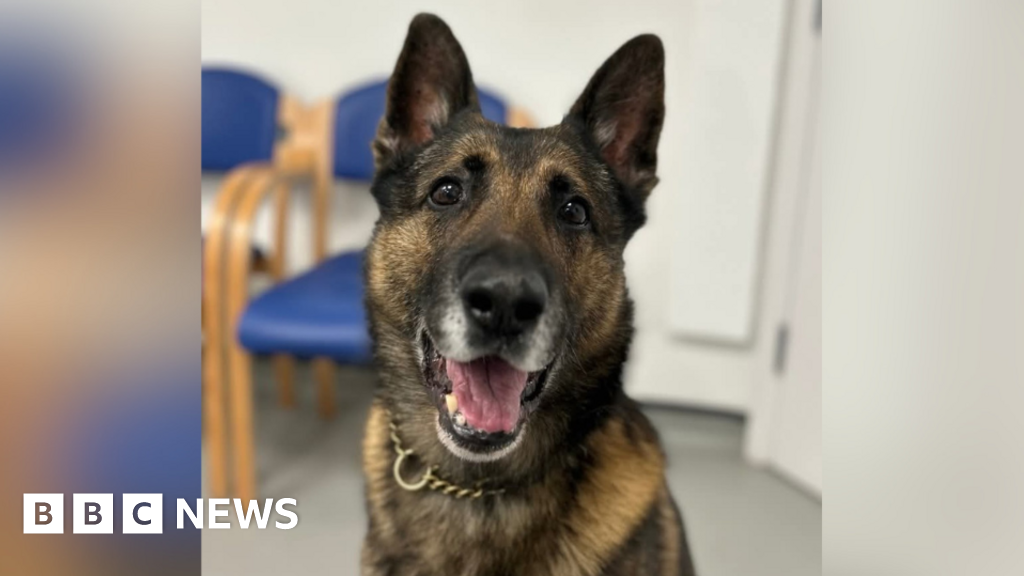
Quantum the German Shepherd survived stab wounds, a beating with a plank of wood, and helped make 250+ arrests. Now he's 10, retired, and the £10,000 in vet bills for injuries linked to his service have no public support behind them.
In 2018, Quantum ran at a man swinging a machete. He was stabbed multiple times during the arrest. He kept going. That year, he received a national bravery award from Nottinghamshire Police, who called him heroic in the press release. In 2020, a violent suspect hit him round the head with a plank of wood at Nottingham railway station. Quantum held on until the arrest was complete. Over six years with the force, he helped bring in more than 250 people. He retired in 2022. Now he is 10 years old, his handler is managing the costs of his dental work and worsening joint pain, and the charities supporting him are asking the public to help cover bills that have reached approximately £10,000.
The BBC reported this week on Quantum's situation, which is not unusual — it is, according to two UK charities, representative of the standard outcome for retired police dogs. The story of what happens when the ceremony is over is less visible than the bravery awards, and considerably less cheerful.
The policy, simply stated
Under UK national police guidance, retired police dogs are typically homed with their former handlers or, where that is not possible, placed with a suitable family. Once the handler signs the paperwork and becomes the dog's legal owner, the welfare and financial liabilities transfer entirely. Insurance is difficult to obtain for retired service animals — the prior work creates coverage gaps that most policies won't touch. The state offers no ongoing support.
Nottinghamshire Police confirmed it follows this guidance. It also confirmed that a police dog pension scheme set up by the county's Police and Crime Commissioner in 2013 is no longer running. The Home Office said each force makes its own policies. Nobody is doing the arithmetic on what six years of high-impact police work does to a German Shepherd's teeth and joints.
After a lifetime of service to communities across the UK, police dogs like Quantum are not afforded a pension in retirement. As a result, the cost of their veterinary care falls entirely to their former handler or to the members of the public who give these heroes a loving home.
— Kieran Stanbridge, founder, Thin Blue Paw
What the vet bills say
Quantum's specific medical issues are not random bad luck. Hero Paws, one of the two charities now assisting his handler Jen Ellse, believes his broken tooth was caused by the physical demands of his working years — the biting, the sustained pressure, the kind of use a household pet's teeth never experience. His joint pain and mobility issues are also thought to be linked to the work. These are occupational injuries in a dog who had no choice about the occupation.
The charity has been covering costs since the insurance problem surfaced, but the cumulative bills have hit around £10,000 and the underlying conditions require ongoing management. Between 50 and 70 police dogs retire every year in the UK. Thin Blue Paw estimates that adopting a retired police dog costs on average £3,000 more annually than an equivalent dog without service history — mostly in veterinary costs that trace back to the work itself.

Police dogs don't actually get any support post service. Once the handler signs over as the guardian, as the owner, that's it. As you can imagine, these bills do mount up. We still class them as a piece of equipment in some cases. More needs to be done and we need to look at these animals, not as animals, but as a partnership, as another officer, another soldier.
— Jaime Garner, army veteran and founder, Hero Paws
The argument that isn't being made loudly enough
Quantum's situation is, at its core, a labor argument. He performed dangerous, specialized, high-value work for the state. That work damaged his body. The state has no mechanism for covering the resulting costs. His handler now relies on charity and public donation to keep him comfortable in his old age. The fact that he has four legs and cannot speak at a parliamentary inquiry does not change the basic structure of what happened.
Military working dogs face a version of the same gap, though the conversation around them has grown louder in recent years. Police dogs in the UK appear to be in a quieter place in that debate — recognized individually for specific acts of bravery, but without systemic support for the aftermath. Hero Paws supports both retired military and police dogs. The framing, Garner argues, needs to shift from charity to obligation.
I don't think any human or animal veteran should need charity help. The support should automatically be there.
— Jaime Garner, founder, Hero Paws
Quantum at ten
By his handler's account, Quantum was "everything you would want from a police dog — dependable, loyal, reliable and absolutely fearless." He earned his bravery award by running at a machete. He kept working after being hit with a plank of wood. He is now a decade old, in a home he shares with the person who handled him through all of it, managing the pain that the work left behind.
Hero Paws and Thin Blue Paw are both accepting donations toward his ongoing care and toward the broader campaign for a statutory police dog pension. The hope is that Quantum's name, carried enough, might produce a policy change that arrives in time for the next generation of dogs who are currently running at things that swing.
The thing about fearlessness
There is a version of this story in which Quantum is called a hero and the campaign is called heartwarming and everyone feels good and nothing changes. That version requires not thinking too hard about what fearlessness actually costs an animal who has no concept of a pension or a press release, who simply ran at what his handler pointed him toward, for six years, because that was what the relationship asked of him.
Quantum retired in 2022. He still goes for walks. On good days, his handler reports, he has "some pep in his step" — the specific phrase that stuck from the shelter visit, the phrasing that has since traveled through every article and charity appeal. That pep in his step is what the work left him with. The joint pain and the bills are what the work left him with too. The first part gets the photograph. The second part gets the crowdfund.