Portland turned out for the dogs — 39 years and still counting
Doges Editorial · 2026-05-12 · 5 min read

Three thousand dogs and their humans took over Tom McCall Waterfront Park for the Oregon Humane Society's 39th annual Doggie Dash, raising nearly $450,000 for shelter animals before the afternoon was out.
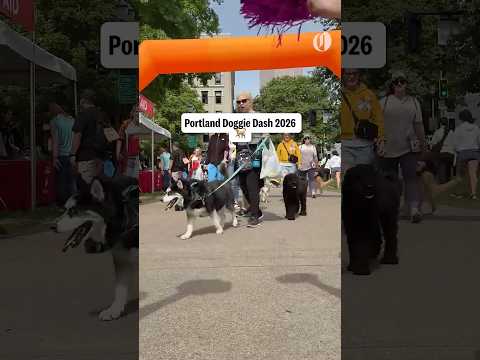
By noon on Saturday, Tom McCall Waterfront Park in downtown Portland smelled like dogs. Not in the way that phrase usually implies — this was beef-broth snow cones and agility mats and the particular warm-animal density of several thousand dogs compressed into one riverfront park on a May morning. Pomeranians and pit bulls, border collies and mystery mixes, dogs in costumes and dogs who had firmly declined to be in costumes.
The 39th annual Oregon Humane Society Doggie Dash had drawn its crowd. Out on the water, the Steel and Hawthorne bridges arced over the Willamette in the spring light. Ahead of the starting line, a patchwork of leashes and wagging tails filled the park in the agreeable chaos of a large outdoor gathering where everyone is excited and nobody is entirely sure of the logistics. Shane Dixon Kavanaugh at The Oregonian/OregonLive covered the event on May 9, 2026.
A run that's been building for nearly four decades
The Doggie Dash started in 1988 as a fundraiser for the Oregon Humane Society. Thirty-nine years later, it's grown into the shelter's biggest annual fundraising event — and into something else as well: a kind of civic ritual for dog owners across the Portland metro area. A day when the private habit of walking your dog becomes collective, public, and a little bit loud.
This year's event offered two routes. The full course was a 2.5-mile loop that crossed both the Hawthorne and Steel bridges before returning along the waterfront. A mellower 1.5-mile option circled Naito Parkway and the park's multi-use path. At a sprawling pet-friendly festival along the route, dogs tucked into treats, tested themselves on an agility course, and cooled off their paws in bright blue kiddie pools.
For dogs who preferred competition to distance, there was a peanut butter lick-off contest. It drew significant participation. By 1 p.m., the event had raised nearly $450,000.
The neighbors you didn't know you had
Frank So, 46, arrived from the Bethany neighborhood west of Portland with a half-dozen neighbors and their dogs. They'd named their group the Bethany Buddies. His dog, Hoku — a collie mix rescue — had already polished off a beef-broth snow cone by the time So stopped to talk. So noted he might have tried one himself, under different circumstances.
We might not share the same language or the same politics. But we all have one thing in common: our love for animals.
— Frank So, 46, Bethany resident, at the 2026 Doggie Dash
The observation was casual — offered while waiting in a portrait line with Hoku — but it had the weight of something true. Dogs function reliably as social infrastructure. They create conditions for strangers to stop, exchange names (usually the dog's name first), and gradually become, if not friends, then at least people who nod at each other on a Tuesday morning.
Hoku, for his part, seemed to have no strong opinions about any of this. He had finished the snow cone and was watching the agility demonstration with the alert, interested expression of a dog who is considering his options.
A 9-month-old Pomeranian's big day
Chloe High, 19, brought her Pomeranian, Munch, for his first Doggie Dash. He was 9 months old and had just completed the full 2.5-mile loop across both bridges. She looked at him with the particular expression of someone who has just discovered something new about their dog.
He's going to be tired today.
— Chloe High, 19, on her 9-month-old Pomeranian Munch, after completing the 2.5-mile route
High's great-grandmother, Marjorie Taylor, 81, had come to cheer from the sideline. She watched the finishing runners arrive throughout the morning and delivered a verdict: 'This is so much better than a dog park.' She was not wrong. A dog park has a fence and a familiar cast of characters. The Doggie Dash had the entirety of Portland's dog-owning community on a riverside loop, with snow cones.
What the money funds
The proceeds from the Doggie Dash support Oregon Humane Society's medical care for incoming animals, shelter operations, and adoption programming. The organization handles thousands of animals annually from across the Pacific Northwest — dogs, cats, and occasionally less ordinary cases — and the costs of that care are substantial in a city where veterinary expenses track closely with the broader cost of healthcare.
Nearly $450,000 by 1 p.m. tells you something about the depth of the commitment in this city. Dog owners in Portland have turned out for this event through rain and sun, on routes that cross working bridges over a working river, for nearly four decades. The money compounds. So, apparently, does the habit.
The 39-year argument
There's an argument being made each time the Doggie Dash comes around, though nobody quite says it out loud. The argument is that dogs are worth showing up for — worth putting on shoes on a Saturday morning, driving to a waterfront park, and walking 2.5 miles in a crowd of strangers and their animals. Multiplied across a few thousand people, that impulse becomes a community.
It's the same logic, scaled up, that governs every morning walk. You go because the dog needs it. You go because you said you would. You go and you end up talking to someone you didn't expect to talk to, or noticing something about the route you'd stopped seeing, or just covering ground in the fresh air while a dog pulls ahead toward something interesting.
Thirty-nine years in, the argument seems to be holding. The Hawthorne Bridge was full. The agility course had a line. And somewhere near the back of the pack, a 9-month-old Pomeranian named Munch was trotting along a May riverbank in Portland, having just covered more ground than he'd ever covered in his life. He was just on his walk. But that, usually, is the point.