From paralyzed, to running in ten days
Doges Editorial · 2026-06-17 · 5 min read
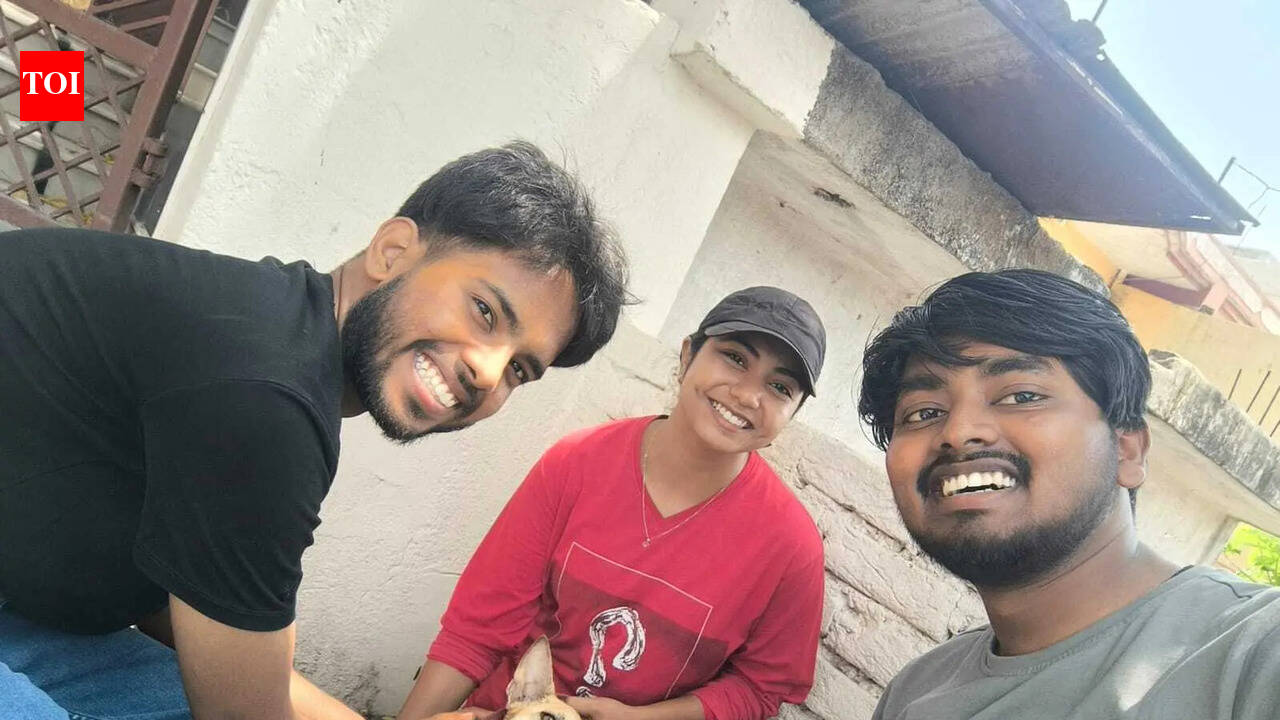
Found paralyzed on June 3 near a lake in Hazaribag, India, a stray dog named Pintu couldn't lift her head. Ten days later, a crowd gathered at that same lake to watch her run.
On June 3, 2026, a stray dog was found on the ground near Okni in Hazaribag, a city in India's Jharkhand state. She could not lift her neck. She had no movement in her limbs. The people who found her named her Pintu, and they called Priyal Akhouri Singh.
Priyal is twenty-eight years old. By profession, she is a qualitative researcher working across rural Bihar and Jharkhand. By practice, she runs Kritagya Group, a twelve-person animal welfare organization she founded, and she has been doing this work for six years. She drives her own car to emergencies. Members of the group have taken to calling it the red ambulance.
What survival looks like at the start
When Priyal arrived, Pintu's prognosis was uncertain. Complete paralysis in a stray dog with no medical history and no previous owner could mean many things: a car strike, a spinal injury, a neurological event, poisoning. There was no way to know. What there was, was the dog lying on the ground, and the question of what to do next.
Priyal contacted Hemant Victor Shaw, a retired government veterinarian in Hazaribag who has been advising the Kritagya Group on complex cases. Shaw assessed Pintu and recommended a treatment protocol combining physiotherapy, infrared therapy, and hydrotherapy. For a stray dog found paralyzed on a dirt road, this is an unusual level of care. Kritagya Group began it anyway.
Into the water
Hydrotherapy for dogs works on the same principle it works for humans: water reduces the load on damaged muscles and joints, allowing movement that would otherwise be impossible. The buoyancy creates a kind of protected space where limbs can begin re-learning what they are supposed to do. For animals with spinal injuries or neurological trauma, water is often the first place where any movement is possible at all.
We took Pintu to Hazaribag lake and released her in shallow water. She started moving her legs on her own. We also conducted water exercises in the room.
— Priyal Akhouri Singh, Kritagya Group founder, June 2026
That moment at the lake, a paralyzed dog's legs beginning to move in shallow water, is the moment the story pivots. Priyal described the response as "surprising." She had not known whether anything was recoverable. Then, in the water, there was movement.
The team also ran water exercises in the room where Pintu was being kept, supplementing the lake visits. Physiotherapy and infrared therapy continued alongside the water work. The treatment was daily, intensive, and built around watching for whatever the dog could do and building from there.
The science behind that first movement is specific. A 2025 clinical study in a peer-reviewed veterinary journal found that even a single underwater treadmill session can significantly increase a dog's joint range of motion and stride length, findings that are especially relevant for neurological patients, where the goal is not just mechanical unloading but sensory re-engagement of injured pathways. (pmc.ncbi.nlm.nih.gov/articles/PMC12607352) Water provides constant proprioceptive input to the submerged limbs, sending positional signals along the spinal cord even when that cord is too damaged to generate voluntary movement on its own. This is why a dog may move her legs in shallow water before producing any movement on land. The water was doing neurological work, not just mechanical work. It was prompting Pintu's nervous system to begin remembering what movement was.
Day by day: crawling, then standing, then walking
Within a few days of beginning treatment, Pintu had progressed from complete stillness to slight movement. Then to crawling. Then, on June 12, nine days after she had been found unable to lift her head, she stood up for the first time. Then she walked.
The progression from paralyzed to ambulatory in under two weeks is not medically unprecedented, but it is genuinely unusual. The factors that contributed are hard to isolate precisely: the timing of the intervention, the combination of therapies, the dog's own resilience, the intensity of daily care from a twelve-person team. What is certain is that it did not happen passively. The Kritagya Group was there every day.
These young people, especially Priyal, are doing a great job. They follow proper treatment guidelines and show remarkable commitment.
— Hemant Victor Shaw, retired government veterinarian, June 2026
The day the neighbors came to watch
On June 14, Kritagya Group brought Pintu back to Okni, the same area near the lake where she had been found eleven days earlier. Residents gathered. Many of them had seen her lying there helpless. They stood at the waterside and watched the Kritagya team release her.
Pintu ran.
That is the whole of it, and it is enough. A dog that could not move, moving. The people who had watched her helpless, now watching her run. The same lake, the same neighborhood, ten days apart.
Six years of red ambulance work
Pintu's story is one case among many. When the Times of India spoke to Priyal in mid-June, Kritagya Group was simultaneously treating several other injured animals in the area, including one dog undergoing chemotherapy near Dipugarha Chowk. The group funds this work independently. There is no institutional support and no government grant. Priyal pays for what she can, and the twelve members cover the rest.
She has been doing this since she was twenty-two. She is a member of People for Animals and participates in wildlife rescue efforts. Her day job takes her across rural communities studying how people live; her evenings and weekends she mostly spends doing this.
When people treat animals with kindness and feed them, they become friendly. Pintu is proof of the behaviour. Treat animals with kindness. If you give love, you receive unlimited love in return.
— Priyal Akhouri Singh, Kritagya Group founder, June 2026
What movement is worth
The word that appears throughout every account of Pintu's recovery is the same one that runs through almost everything significant about dogs: movement. The moment her legs began to work in the lake is the moment everything changed. Not the diagnosis. Not the medication. The first movement.
There is something in this that extends well beyond veterinary rehabilitation. Dogs need to move the way humans need to breathe. Not to survive, exactly, but to be fully themselves. The stray dogs that Kritagya Group treat are often dogs who have never known a routine walk, a leash, a familiar street. Pintu had no owner and no route. She had the road where she was found, and then the lake where she began to come back.
Somewhere out in Hazaribag right now, Pintu is doing whatever stray dogs do in the heat of an Indian June. She is walking on four working legs. She ran at Okni lake while the neighbors watched. She had no idea what it had cost to get her there, no idea that twelve people had taken turns carrying her to a shoreline, had held her in shallow water until she found out she could move.
She just ran. And that was enough for everyone who watched.