The American bulldog who came home after 900 days
Doges Editorial · 2026-05-15 · 4 min read
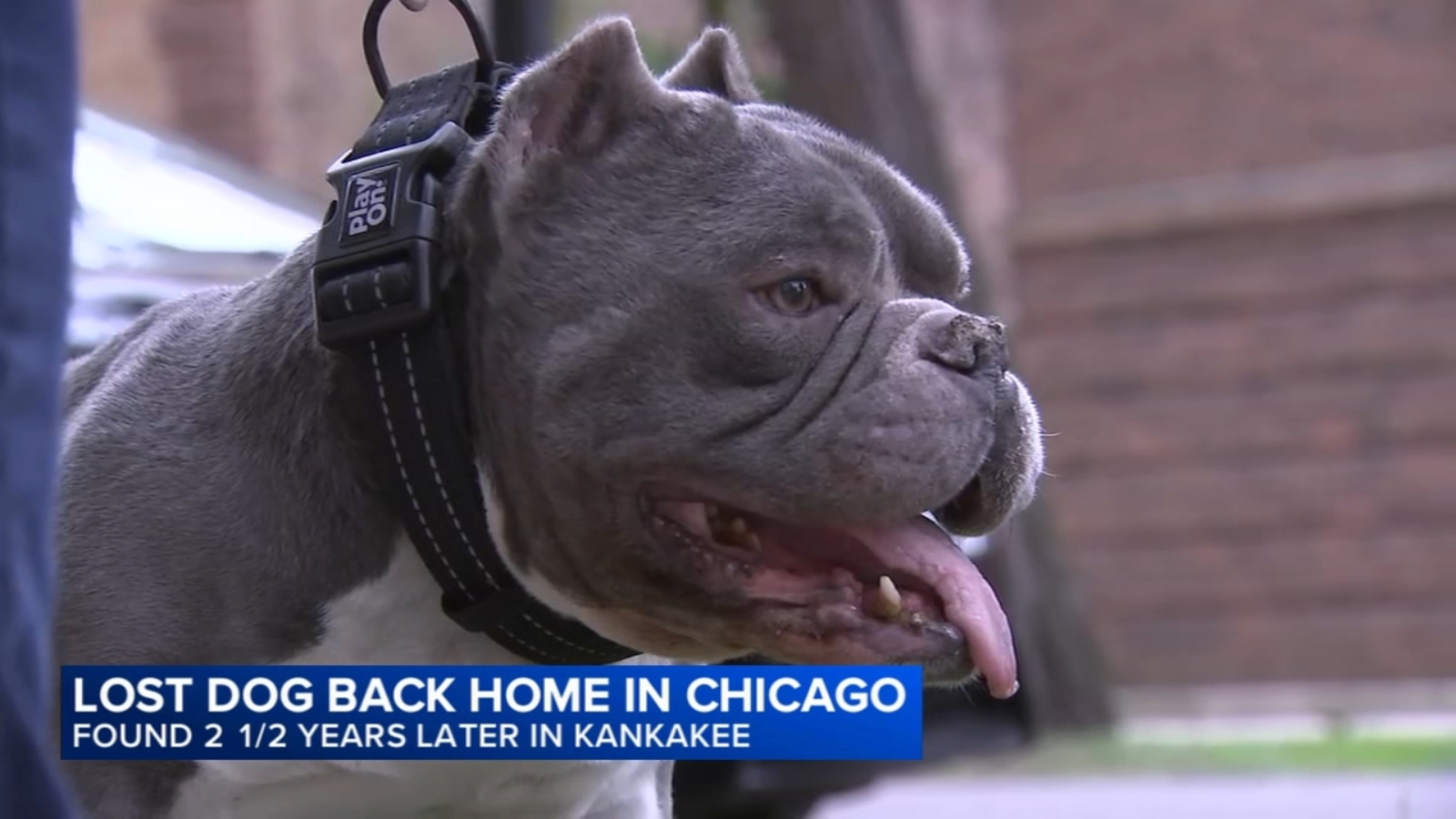
Joel Saucedo saved up for years to buy his dream dog. Then Pezkoi vanished from their Chicago yard. Two and a half years later, a microchip call from an animal shelter 59 miles away changed everything.
Joel Saucedo was nineteen when he started saving. Not for a car or a weekend trip — for an American bulldog. The specific, heavy-jawed, stubbornly loyal kind he had wanted since he was a kid growing up on Chicago's Northwest Side. When he finally had enough, he got Pezkoi. The name came easy. The dog fit even easier.
Big white-and-brindle face. A personality that took up the whole room. Pezkoi settled into the household the way good dogs do — underfoot in the kitchen, sleeping near whoever was still awake, becoming the thing Saucedo's mother Yolanda Chilson checked on the way others check the stove. As reported by ABC7 Chicago's Leah Hope, this was a family that loved this dog in the simple, unconditional way that doesn't need much explaining.
The day the yard went quiet
Then one day Pezkoi got out. Dogs do this — a gate left ajar, a moment of distraction, the scent of something irresistible half a block away. What you can never predict is whether they come back. This one didn't.
The family posted flyers. They put his photo on Facebook, on lost-pet websites, on LostDogsIL — a volunteer network that tracks missing dogs across Illinois. They made signs. Called shelters. Asked every neighbor on the block. Days became weeks. Weeks became months.
It was heartbreaking. My mom was sad. I was sad. It was really devastating. We lost a family member.
— Joel Saucedo
Chilson was equally direct: Pezkoi was like their baby, and she was heartbroken. The family kept his profile active on LostDogsIL — updating, re-posting, hoping someone would recognize those brindle patches. But American bulldogs don't survive Chicago winters easily on their own, and the longer the silence stretched, the harder it became to explain what hope still felt like.
LostDogsIL exists because the official channels aren't enough. Volunteer-run and social-media-native, it operates as a searchable database of missing pets across the state and a community of people who understand that a lost dog isn't a minor inconvenience — it's a missing family member. The network kept Pezkoi's listing current through two Illinois winters and out the other side.
Nine hundred days of not knowing
Two and a half years passed. Pezkoi had been missing for roughly nine hundred days when Chilson's phone rang. Kankakee Animal Control, 59 miles south of Chicago, had picked up a dog. The dog had a microchip. The chip had a phone number. The number was hers.
Pezkoi was alive. Injured — damage to his mouth told its own silent story about what those nine hundred days had looked like — but alive, and 59 miles from the yard where he had vanished. How he got there, nobody knows. What happened in between, nobody will ever be able to ask him. But the chip held.
A reunion that landed them on the floor
I fell to the floor. 'Pezkoi, Pezkoi.' Oh, I was happy, happy, happy.
— Yolanda Chilson, Pezkoi's owner
There is a kind of joy that doesn't have more elegant words than that — the falling, the repetition of a name, the pure animal relief of a living thing coming back when you had stopped letting yourself expect it. Saucedo put it simply: "I felt like a little kid in a candy store. I was the happiest person alive. It was a miracle."
The family set up a GoFundMe to cover Pezkoi's medical bills, particularly the work needed on his injured mouth. He came home with questions attached to him — where he had been, how he had survived — but home nonetheless. Some questions matter less than the one answer that counts: he's here.
What a microchip actually does
Jeanette Garlow is the co-director of LostDogsIL, the network that had kept Pezkoi's case visible for more than two years. She was direct about what made the reunion possible.
A microchip really got that dog home. You don't know if your dog is going to be picked up and taken to another county, another town, another state.
— Jeanette Garlow, Co-Director of LostDogsIL
A microchip is roughly the size of a grain of rice, injected between the shoulder blades, readable by any shelter scanner in seconds. It doesn't track a dog's location — that requires a GPS collar — but it carries an ID number tied to the owner's contact information. The critical detail, the one Garlow emphasizes: that contact information has to stay current. A changed phone number, an old address, a forgotten registration means the chip leads nowhere.
Spring and early summer are when pets go missing at higher rates — open windows, summer activity, storms, and eventually Fourth of July fireworks all break familiar routines. Pezkoi disappeared at a different time of year, but the lesson holds regardless: a microchip is only as useful as the number still attached to it.
Waking up to check
The morning after Pezkoi came home, Saucedo said something that sounds small but carries real weight: "I wake up every day just to see if he's still here, and he's here. He's really here. It's a good feeling to have my dog back."
Most of us don't walk out the door wondering if our dog will still be there when we return. But most of us know, at some level, how quickly a yard can go quiet. The leash by the door, the route around the block, the way a specific dog at a specific pace makes a specific neighborhood feel like yours — those things aren't background noise. They're the whole point.
Pezkoi is injured and healing. His owners are covering the bills and calling themselves lucky to have the bills to cover. Somewhere in Kankakee, an animal control officer scanned a chip and made a phone call, and the whole long wait collapsed into a moment on a floor.