A Navy veteran with PTSD won't leave Jacksonville without his service dog
Doges Editorial · 2026-05-29 · 5 min read
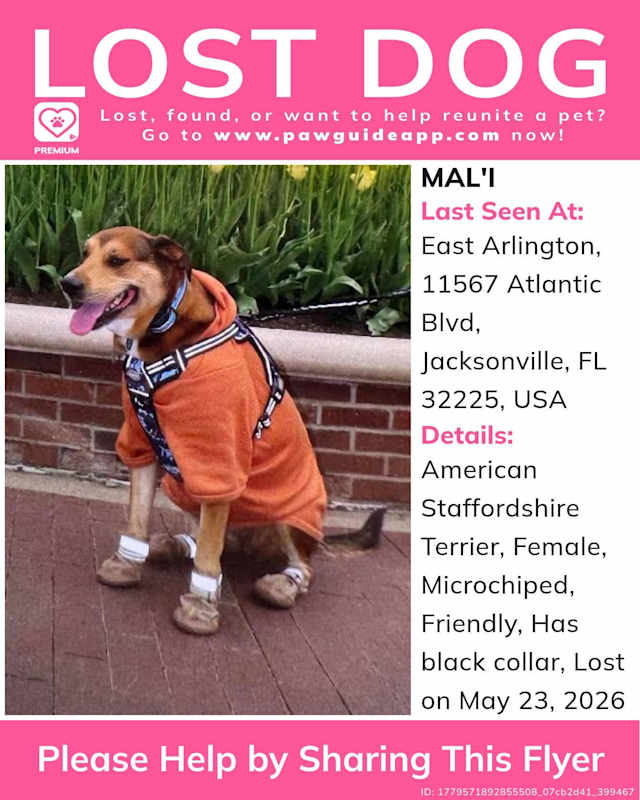
Scott Baker drove from Iowa to help his son move in. Then his four-year-old PTSD service dog was struck by a hit-and-run driver and disappeared into an unfamiliar city — and Baker refused to go home without her.
Seven-thirty on a Saturday morning, East Arlington, Jacksonville. Mal'i — a four-year-old brown-and-tan American Staffordshire Terrier — was outside getting some air with her handler's daughter when a truck hit her and kept moving. Mal'i ran. Scared, probably hurt, she disappeared into a city she had never been to before, wearing a black collar with her owner's military dog tags.
The dog who makes sleep possible
Mal'i belongs to Scott Baker, a Navy veteran from Iowa who drove to Jacksonville to help his son — also in the Navy — move into a new apartment. Baker has PTSD. Mal'i is not incidental to his life. She is calibrated to it. She sleeps in his room, monitors his nights, and wakes him when an episode arrives — staying close until the world comes back into focus. He's had her since she was six months old.
I have PTSD and she sleeps with me at night. She wakes me up when I have episodes and lets me know everything is okay. She's not there. I can't sleep because she's not with me. And I can't go back to Iowa without her.
— Scott Baker, Navy veteran
There is a particular kind of knowledge a PTSD service dog develops over years: the spike of cortisol before the handler consciously registers the shift, the exact pressure a nose against the hand provides, the way a body settling next to yours on a mattress at 3 a.m. says more than words can. Baker and Mal'i built that language together across four and a half years. It cannot be quickly replaced.
Saturday morning, East Arlington
Baker's daughter had let Mal'i outside briefly — no leash, just for a moment — near the Lux Apartments on Kernan and Atlantic boulevards. The truck came through. The driver did not stop. Mal'i ran toward the Cinemark theater on Atlantic Boulevard and Baker ran after her, until the maze of parking lots and strip malls swallowed her entirely. He stopped where the trail did.
As of the time this was reported, she hadn't been found. Mal'i is microchipped but doesn't know Jacksonville. She was last seen wearing an aquamarine onesie and the black collar carrying Baker's dog tags — pieces of his military identity worn around her neck, which might say everything about what this dog means to a man who served.
A city Baker barely knows rallies
Baker filed a report with the Jacksonville Sheriff's Office. Animal Care and Protective Services joined the search. Volunteers showed up. Local officials reached out. The response, for a man hundreds of miles from home in a city he came to only by accident, wasn't what he expected.
It makes me feel so warm that there is such a caring community. That's giving me hope, because otherwise I don't have hope right now just because we're in an unfamiliar area.
— Scott Baker
Strangers were driving through parking lots before work, posting flyers, peering into the gaps between buildings. A dog they'd never met — a dog whose name they'd had to look up — had organized their morning. That is a particular kind of community, formed entirely around the love someone else has for their animal.
An irreplaceable partner
PTSD service dogs trained for a specific handler take years to develop their skills. They learn to read one person, not general behavioral cues: this heartbeat, this breathing pattern, this particular restlessness before a nightmare. A replacement — even the most carefully matched animal — starts over. The years of attunement cannot be transferred.
She's not a service dog for anyone else but me. She knows what I need when I need it and why. And that's why I need her back because I can't live without her.
— Scott Baker
Baker asked that anyone who spots a brown-and-tan Staffordshire Terrier — cautious, possibly limping, wearing a black collar with military dog tags — call him directly at 805-512-1860, and not approach her first. A frightened dog in an unfamiliar place will run from a stranger before she runs toward one. She needs to see Baker's face, hear his voice, smell him. That's what she's been trained to read.
The thread that holds everything together
Baker came to Jacksonville to help his son step into a new chapter. He's been here ever since, driving slowly through East Arlington, watching edges of parking lots and the shadows under chain-link fences. He came to Florida to do something for his family and ended up stranded in someone else's city, searching for the animal who knows what to do when his mind goes somewhere dark.
The daily walk with a service dog is not a stroll. It is maintenance — the physical act of keeping a partnership tight, of giving the dog space to stay calibrated to you. Moving together through a neighborhood, at the same pace, returning to the same door. For Baker, that daily rhythm is the thing standing between manageable nights and unmanageable ones. When the rhythm breaks, everything downstream frays.
There's a version of this story where you read about the bond between a veteran and a service animal and it stays abstract. Scott Baker's situation makes it concrete: a man who woke up the morning of May 23rd with a dog asleep beside him, and hasn't slept properly since she ran. That's the bond, in practical terms. That's what four and a half years of morning walks builds.