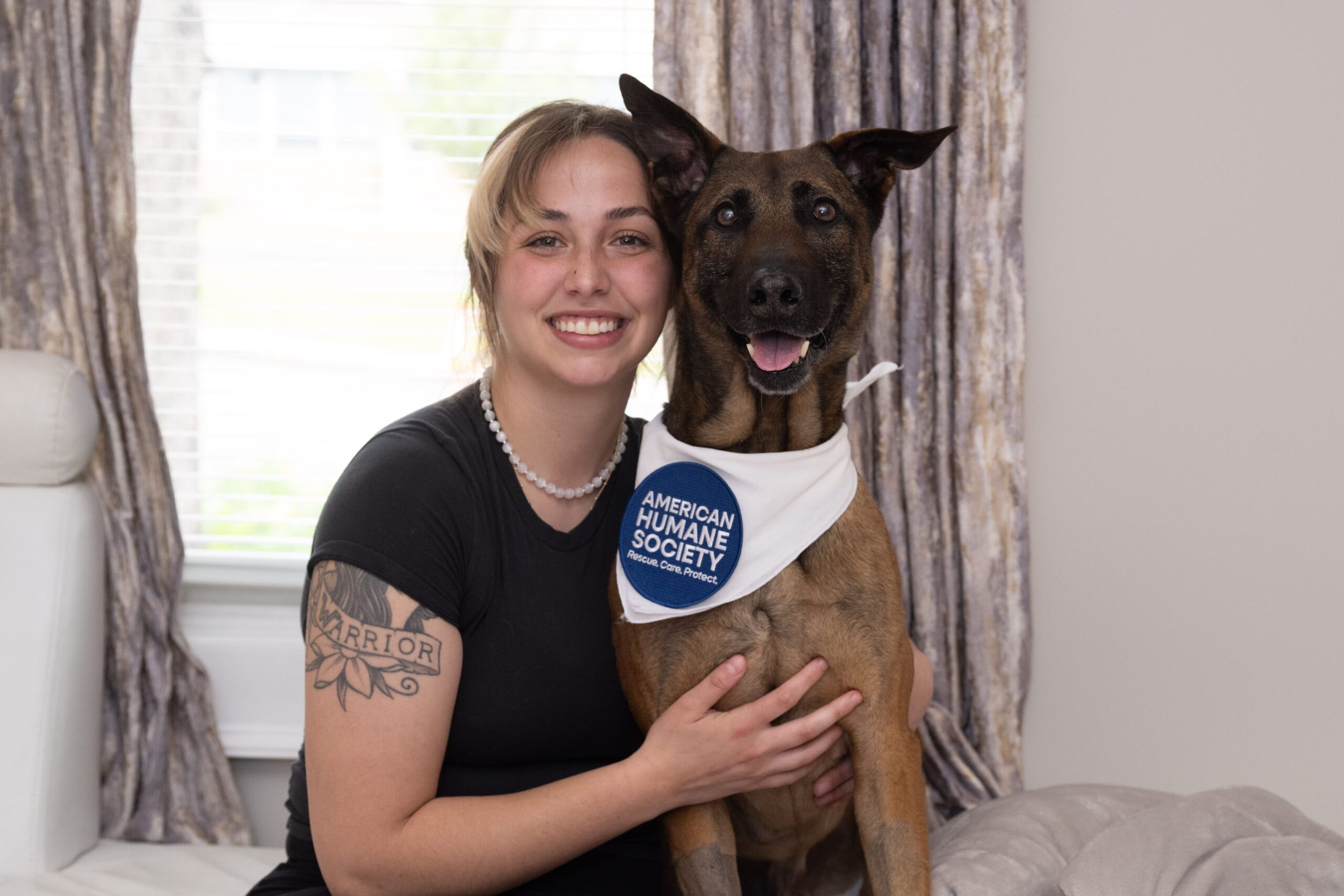
The dog who came home on Memorial Day
Doges Editorial · 2026-06-09 · 5 min read
After seven years of military service — night patrols in Hawaii, a Secret Service mission to Fiji, a retirement forced by injury — Military Working Dog Menson made it back to the Marine Corps handler who never stopped wanting him home.
The driveway was already full of family when the car pulled up. Angela's people had gathered — parents, siblings, children — in the way families do when something important is about to happen. Then the door opened, and Menson stepped out, and the reunion was immediate. He had spent seven years as a U.S. Marine Corps patrol and scent-detection dog, run night shifts at a base in Hawaii, boarded a military aircraft bound for Fiji as part of a Secret Service security detail, and retired at age seven with a back injury that ended his working life. What he had not done, not yet, was come home. This Memorial Day, as reported by American Humane Society, he finally did — and when he saw Angela, he didn't wait. The neuroscience behind that moment is specific: a 2014 brain-imaging study published in the journal Behavioural Processes found that a dog's caudate nucleus — the region associated with reward and positive expectation — responds more strongly to a familiar person's scent than to any other input, including familiar dogs or the dog's own smell. For Menson, Angela's scent had apparently never stopped being the thing his brain classified as home.
Eight months on the night shift
In military working dog partnerships, eight months is long enough to matter. The work is relentless and physical and built on a particular kind of mutual reading — the handler learning to trust the dog's nose over their own intuition, the dog learning to read shifts in the handler's body language as reliably as any spoken command. Angela and Menson — a Belgian Malinois — ran night patrols in Hawaii, trained through the heat and humidity of a Pacific base, and shared the specific, wordless closeness that develops when two beings are regularly responsible for keeping each other safe. The Malinois is not incidentally the dominant breed in elite military units: lighter than a German Shepherd, suited for tandem parachute work, and bred for a handler-focused intensity that approaches devotion. Cairo, the Malinois who accompanied SEAL Team 6 on the 2011 mission to find Osama bin Laden, is the most publicly known example — but the breed's reputation in the military long predates that mission.
Then the assignment ended, as they do. Angela moved on. Menson stayed. This is the standard trajectory of military working dog service: the handler rotates out, the dog continues until retirement, and whether they ever see each other again depends largely on whether anyone makes it happen.
Beloved, and waiting
Menson retired at seven with a back injury that ended his active duty mid-career. He had earned the informal title of kennel mascot by the time his working life was over — which is another way of saying he was known and well-liked by everyone at the base and had nowhere particular to go. New handlers came and cycled through. He knew the smell of the kennel in the morning and the sound of each volunteer's footstep. He was cared for. He was also waiting, in the particular way that dogs wait: without knowing what for.
Years passed. Menson grew older in the kennel. The kind of dog who was made for a specific purpose and then found himself without one. This is not cruelty — it is simply the gap that the military's retirement process creates, the space between a working dog's last mission and the moment, if it comes, when someone claims them.
The program that bridges the gap
American Humane Society's Military Working Dog Reunification program exists specifically for that gap. Roughly 300 to 400 working dogs retire from U.S. military service each year; a study of 1,230 MWDs discharged between 2019 and 2021 found that 84.23 percent were eventually adopted — but reaching that outcome requires navigating a tangle of logistics that the program exists to cut through. Handlers move between bases, units, and civilian life; administrative threads connecting a retired dog to their former person fray quickly. The gap has a longer history, too: for much of the twentieth century, U.S. military working dogs were classified as equipment, legally disposable at the end of a deployment. Congress eventually changed that — today, law requires retired MWDs to be returned to U.S. soil and gives former handlers first right to adopt. The American Humane program covers the transportation costs and logistics that still prevent many reunions from happening. (MWD adoption data: https://pmc.ncbi.nlm.nih.gov/articles/PMC12548479)
Angela had navigated this process before. In 2021, she adopted MWD Bogi — another retired military working dog — through the same program. She understood how it worked and what was waiting on the other side. When the opportunity to bring Menson home arose, she was ready.
After seven years of dedicated service, including protecting U.S. Marines in Hawaii and supporting international Secret Service missions, retired Military Working Dog Menson is officially home, reunited with his former handler, Sgt. Angela.
— American Humane Society
A house of heroes
Angela's household now holds two retired military working dogs. Bogi arrived first, in 2021. Menson arrived this Memorial Day. Whatever the negotiations look like between two experienced, disciplined dogs who have both spent their careers on patrol — and they are dogs, so there are negotiations, about territory and sleeping spots and who gets the better end of the couch — they are working it out in a home that was built to hold them.
The neuroscience of what happened in that driveway is more specific than a bond that simply persisted. In the 2014 fMRI study led by neurologist Gregory Berns at Emory University — among the first to use brain imaging on awake, trained dogs — the caudate nucleus responded most strongly to a familiar human's scent: more than to unfamiliar humans, more than to familiar dogs, more than to the dog's own smell. That region is directly tied to reward and positive expectation. When Menson recognized Angela, his brain was registering her as a pleasure signal that had apparently never been overwritten. Seven years of separation, a career's worth of distance, and then a driveway full of family, and something in him knew immediately. That is not sentiment. That is how canine memory stores the people who matter. (Source: https://www.sciencedirect.com/science/article/pii/S0376635714000473)
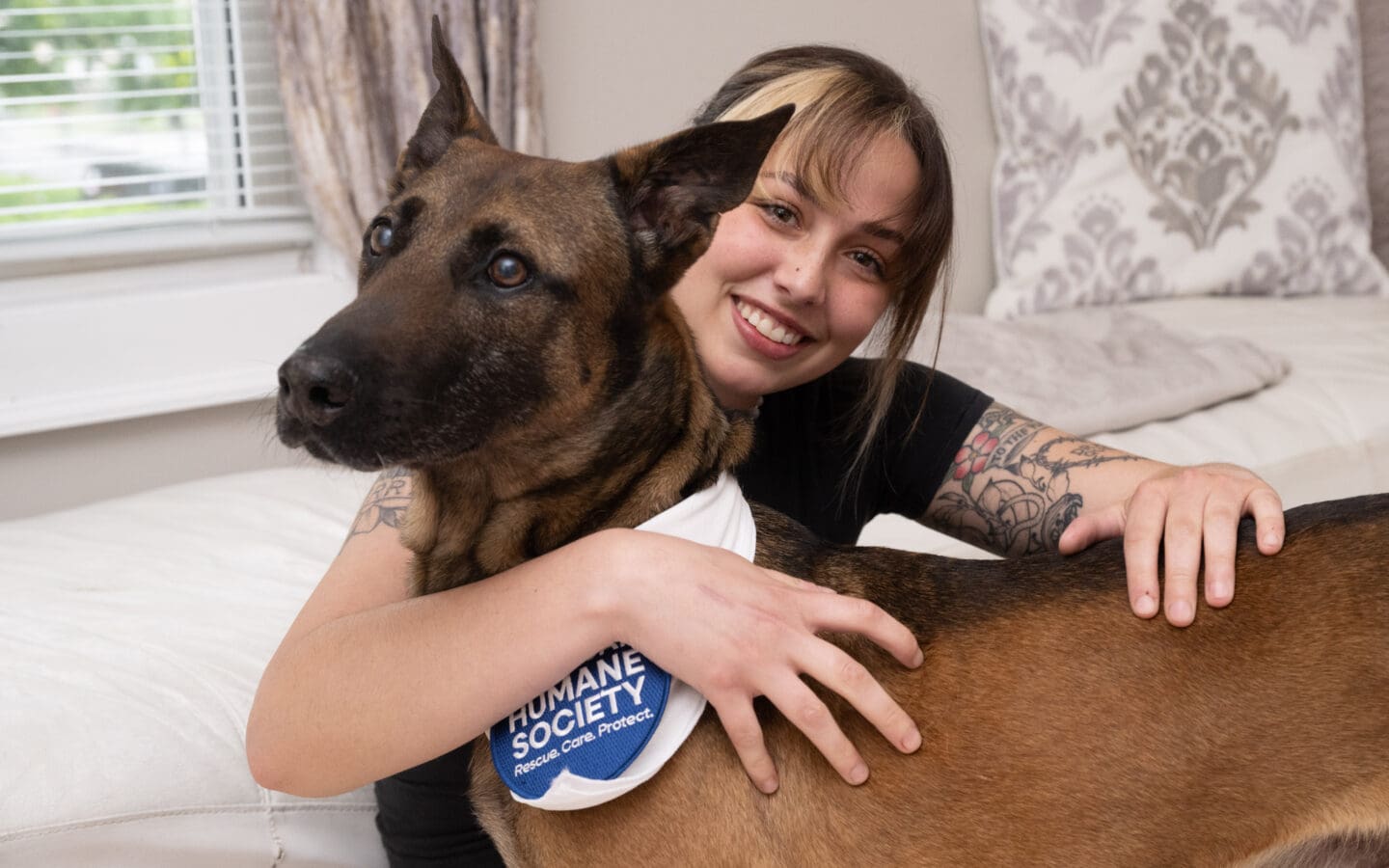
When Menson saw Angela again, his excitement was immediate. Surrounded by her family, the joyful reunion was filled with love, relief and a bond that never faded, even after years apart.
— American Humane Society
What the bond survives
There is a version of this story that gets told as a quick feel-good item: dog and handler reunited, the end. But the detail that matters is the seven-year gap. That is the actual story — evidence that what forms between a working dog and their handler is not simply the product of daily proximity or routine or reward. It is something that persists through reassignment and retirement and the long administrative passage of military life.
American Humane chose Memorial Day for the reunion deliberately. It is a day for honoring the service of those who gave significant years to something larger than themselves — and military working dogs do exactly that, without ceremony or pension or the ability to understand what they're being asked to give. Menson ran patrols in the Pacific dark. He flew to Fiji to keep people safe. He held his loyalty somewhere quiet and deep for the years that followed. And then, on a May afternoon in a driveway surrounded by people who wanted to see this moment happen, he came home.
The caudate nucleus doesn't distinguish between a military working dog and a family pet. Whatever your dog is building with you today — on this morning's walk, through this evening's routine — is being filed in the same reward system that carried Menson's recognition of Angela through seven years. They are keeping track of something you may not have noticed yet.