What Meikle does that no human carer can
Doges Editorial · 2026-05-15 · 5 min read
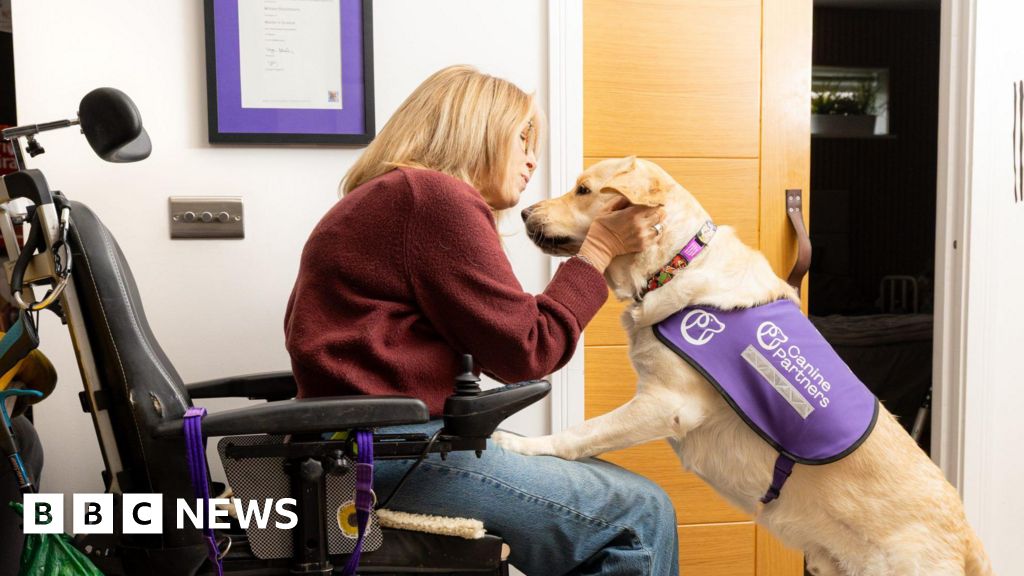
Shelley Fitzsimmons has Ehlers-Danlos Syndrome — her joints dislocate without warning. Her golden Labrador assistance dog Meikle doesn't just help around the house. He changed what an ordinary morning looks like.
Most mornings begin with assumptions. You assume your hips will be where you left them. You assume you can reach the drawer, work the washing machine, stand in the shower without wondering if this is the moment something slips out of place. Shelley Fitzsimmons, 52, from Leighton Buzzard in Bedfordshire, lost those assumptions a long time ago.
Fitzsimmons has Ehlers-Danlos Syndrome — a rare connective tissue disorder that causes her joints to dislocate without warning. It means pain that arrives on its own schedule, falls that can happen in a corridor or a bathroom, and a body that can't always be trusted to do the same thing twice. As the BBC reported this week, what changed her daily life wasn't a medication or a mobility aid. It was a dog.
What it looked like before
Before Fitzsimmons was matched with her first assistance dog, she describes a life made small by fear. She would not go out of the house. She would not answer the telephone. Everything was scary — not in the abstract, but in the practical way that every threshold and errand carries real physical risk when your body can betray you at any moment.
The first dog, a black Labrador named Kibble, came from the charity Canine Partners and stayed for a decade. What he did was harder to describe than fetching a towel. "He would figure out when my heart rate was going high and would make me sit down," Fitzsimmons said. That's not a trained behavior in the simplest sense — it's attunement, the result of years of close daily living with someone whose body gives off signals that a human might overlook and a well-trained dog learns to read.
Before I had Kibble I would not go out of the house, I would not answer the telephone and everything was scary. He brought me out of my shell.
— Shelley Fitzsimmons
Kibble also changed something social. "People don't see you in a wheelchair when you have a beautiful dog by your side," Fitzsimmons said. It's a line that deserves a pause. The dog becomes the thing people respond to first — an opening, a warmth, a reason to stop and talk. For someone who had been housebound, that shift matters enormously.
The morning Meikle arrived
Last year, after Kibble retired, Fitzsimmons was matched with Meikle — a three-year-old golden Labrador retriever, also trained by Canine Partners. She described his arrival with the kind of precision that sticks: "He bounced into our lives." And then: "It was like a light came back on."
Meikle is trained to do specific physical tasks that might sound mundane until you consider what they represent. He can get Fitzsimmons sitting up in bed. He accompanies her to the bathroom and passes her shower gel, shampoo, and towel. He helps get clothes out of the drawer. He loads the washing machine and the tumble dryer. Each of these is a moment in an ordinary morning that could otherwise mean a dislocated joint, a fall, a call for help — or simply not happening at all.
He can get me sitting up in bed; he can come in the bathroom with me and pass me my shower gel, shampoo and towel. He can help get my clothes out of the drawer and he can do the tumble dryer and washing machine.
— Shelley Fitzsimmons
This is what assistance looks like when it's calibrated exactly right. Not a dog doing tricks, not a dog as a companion in the background, but a dog woven into the day — its timing, its reach, its quiet understanding of what comes next.
Two years to build one dog
Jo Burns, from Canine Partners, explained the program that produced both Kibble and Meikle. Training a single assistance dog takes about two years. Labradors are favored for their eagerness to please and their responsiveness to food rewards, both of which make them more tractable than many other breeds. Their size is also deliberate — they need to be tall enough to reach buttons, drawers, and washing machine doors, and steady enough to provide balance support without toppling.
Burns described the effect of the program in terms that match what Fitzsimmons has lived: "The dogs transform lives, restore confidence and reduce isolation." And then she said something that captures what a trained assistance dog actually is: "They open doors, literally and figuratively, for people."
The dogs transform lives, restore confidence and reduce isolation. They open doors, literally and figuratively, for people.
— Jo Burns, Canine Partners
What a Meikle is
Fitzsimmons landed on the distinction that matters: "You can have a human carer, but you can't always have a Meikle." It isn't a critique of human care. It's an acknowledgment of something different that dogs offer — presence without condition, attentiveness without schedule, a specific relationship that can't be replicated by someone clocking in and out.
A human carer doesn't sleep at the foot of the bed to notice a change in breathing. A human carer doesn't read a shift in heart rate the way Kibble did. And a human carer, however skilled and kind, is not a dog who bounced into a room and made the light come back on.
What the ordinary morning holds
Most of us experience the morning walk as routine — leash on, door open, the familiar loop that the dog navigates from memory. The dog pulls toward the same corner, stops at the same patch of grass, comes alive the same way at 7 a.m. regardless of how you're feeling. That consistency is not a small thing.
For Fitzsimmons, Meikle isn't just company on the walk. He's the reason the walk is possible, and the reason so many other moments in the day are possible too. "Life has just been amazing," she said, more than a year in. That's not a quote about extraordinary circumstances. That's a quote about a morning routine — about being able to reach a towel, fill a washing machine, sit up in bed — made possible by a three-year-old golden Labrador who arrived bouncing and didn't stop.