The Border Collie Who Started It All: Megan Boxall's 5,240-Mile Answer to MS
Doges Editorial · 2026-05-20 · 5 min read
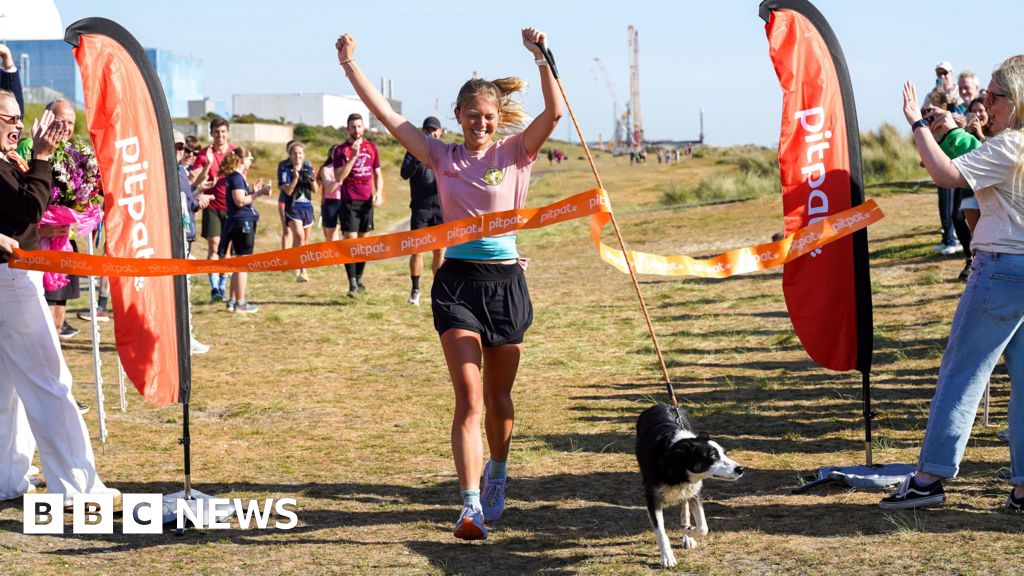
Megan Boxall ran the entire British coastline in 204 days after a multiple sclerosis diagnosis. The reason she started running in the first place was a Border Collie named Shadow.
The last few steps happened the way the whole journey did: moving forward. On the morning of May 10, 2026, Megan Boxall arrived at the point where Britain's coast finally ran out of coast, having covered 5,240 miles on foot. She was 33 years old, she had a diagnosis of multiple sclerosis, and somewhere in the earliest chapters of this story was a Border Collie named Shadow.
That specific detail — the dog — is not decorative. Shadow is the reason any of this happened.
The Dog Who Changed Her Direction
Before the marathons, before the MS diagnosis, before the fundraising pages and the cold winter headlands, there was Shadow. Boxall has said that her Border Collie was the reason she started running at all — one of those specific, small-seeming facts that turns out to be the load-bearing wall of an entire life.
She didn't take it up to compete. She took it up because a dog needed walks, and walks became runs, and runs became something she couldn't put down. Anyone who has followed a dog's nose down a trail they hadn't planned to take understands exactly how that escalation happens.
Border Collies in particular have a way of making you feel that slowing down is a moral failure. They are animals built for sustained, purposeful movement — herding dogs whose satisfaction depends on covering ground with intention. Run with one long enough and the distinction between the dog's need and your own starts to blur.
A Diagnosis, Then a Decision
In 2024, Boxall learned she had multiple sclerosis. MS is unpredictable in almost every direction — some people live decades with minimal symptoms, others move toward significant disability much faster. The uncertainty itself is its own kind of weight, a number that could mean almost anything perched somewhere in your future.
What she did next was, by most measures, extraordinary: she kept running. The specific decision she made was to attempt the fastest-ever solo unsupported circumnavigation of Britain's coastline on foot — a record previously held with a time 97 days longer than what she would ultimately achieve.
The route follows the entirety of Britain's coastline: the chalky southern cliffs, the Welsh headlands, Scotland's ragged northwest shoulder, the flat East Anglian estuaries, the North Sea in winter. In total: 5,240 miles, the equivalent of 200 marathons, back to back, day after day, for 204 consecutive days.
204 Days on Britain's Edge
She set off on October 18, 2025. A marathon is 26.2 miles. Running one requires a specific kind of resolve. Running two hundred of them — on terrain that shifts between soft sand, sharp shingle, steep coastal path, and cliff-edge track — requires something that doesn't have a clean name.
The weather in the winter was really hard, and there were some quite big chunks that were incredibly windy, cold and lonely, but that's all forgotten now.
— Megan Boxall, speaking at the finish
The North Sea in January doesn't forgive much. Neither does the wind that comes off the Atlantic and hits the exposed headlands of Cornwall or Pembrokeshire without warning. Boxall ran through all of it — the darkness of the short winter days, the mud, the sections of path that erode back toward the cliff edge a little more each year.
What coastal running asks of you that road running doesn't is an ongoing reckoning with the environment. The surface underfoot changes constantly. The weather arrives without precedent. There are no mile markers and very few people. It is running stripped back to its most elemental version, which is simply: you, moving forward, through whatever is there.
Eight Million Steps
The numbers, when you look at them plainly, are difficult to absorb. Approximately eight million steps. Roughly 1,000 hours of running. A fundraising total of £57,000 raised for the Samaritans, a mental health charity that offers crisis support across the UK and Ireland.
The Samaritans connection is not incidental. Boxall has spoken openly about the low moments on the route — the days when the question of why she was doing this at all pressed in close. Coming back to the purpose, the concrete human good the fundraising would do, was what kept her moving.
There have been a lot of low moments where I've questioned why I'm doing this. But coming back to my 'why' — that's what got me through.
— Megan Boxall, on her fundraising page for Samaritans
The Samaritans' work is specifically tied to what happens when people can't find their own 'why' on the worst days. There is a particular coherence to choosing them as the cause — running through your own low moments to raise money for an organisation that answers the phone when someone else has reached theirs.
What Shadow Started
There is a particular quality to the bond between a person and the dog that first gets them outside. Shadow didn't run 5,240 miles. Shadow started something, which is different — and in some ways more important.
The specific way dogs do this — by needing to move, by pulling you toward the door before you've decided whether you want to go, by making the question of exercise feel less like discipline and more like companionship — has changed more lives than any motivational program ever has.
Boxall's love of running began with a Border Collie who needed to run. That love outlasted the easy terrain, the good weather, the healthy body she had when she started. It became something that held when other things didn't — something she could return to even after receiving news that would have stopped many people cold.
After the Coastline Ends
It's been the most incredible morning. I cannot really believe I've done it — I've become the fastest woman to run the coastline of Britain.
— Megan Boxall, at the finish on May 10, 2026
The MS diagnosis is still there. The record is official. The £57,000 went to Samaritans. She beat the previous record by 97 days — almost a third of the total journey — which suggests that the conditions she ran through, the diagnosis she carried, the winter she crossed in full, were not limitations that slowed her down.
And somewhere, presumably, a Border Collie named Shadow is waiting for the next walk. That is still where this all began — a dog with somewhere to be, and someone willing to follow.