Lola graduated after fifteen years in the same school
Doges Editorial · 2026-06-23 · 6 min read
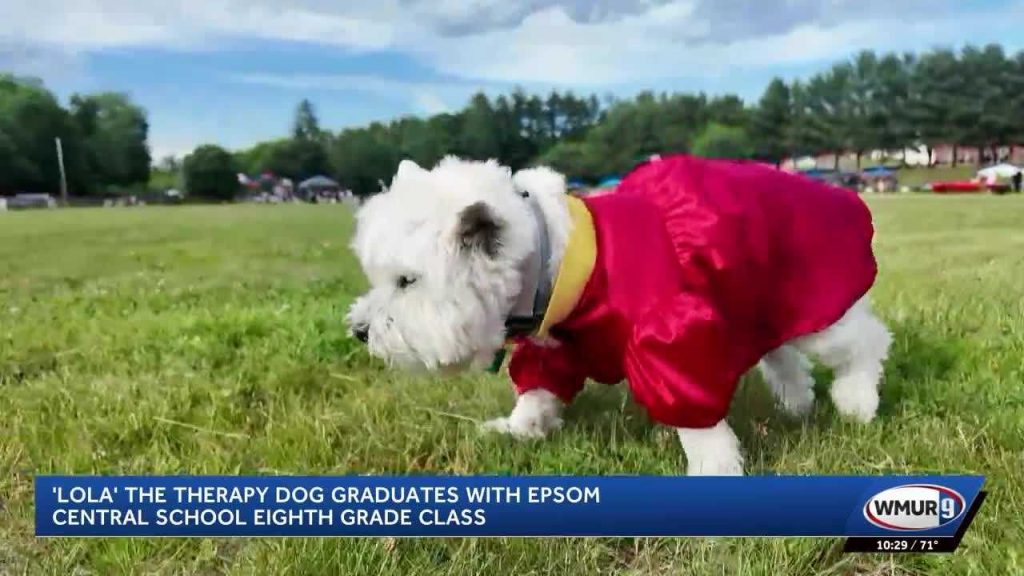
Lola has been the occupational therapist's partner at Epsom Central School in New Hampshire for fifteen years. When the 8th graders were planning graduation, they asked her to come.
The hallway at Epsom Central School has a particular geography to it, shaped over fifteen years by one dog who learned which classrooms had the warmest floors and which staff members would reliably stop for a pat. Lola has the run of the building a few days a week. She's not a student. She's not exactly staff. She's something schools rarely get to have: a presence that belongs entirely to the emotional weather of a place.
Fifteen years is a long time to know a school
Lola has been the partner and assistant to the occupational therapist at Epsom Central School in New Hampshire for fifteen years. Over that stretch, she has met thousands of students — kindergarteners who are now adults, middle schoolers who are now in their late twenties. She's sat with kids who couldn't sit still, been quiet for kids who needed quiet, and taken whatever affection the hallways offered. By now, she's institutional in the way that only time can make something institutional. She is simply part of what school is.
This year's 8th grade class is heading to high school. Their last weeks at Epsom Central involved the usual graduation planning: a ceremony, some speeches, arrangements for how to mark the end of something. At some point, the conversation turned to Lola. The students wanted her there.
Kids come in and see her, she wanders the halls, she takes snuggles, and pats and kisses from anybody, including staff.
— Lisa Freeman, Epsom Central School
The dog who showed up through a pandemic
Lola's years at Epsom Central have spanned a lot of school history, but the COVID years sit differently in the collective memory. When classrooms went remote in 2020 and students disappeared from the building, the school made videos to stay connected with families. Lola appeared in some of them — a familiar constant in the suddenly depopulated hallways. For students logging into class from their bedrooms, seeing a recognizable dog's face carry on normally in an otherwise altered school was a small but real form of continuity. She didn't know about the pandemic. She just kept being Lola.
This is what therapy dogs do in schools, when they're working well. They're not a program. They're not a lesson plan. They're a mammal in the building who is always happy to see you and doesn't remember that you had a bad day yesterday. Lola has been that for Epsom Central for fifteen years — a creature without institutional memory of the bad days, even as she accumulates fifteen years of institutional presence.
What the occupational therapist's room needs
Occupational therapy in a school setting addresses a different kind of work than academic learning — the sensory, motor, and self-regulation skills that children need to function in a classroom. It's hands-on, often tactile, and frequently involves children who are dysregulated, anxious, or struggling with the physical experience of school. Dogs are used in some therapy settings because they provide consistent sensory input, require gentle touch, and respond reliably to calm behavior. Lola, in fifteen years, has presumably learned more about co-regulation than most continuing-education credits cover.
The research on why this works has grown precise enough to cite. A 2022 randomized controlled trial published in PLOS One measured salivary cortisol in school-aged children before and after dog-assisted sessions. For children with special educational needs — the population at the core of an occupational therapist's caseload — cortisol fell after each session at an effect size of 1.39, which researchers classify as very large. Children in the no-treatment group, measured across the same weeks, showed cortisol trending in the other direction. A 2025 study published in JAMA Network found that ten minutes with a therapy dog in a children's emergency department nearly halved the proportion of anxious patients: 46% of children in the dog group saw their anxiety scores fall, against 23% in standard care. Lola is not a supplement to the occupational therapist's work. She is part of the mechanism.
She reads differently from a textbook or a fidget tool. She's warm. She breathes. She'll put her head in your lap and stay there. For some children, the experience of being responsible for a dog's comfort — staying calm so she doesn't get startled, petting slowly, being gentle — is one of the most direct routes to self-regulation available.
Graduation day
The ceremony was June 20, 2026. Lola attended. She has no understanding of graduation as a concept, of course. But she knows crowds and she knows familiar faces. The 8th graders who filed into that gymnasium had known her since they started at the school — since kindergarten or first grade or whenever they first encountered the dog in the hallway who'd let anyone pet her. That continuity is what the students were honoring. Not a program. Just Lola.
They absolutely love her and really appreciate her being a part of our district.
— Lisa Freeman, Epsom Central School
Epsom is a small town — fewer than five thousand people, one main school building that covers kindergarten through eighth grade. The kind of place where the same faces show up for years, where the custodian and the principal have eaten lunch in the same room for a decade, where a dog can spend fifteen years in a hallway and become genuinely known, not just tolerated. Lola didn't end up at a big suburban district with a rotating cast of several hundred new students a year. She ended up somewhere small enough to remember her.
School ceremonies are full of endings. Teachers say goodbye to students they've watched grow up. Students leave friends behind. The building itself recedes into memory and becomes the place-I-used-to-go. Dogs, unsentimental by design, make good witnesses to this kind of moment. They don't make it heavier with feeling. They're just there — warm and unhurried — while the humans sort out what they're feeling.
The length of a dog's working life
Fifteen years is a long career for a therapy dog. It means that the students who were there when Lola started are grown now. It means she's seen staff come and go, watched the building through however many budget cycles and policy changes and school-calendar restructurings have happened in a small New Hampshire school district since the early 2010s. She has stayed. The occupational therapist has stayed. Generations of students have moved through.
There's something specific about the long-term school therapy dog that short-term deployments can't replicate. A dog who's been in a building for fifteen years isn't a visitor with benefits. She's part of the institution's immune system — the thing that holds steady when other things shift. The kids who asked for her at graduation weren't honoring a service. They were honoring a presence.
What Lola gets out of it
This is the question that gets lost in coverage of therapy dogs — the animal's own experience. Lola has presumably been assessed regularly for signs of stress and overstimulation; responsible therapy dog programs do that. If she wanders the halls by choice, seeks out interaction on her own terms, and has done this for fifteen years without apparent burnout, the most reasonable inference is that she is doing something she's built for. Not all dogs are. The ones who are, given a job they fit and humans who tend to them carefully, can keep going for a very long time.
Lola walked into the graduation gymnasium the same way she walks into any room at Epsom Central — not knowing what it means, not needing to. The kids knew. That was enough.