The dog who wasn't supposed to walk is running now
Doges Editorial · 2026-05-12 · 5 min read
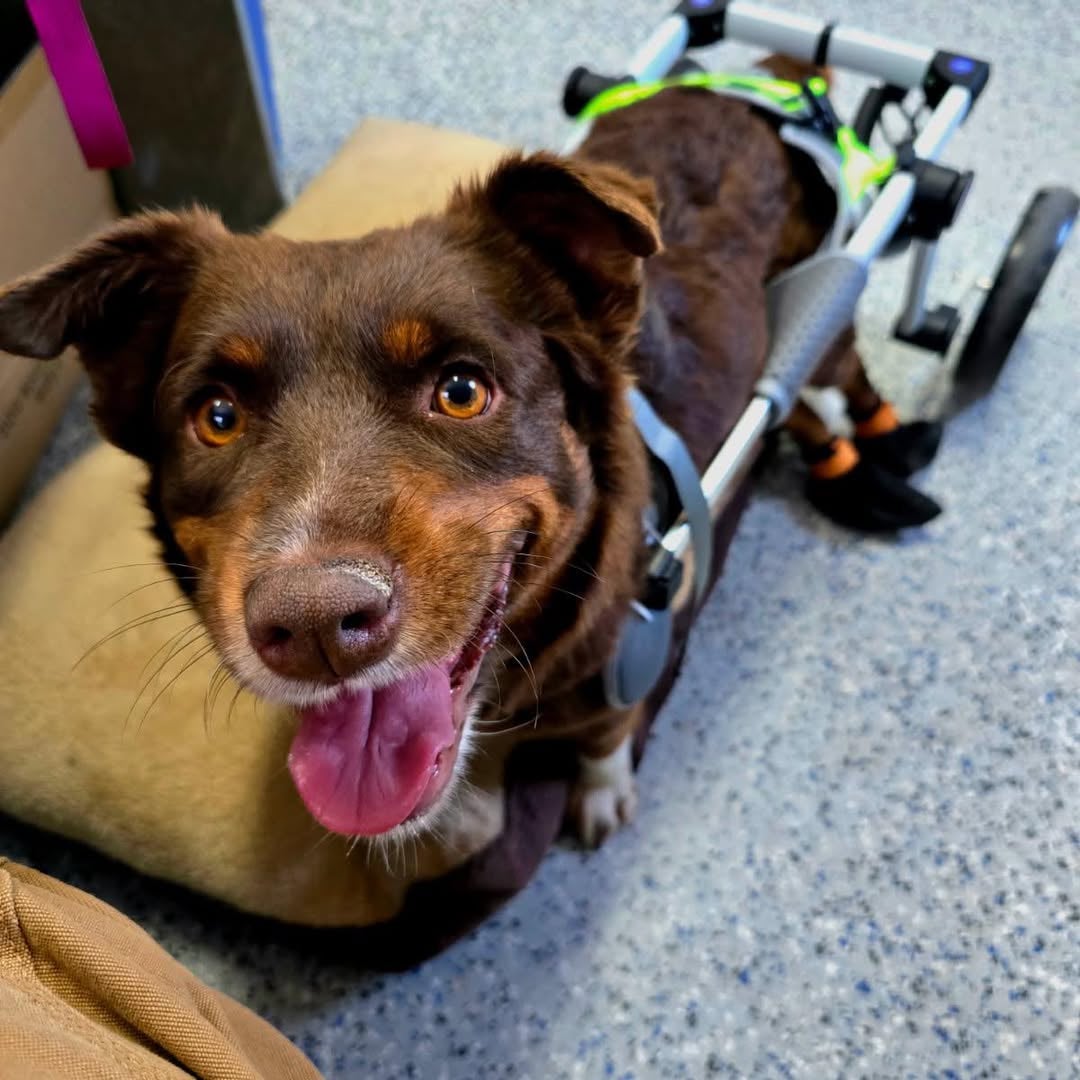
Lil Debbie arrived at an Arizona shelter unable to use her back legs, dragging herself across the floor on her front legs alone. Six months of wheelchairs and foster care later, she runs.
The brown dog arrived at Holbrook Animal Care & Control in rural Arizona dragging herself by her front legs. Her back legs trailed behind her on the concrete floor — not limp exactly, more like trailing, as if she'd simply decided they weren't going to be useful today. Nobody at the shelter knew how long she'd been injured. Nobody knew who had owned her before she ended up there, on a spring morning, doing this.
What they did know: she was two years old. She was a little brown mixed breed. And despite everything — the injury, the uncertainty, the unfamiliar smell of a kennel — she seemed almost unbothered by her situation. Curious, alert, and full of an enthusiasm for life that the staff at Holbrook found difficult to look at without feeling something. Best Friends Animal Society documented her recovery story on May 5, 2026, in partnership with Holbrook Animal Care & Control, a Best Friends Network Partner.
Twenty-nine pounds of pure joy
A veterinarian examined Lil Debbie and gave a careful answer. Her injury appeared to be old. The exact cause wasn't clear. And when it came to prognosis — permanent or not? — the honest answer was: we don't know. She had some sensation in her back legs. That was meaningful. But it wasn't a promise.
The shelter staff took photos and posted them. They noted something that would matter a great deal to anyone considering fostering her: Lil Debbie could go to the bathroom on her own. Many dogs with spinal injuries cannot, and the practical care demands that creates are significant. That one detail kept a door open.
29 pounds of pure joy.
— Holbrook Animal Care & Control staff, in intake notes for Lil Debbie
Holbrook Animal Care & Control is part of the Best Friends Animal Society's national network — a collaboration of more than 3,900 rescue groups, shelters, and sanctuaries working toward no-kill communities across the United States. When a dog's needs exceed what a small rural shelter can provide, the network is how the word gets out.
The rescue that said yes
Cooper's Chance Animal Rescue, based a few hours' drive from Holbrook, answered the call. They took Lil Debbie into their care and found her a wheelchair — a custom two-wheeled support rig with a fabric harness that holds a dog's hindquarters off the ground, letting the front legs do the work of locomotion while the rear wheels follow. Lil Debbie took to it with characteristic speed.
A foster home and the slow work of rehabilitation
The wheelchair helped. But the real work happened in a foster home, where a family took her in and began the daily, patient process of rehabilitation. This is not dramatic work. It doesn't usually make a satisfying video montage. It's range-of-motion exercises, supported standing, and daily sessions of asking a body to try something it couldn't do yesterday.
Foster families who take in dogs with spinal injuries are doing something that requires a particular kind of patience. The rewards are real but they are not fast. You're watching a dog not give up, day after day — which is a different kind of thing to witness than a straight-line recovery.
Lil Debbie, apparently, was excellent at not giving up. She continued to move through her foster home the way she'd moved through the kennel: with her front legs pulling and her eyes scanning for the next interesting thing. The shelter had gotten it right in those intake notes.
The first step
At some point during her rehabilitation — impossible to pin to a specific day — Lil Debbie pushed a back leg forward and it held her weight. One step. Not graceful, not fast. Just a small, effortful movement where a hind leg that had been trailing behind her for months actually contributed something.
Then another step. And another. The progression was uneven — better days and worse, sessions where she seemed close to something and sessions where she'd flop sideways as if to say: not today. But the steps kept coming. They became more frequent. The wobble started to iron out.

She runs now
As of May 2026, Lil Debbie walks on her own. She also runs. The dog who arrived at a shelter in rural Arizona dragging herself on her front legs — described in staff notes as pure joy despite everything — now moves the way dogs are supposed to move: quickly, completely, with all four legs doing their part.
The recovery was documented in updates and a YouTube video from Cooper's Chance Animal Rescue. It is, as these things go, hard to watch without feeling something disproportionate to the situation — a dog trotting, then breaking into a run, tail up, ears forward, completely absorbed in the fact of being able to do this.
Lil Debbie is living proof of what love, patience, and a second chance can do.
— Kelli Harmon, Best Friends Animal Society
What she kept through all of it
What's most striking about Lil Debbie's story isn't just the recovery — remarkable as it is. It's that through every stage, from the shelter floor to the wheelchair to those first wobbling steps, she seems to have kept the same fundamental personality. The staff said she was pure joy at intake, before anyone had done anything for her. That wasn't a response to improving circumstances. It was just who she was.
Dogs tend to have this quality — an absorption in the present that makes them, in any given moment, simply themselves. They're not waiting for better conditions to start being okay. They're okay right now, in whatever kennel or foster home or living room they currently occupy.
On an ordinary walk this week — the same block, the same park, the familiar corner where someone's dog has marked for years — your dog is probably doing the same thing: paying complete attention to exactly where they are. They're not thinking about the walks they missed. They're on this one. That's the habit. You can borrow it, for a few blocks, if you need to.