Libby has been running wild for three Iowa winters
Doges Editorial · 2026-06-21 · 6 min read
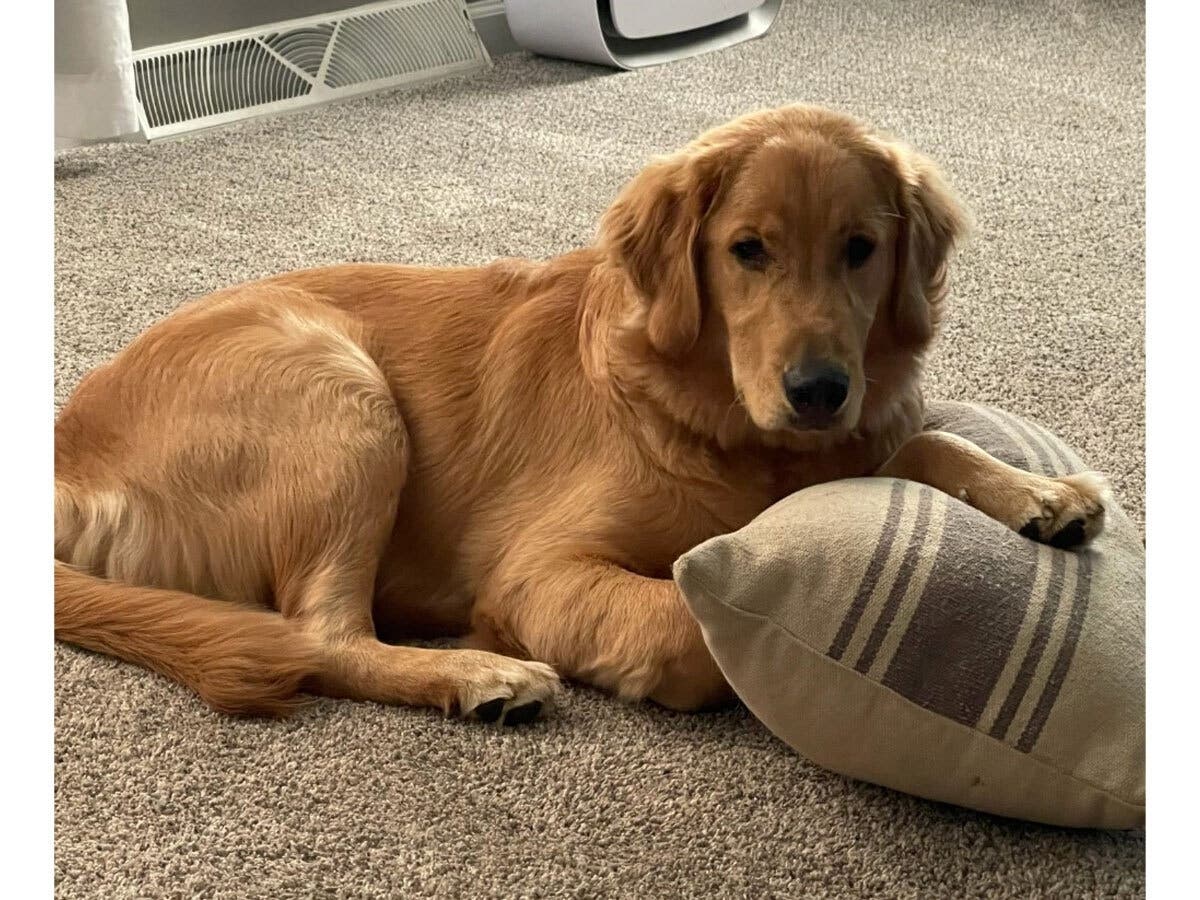
Three years ago, a golden retriever named Libby bolted from a family road trip in Iowa, startled by an air compressor. She's been living wild ever since — surviving blizzards, befriending skunks, and drawing hundreds of thousands of followers who keep watching the trail cameras.
The first winter alone, nobody knew how she was surviving. Then the trail cameras started picking her up — a golden retriever moving through Iowa cornfields at night, moving through snow that by February came up past her belly. She'd found a rhythm. She was alive.
Libby has been out there since May 26, 2023. That was the day she bolted from a family road trip near Tama, Iowa, startled by the noise of an air compressor. She'd never lived outdoors. She was barely a year old. And once her body went into survival mode, the instinct driving her wasn't to find home — it was to get away from danger and keep moving.
Three winters have passed since then. She's four years old now.
The dog Chris Vest got at eight weeks old
Chris Vest describes the Libby she knew as 'a big fluffball with a sweet disposition.' She got her at eight weeks, watched her grow up, took her on the family road trip that ended with that sound from the air compressor and Libby vanishing into unfamiliar terrain twenty-five miles from home.
Vest searched for days. Libby actually appeared once — on June 15, two weeks after she disappeared — not far from where she'd bolted. Vest set up a trail camera and a kennel trap. Libby never came back to that spot. She'd already figured out that the places where humans looked for her weren't safe.
That intelligence, which would be a remarkable quality in a house pet, has kept Libby free and kept her out of reach for three years.
The network that formed around her absence
Word spread the way it does now — through Facebook lost-pet pages, through shared posts, through someone saying 'I bet that's Libby' on a thread about a different missing golden retriever twelve miles away. Paws of Hope Animal Rescue, a small Iowa nonprofit, joined the search and built a coordination network around it. Hundreds of thousands of people followed the updates. Volunteers started leaving food, setting cameras, trading sightings.
In 2025 alone, Paws of Hope tracked and returned 420 lost pets to their families — mostly dogs, most of them home within two weeks. Libby is the outlier. She's also the reason the organization's Facebook page has the reach it does.
Niki Kerr, a vet tech in Des Moines, coordinates the search for Paws of Hope. She drives eighty miles round-trip to leave food for Libby three or four days a week, often after full shifts at her clinic. She stays up on Libby's flea and tick prevention and her deworming schedule, administering both through her food. 'There are a couple of raccoons that are probably flea-free,' Kerr said.
The farmer who left a field fallow
Libby has stayed in the same general area since last fall — something that works in the searchers' favor, but only because of an act of generosity that sounds almost implausible when you hear it. A local farmer, when he learned that the search effort needed access to his land, said they could do whatever they needed to do. When planting season arrived and they worried about losing access, he said he'd plant around it. He left a square mile fallow to give the search team room to work.
If not for that farmer, we wouldn't be successful at keeping her contained where she is. He said we can do whatever we need to do. He still says that.
— Chris Vest, Libby's owner, speaking to Patch, June 2026
In that square mile, the team has set the Missy Trap — a large containment trap named after another spooked dog, built for animals too wary to enter a conventional box. Sensors are calibrated for a dog Libby's size. Cameras watch every angle. Libby has come close enough to trip the sensors and backed away. On a recent video, she grabbed a toy scented with Vest's smell, played with it in the entrance, and retreated.
What survival mode does to a dog
People watching Libby's story sometimes comment that she must be living her best life — that she's thriving out there, that the search should be called off. Kerr's response to that is measured and specific. A dog in survival mode isn't a dog living freely. She's a dog running on adrenaline and instinct, in a posture that can't be comfortable to hold for three years.
You can't lose hope. Losing hope is the worst thing you can do in this scenario. Sometimes, it's really hard. There are days I bawl my eyeballs out because I don't know what else to do.
— Niki Kerr, Paws of Hope Animal Rescue coordinator, speaking to Patch, June 2026
The mechanism behind survival mode is physiological. Severe stress depletes serotonin, and researchers studying lost-dog behavior have found that the resulting disruption to short-term memory allows a domesticated dog to stop recognizing even familiar people as safe. Each time a well-meaning stranger approaches Libby and she bolts, that fear re-encodes — and the location gets added to her internal map of places to avoid. It's the reason the spot where the first trail camera caught her in 2023 is now somewhere she won't return to, and why lost-dog recovery specialists warn that calling a dog's name or moving toward it in survival mode drives it farther away rather than closer.
The things Libby has endured — three Iowa winters, thunderstorms severe enough to flatten crops, heat that settles into the cornfields in August — these aren't comfortable. She has survived them, which says something about her constitution. But surviving isn't the same as being home.
What the trail cameras show
Libby has a documented social life in the fields. The cameras have caught her with skunks, with opossums, with coyotes. On Christmas Eve, according to Kerr, Libby followed a skunk across the frame as if inviting it to dinner. These images have given the story its fairy-tale quality — the golden retriever who went feral, who made friends with the night creatures.
But those same smaller animals are part of the trap strategy. Skunks and opossums can enter the Missy Trap and exit without triggering the sensors. Libby sees that they can go in safely, which should lower her guard. So far, it hasn't quite worked. She's 'too smart for her own britches,' as Vest puts it — a phrase that contains both exasperation and pride.
The thing Chris Vest said about survival mode
Vest has thought a great deal about what it means to be separated from a dog who is demonstrably alive and nearby — within camera range, within smell of the food she brings — but unreachable. She's driven through snowstorms to leave food that Libby might not find for days. She trudged through February knee-deep snow on a night she thought she might not make it back to her truck.
She keeps going. So do Kerr, and the farmer who left the field fallow, and the network of strangers who report sightings from their trucks as they drive past.
In survival mode, everyone's a stranger. Even her owner.
— Chris Vest, speaking to Patch, June 2026
That sentence lands differently the more you sit with it. Libby knows, on some level, that the humans who approach her represent danger. She can't separate the ones who mean well from the ones that might not. She doesn't know that the woman driving eighty miles round-trip is the person who got her at eight weeks and watched her grow up. She just knows to run.
What the people who show up believe
Vest has everything ready for when Libby comes home. Her garage has been set up as a decompression space — quiet, separated from the other house pets, a place for a dog whose nervous system has been running hot for three years to start unwinding. The team is confident Libby will settle. 'People don't understand survival mode,' Kerr said. 'They think she'll be feral, but dogs snap out of it fairly quickly if they were domesticated in the first place.'
The science supports that confidence. Dogs store long-term memories of their owners primarily through scent — an olfactory imprint that researchers have found remains retrievable after years of separation, even in dogs that have been in survival mode. When Libby is finally enclosed somewhere quiet and Vest is present, recognition may come sooner than the three-year timeline would make anyone dare to expect.
That confidence is part of what keeps the search going. Not certainty — nobody promises certainty in a situation like this — but a reasoned belief that the dog Vest remembers is still in there, running on adrenaline through Iowa cornfields, waiting for the moment when the trap doesn't feel like danger.
There's something in this story that resonates for anyone who walks a dog regularly — not because most dogs go missing, but because of the particular attentiveness that comes with it. You notice when the pace slows. You notice which corners they investigate and which they pass. You know, in a physical and specific way, whether this is a good day or a harder one. That dailiness is what Vest has been driving eighty miles to preserve a version of — the hope that the daily walk is still coming, even if not yet.
'As long as she's out there,' Vest said, 'I'm going to keep going.'