Eleven days in the New Jersey woods
Doges Editorial · 2026-06-02 · 5 min read
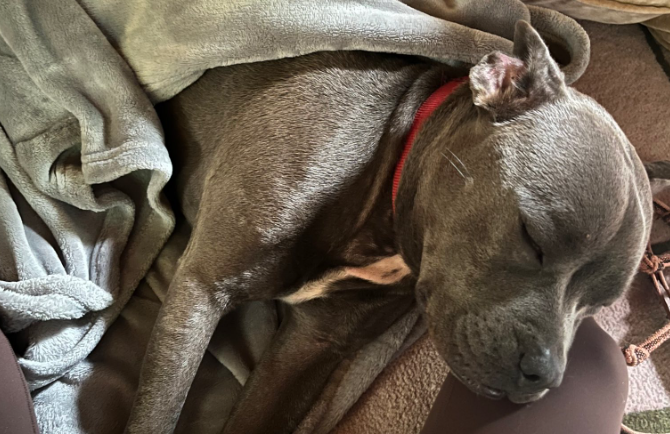
After a car crash on Route 23 sent Leo bolting into the New Jersey woods, an 11-day search involving trail cameras, thermal drones, and one famously camera-shy local bear ended with an owner sprinting down a trail.
For seven nights, the trail cameras above Route 23 kept catching the same bear. A large black bear, same animal, shambling through the dark past the feeding stations that had been placed there for a different reason entirely. Local residents recognized him — Sussex County had a bear so reliably photographed that people had started calling him Tank. But no Leo. Never Leo. According to WRNJ Radio and Buddha Dog Rescue & Recovery, who documented Leo's eleven-day ordeal in New Jersey's Wantage Township, the bear became a kind of dark joke in the search: the cameras were working perfectly, they just kept proving the wrong animal was using the trail.
It had started on a Tuesday afternoon in May, when a truck ran a stop sign and slammed into the car Leo was riding in on Route 23. Leo — a dog of uncertain size and very certain fear — did what frightened animals do. He bolted. Over the guardrail, into the tree line, gone.
A crash, a bolt, and a dog gone
Buddha Dog Rescue & Recovery, a New Jersey nonprofit that specializes in the particular challenge of finding dogs that have gone feral with terror, teamed with Wantage Township Animal Control from the first day. Leo wasn't injured in the collision — fear had done what injury sometimes can't. Within hours, the search mechanics were already in motion: posters printed, social media posts circulating, feeding stations placed along the road edge and into the first stretch of trail.
Over the following days, the search expanded to include thermal drone flights over the canopy, more feeding stations deeper in the woods, and a network of trail cameras set to catch whatever moved after dark. Dozens of volunteers organized grid searches. Local businesses helped fund the effort. Neighbors shared posts and drove past the crash site on their way to work, slowing to look. The apparatus of a modern missing-dog search is bigger and more logistically intricate than most people realize until they need one.
The science of a fear-frozen dog
A dog that has been badly frightened doesn't behave like a lost dog hoping to be found. Familiar voices can become threats. The smell of an owner — normally the most comforting signal a dog knows — registers as alarm. Frightened dogs travel farther than expected, avoid humans, and shut down the social behaviors that make them locatable. Rescue workers know this. The feeding stations weren't primarily about calories. They were about re-establishing a pattern: a specific smell at a specific place, night after night, asking the dog to return to something predictable.
The problem was Tank. And Tank's friends. And the half-dozen other bears apparently circling the same patch of Sussex County woods.
Night after night, the cameras captured bear after bear wandering through the darkness including none other than local celebrity bear known as 'Tank' but still no Leo.
— Buddha Dog Rescue & Recovery
A bus stop in the rain
On the seventh day, a passing motorist spotted Leo — not in the woods, but at a covered bus stop about a quarter mile from the crash site. He had emerged from the tree line during a rainstorm and was taking shelter under the overhang, the way any sensible creature would. When someone approached, Leo panicked and ran back across Route 23 and into the trees. He hadn't lost his survival instincts. He just hadn't found his way back to the world yet.
That sighting was both encouraging and heartbreaking — he was alive, oriented, within a mile of where he started, and completely unreachable. He had established a territory somewhere between the road and the trail system. He knew where the bus stop was. He knew where the road was. What he didn't know was how to stop running.
Focusing the search
Rescuers refocused. New cameras and feeding stations went into the nearby trail system, saturating the area Leo was most likely using. The strategy was patience: reduce the range of uncertainty, increase the probability of a sighting, wait. This is the part of a long search that doesn't make the news — the days when nothing happens except people keeping the infrastructure running. The volunteers checking cameras before dawn. Brianna checking the feeds. The neighbors who shared the posts again even when there was nothing new to report.
Five more days passed. Five more nights of bears and darkness. The search support network — hundreds of people who had never met Leo and likely never would — kept the posts circulating. A community becomes a kind of extended pack in these situations, functioning as a distributed nervous system across a stretch of rural New Jersey, alert to the one signal that matters.
The moment on the trail
On the eleventh day, Leo appeared on the camera. Not Tank. Leo. Moving through the trail system — thinner than before, slower — but alive and oriented toward the feeding station. When Brianna saw the footage, she didn't deliberate.
The moment Brianna saw him, she raced down the trail. She heard rustling in the brush… then suddenly, Leo stepped out into the middle of the path. Calmly, softly, Brianna called to him. And after 11 days of fear, survival, exhaustion, and uncertainty… Leo ran straight into her arms.
— Buddha Dog Rescue & Recovery
Wantage Township Animal Control confirmed the reunion. Eleven days of bear encounters, cold nights, a rainstorm sheltered in a bus stop, and at least two panicked sprints across a four-lane road — and Leo had come through all of it. He was home.
What a community search looks like
This happy ending is a reminder that persistence, teamwork, and never giving up can make all the difference.
— Wantage Township Animal Control
The list of what made this reunion possible is long: a nonprofit that knew how to think like a frightened dog, volunteers who walked trails at dawn, a motorist who slowed down in the rain and looked twice, a network of neighbors who kept sharing even when the news was just another photo of Tank. Modern missing-dog searches are collaborative in a way that would have been impossible twenty years ago — the trail cameras, the thermal drones, the instant reach of social media. But the infrastructure only works if people choose to use it.
The first walk home
There is a specific quality to the first real walk after a dog comes home — not the frantic nose-to-ground survey of the yard, but the first calm loop of the block, the one where the world begins to reassemble into something familiar. For Leo, that first walk was eleven days in the making. The route he'd walked a hundred times before Wantage Township looked different after eleven nights in the woods, the bus shelter, the dark. Routes tend to look different after something like that. For both of them.