Ten days in the Santa Fe scrub, then she came running
Doges Editorial · 2026-06-13 · 5 min read

Lala, a 9-year-old Chihuahua rescued from a puppy mill and made famous online, survived 10 days lost in the New Mexico desert after a dog-park attack — held in place by instinct and found by a neighbor with a phone.
At about two feet away from Tangerine Bolen, Lala stopped. She had been moving like a wild animal since May 23 — watchful, low to the ground, half-turned toward any possible exit — and she'd been doing it for ten days in the scrubland near Frank S. Ortiz Dog Park in Santa Fe, New Mexico. Then something shifted. Keri Pink, the rescue director who had been coordinating the search from a few yards back, was watching when it happened.
As Lala got maybe 2 or 3 feet away from Tangerine, I literally saw the switch. She turned from wild dog — taking all the precautions, being really hesitant — to 'Oh my god, this is my mom.' Like, she ran into Tangerine's arms, licked her face, tail wagging. It was like this joyous reunion.
— Keri Pink, Tickled Pink Weimaraner Rescue
Where she came from
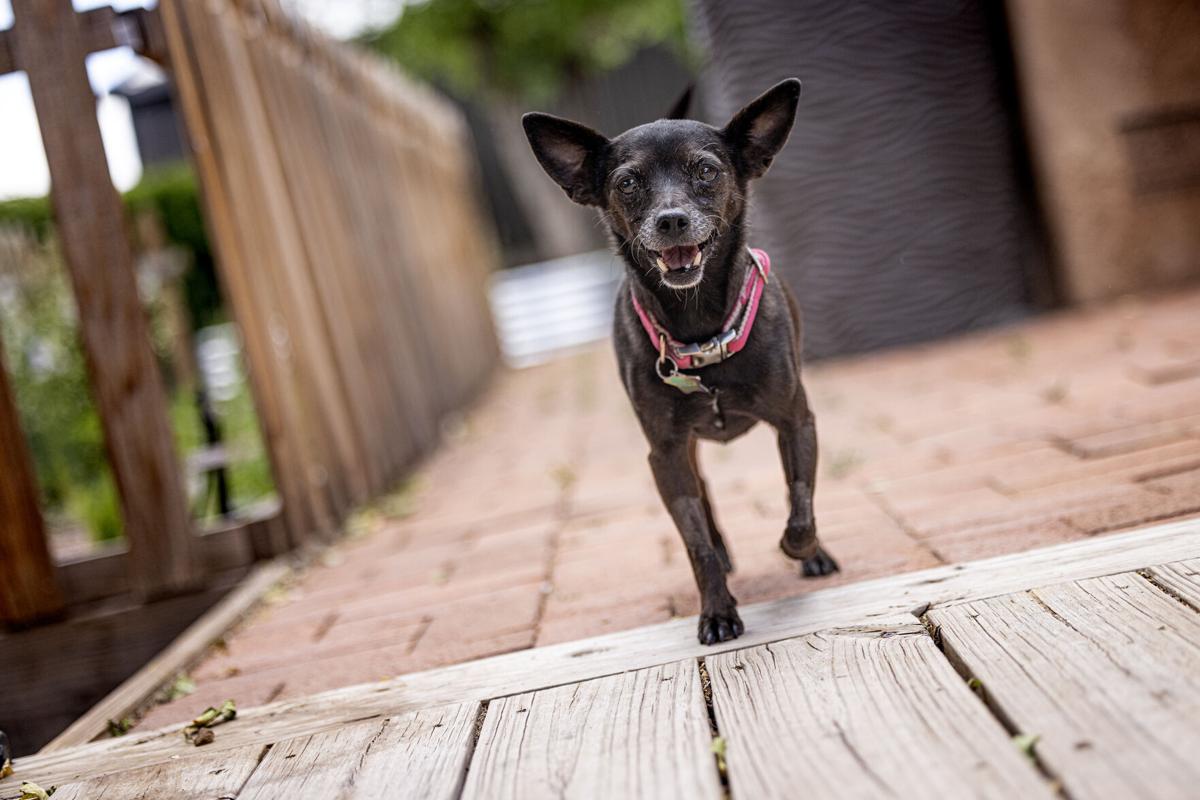
Lala — whose full name is Dhalia — is nine years old, approximately nine pounds, and a survivor by habit. She was one of roughly 98 Chihuahuas removed from a single property in Socorro, New Mexico, where they had been found living in poor conditions. Tangerine Bolen, a Santa Fe resident known locally for leading searches for missing elderly people, began fostering Lala in 2024. Over time, the dog became a fixture of Bolen's social media presence — compact, watchful, with the particular solemnity of a small dog who has learned to assess situations carefully.
Bolen eventually adopted her. By the spring of 2026, Lala had accumulated followers in England, Australia, France, and across the United States — people who had found her through Bolen's posts and stayed because something about a nine-pound dog rescued from a crowded floor had a particular pull. When Lala disappeared, those people mobilized.
The afternoon of May 23
Bolen brought four dogs — a Maltipoo, a husky, and two Chihuahua mixes including Lala — to Frank S. Ortiz Dog Park that Friday. Two pit bulls attacked the group. In the chaos, Lala ran. By the time the immediate situation was under control, the small dog had vanished into the terrain beyond the park.
What Lala was doing over the days that followed has a specific name in animal rescue: survival mode. After roughly twenty-four hours alone, most dogs experience an adrenaline and cortisol surge that overrides domesticated responses almost entirely. A dog in this state won't answer to its name, its favorite toy, or its owner's direct call — even a well-trained dog won't come. Every approaching human, including the most familiar one, is assessed as a threat from a safe distance. The state is not permanent; it reverses once the dog is safely contained. But it cannot be called off from the outside.
Bolen searched through the afternoon and into the evening. The trail went cold quickly. The scrubland near Ortiz runs warm and dry during the day, cold at night; a nine-pound dog can disappear into it without leaving much.
The search began formally the following morning. Sightings filtered in sporadically over the first days — Lala spotted near a library, then near a creek, then not seen at all for a stretch. Rescue volunteers from Found A Hound Rescue helped set a live trap in an area where she'd been seen. But too many cars slowed down to look, too many strangers approached to check, and Lala, who had been learning to be wary of everything, never approached the trap.
A search that crossed borders
What followed over the next week was the particular exhaustion of a search that won't resolve. Neon posters went up within a three-mile radius of the park. Donations to fund the effort arrived from England, Australia, France, and across the US — people who had never been to Santa Fe sending money to help find a dog they knew from a screen. Local businesses were asked to watch. Strangers drove the perimeter roads at dusk.
Around day seven, Bolen received a message from an online "animal communicator" — someone claiming to receive intuitive impressions from animals at a distance — who told her Lala was dead. Bolen has described it as a breaking point: the kind of moment in a long search where the mind starts to accept what it doesn't yet know.
Keri Pink arrived around the same time. Pink directs Tickled Pink Weimaraner Rescue, which operates across the Southwest and specializes in finding dogs that have been missing long enough for their owners to lose hope. She had seen Lala's case shared on a community social media page for lost pets. She brought new trapping strategies, a more systematic radius, and the steady professionalism of someone who has run this kind of search dozens of times and knows that patience, not certainty, is what it requires.
Day ten: the neighbor's call
On June 2, a neighbor called Bolen. A small dog matching Lala's description had appeared in the neighbor's yard, not far from the park. Bolen and Pink drove over quickly. Pink blocked the exits. Bolen crouched low and placed chicken on the ground in front of her — Lala's favorite food, a detail she had shared publicly enough that the whole search operation knew it.
Lala came toward the chicken, then slowed, then stopped. Ten days of self-reliance had put her into a different mode — every approach weighed, every person assessed from a distance. Bolen stayed still. At about two feet away, it broke.
That night, Lala stayed at Mosaic Emergency and Specialty Animal Hospital in Santa Fe for observation. She was dehydrated, had lost some weight, but was otherwise intact. The hospital staff, according to Bolen, rolled out the red carpet when she left the following morning.
The stranger at the gate
While the search was still running, a man named Jerry Watts — owner of Accent Fire Safety Associates — had driven past the dog park and seen a crew taking down the neon Lala posters. He assumed it meant the search had ended badly. He called Mosaic Animal Hospital, identified himself, and asked to cover Bolen's bill whatever it came to. He was paying for a loss he didn't yet know hadn't happened.
When Watts found out Lala was alive, he described himself as exhilarated. He kept the payment.
Every time I stirred or she stirred, she would leap into my arms and lick my face ecstatically — and every time she woke up, she had a second, and then she realized she was home.
— Tangerine Bolen
What recognition looks like
Lala came home on June 3. She was clingy for days, startling at sounds, reluctant to be put down. The scrubland had done something to her vigilance that would take time to soften. But the moment Keri Pink watched — the switch from assessment to recognition, the sudden run across a stranger's yard toward a familiar person — has an explanation that goes deeper than loyalty.
In 2015, neuroscientist Gregory Berns at Emory University trained dogs to lie still in an fMRI scanner, then presented each with five scents: their own, a familiar human's, a stranger's, a familiar dog's, and a stranger dog's. The caudate nucleus — the brain's reward center, associated with positive expectation — activated most strongly to the scent of the familiar human. Not food. Not other dogs. The person the dog knew. (Berns, Brooks & Spivak, Behavioural Processes, 2015; wellbeingintlstudiesrepository.org/soccog/17.) At two feet from Tangerine Bolen, Lala's olfactory system had what it needed. The survival state broke. She ran.
A dog that spent ten days learning to survive without people had not, at two feet away, forgotten what a specific person meant. That knowledge ran deeper than the survival instinct that had replaced it. It surfaced the moment it was close enough to confirm.