The dog named King: a Kangal called Kral stepped between two bears and a 10-year-old boy in eastern Turkey
Doges Editorial · 2026-05-14 · 5 min read
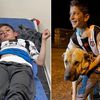
On a rocky hillside in Erzurum province, a 10-year-old boy named Sencar came face to face with two bears. What happened next is being called the work of a dog who was simply doing what he had always done.
The hillside above Çakmaközü Village sits in Erzurum province, deep in eastern Turkey, where the land is high and open and the winters are long. On the morning of May 9, 10-year-old Sencar Kaya was out with his father Hüsamettin checking on one of the mares — she had started to give birth near the edge of the pasture. Sencar was trying to get her tethered to a tree to keep her steady. Bears had been coming down from the higher slopes that spring, as they sometimes do, but nobody was worried about that particular morning.
Then two appeared out of the scrub, close. Sencar ran. The terrain was uneven, and he fell. The bears kept coming.
A dog named King
Kral means King in Turkish. He is a Kangal — one of the large livestock guardian breeds that have worked the Anatolian highlands for centuries. Where herding breeds manage animals by circling and gathering, Kangals work the center: they position themselves between the herd and whatever threatens it, and they hold that position. They are pale-coated, black-masked, and built for endurance in country that punishes both speed and hesitation.
Kral had already earned a reputation in Çakmaközü before that morning. Months earlier, when a ewe in the herd gave birth out in an open field, Kral had stayed beside her and her newborn lamb for two days — standing guard through rain and dark, without being called back, until the lamb was strong enough to move. Nobody told him to do it. That kind of faithfulness doesn't require instruction. It's what the breed was built for across generations of cold nights and real threats.
Bears are not unusual in the Karayazı highlands. The Erzurum region sits at altitude — most of the province lies above 1,700 meters — and brown bears are a known presence in the forests above the pasturelands. Shepherding families here have always kept guardian dogs for a reason. But knowing a risk exists in the abstract is different from seeing two bears appear at close range while your 10-year-old is alone in a field, trying to tie a rope.
What happened on the hillside
When Sencar fell and the bears continued toward him, Hüsamettin shouted for the shepherd dogs. Kral was the first to arrive. He drove directly at the two bears — not barking from a safe distance, but moving forward, closing the gap. The bears broke off their pursuit of the boy and turned to face Kral. With the other dogs arriving behind him, the bears had no remaining advantage and fled back up toward the treeline.
Sencar was physically uninjured. But he was shaking so badly he couldn't form words. His father brought him immediately to Karayazı District Hospital. The doctors ran their checks and found no wounds — what Sencar was experiencing was temporary speech difficulty triggered by the intensity of the shock. He was kept under observation, and then discharged.
He went to Kral first
If it weren't for Kral, the bears would have eaten me.
— Sencar Kaya, age 10, speaking after discharge from Karayazı District Hospital
When Sencar came home to Çakmaközü Village, he did something that says everything without needing to be explained. Before he went inside, before he ate anything or changed clothes, he walked to where Kral was. He put his arms around the big dog and pressed his face against Kral's neck. He stayed there for several minutes, just holding him. The hug of someone who had understood, very suddenly and completely, what a particular animal meant to him.
Our dog Kral literally acts as a lifesaver. We love him very much. This time too, he gave my nephew a new lease on life.
— Ferit Kaya, Sencar's uncle, speaking to Turkish media
The story has a detail that might easily be missed in the headlines. After Sencar was discharged and came home, he went to Kral before he went inside. Not to reward him, not because someone told him to — just because that was the first thing he needed to do. Kral had been the Kaya family's dog for years. He had grown up knowing Sencar. The embrace on the path outside the house was not the beginning of a bond. It was the continuation of one.
A breed built for this
The Kangal is one of the oldest working breeds, its lineage tracing back to the highland shepherding culture of Sivas province in central Turkey. Breed records and oral history both suggest Kangals have been guarding Anatolian flocks for somewhere between 600 and 1,000 years. They are large — males commonly exceed 50 kilograms — with a bite force that ranks among the strongest of any domestic breed. But size alone doesn't explain Kral. What makes Kangals remarkable is the quality of their attention.
They are calm around children. They are patient with the animals they guard. They do not spook easily and they do not act from bravado. When a Kangal moves toward a threat, it is a considered decision, not a reactive one. The breed developed in a context where wrong decisions cost livestock and sometimes lives. That selection pressure, over centuries, produced something that reads less like guard-dog aggression and more like a very deep form of responsibility.
The village already knew
The story traveled fast. The bpthaber news agency published footage of Sencar's family and the scene, and the clip reached more than 700,000 views in a matter of hours across Turkish social media. For many viewers, the story arrived as a surprise — a dog, a child, two bears, an outcome. In Çakmaközü, it was not a surprise. The family had watched Kral for years. They knew what he was.
What feels worth carrying away from this story is something smaller than heroism. Kral was on that hillside because he was always on that hillside. He was watching because he was always watching. He stepped forward when it mattered because stepping forward was the thing he had trained himself, across a lifetime of mornings, to do. Sencar is alive. And when Sencar got home, before anything else, he went to find the dog.
