King saved a dog's life, then went back to his kennel
Doges Editorial · 2026-06-25 · 4 min read
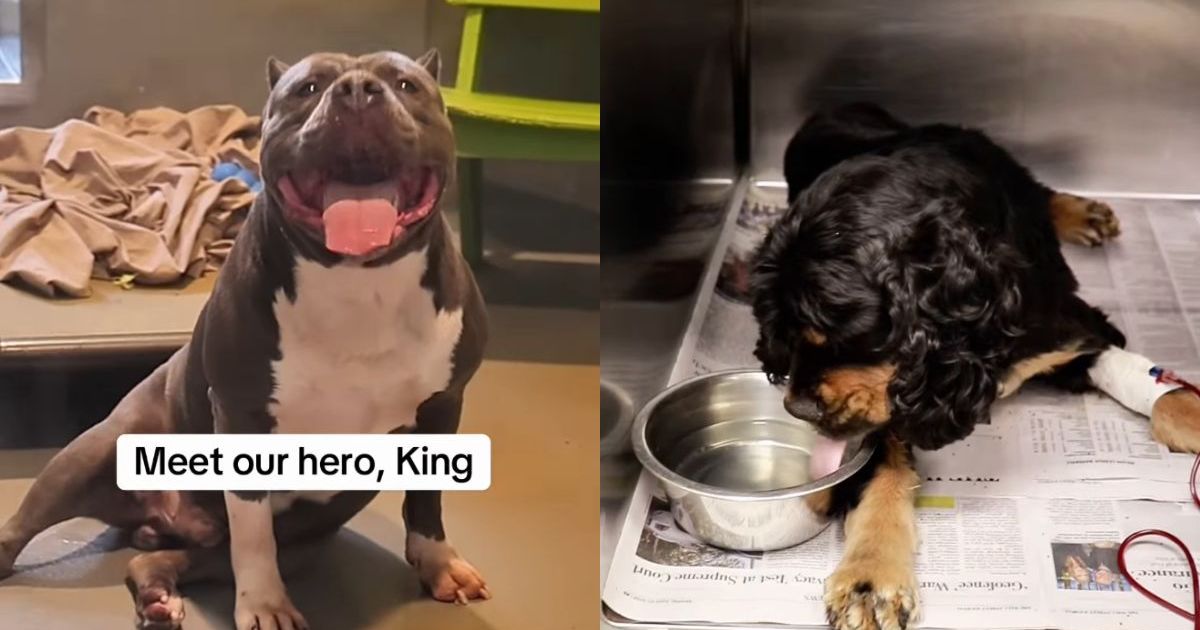
King is a shelter dog at the Louisiana SPCA in New Orleans. Last week, he donated blood to save Ricky, an anemic Cocker Spaniel in critical condition — then walked back to his kennel, still waiting for a home.
The first thing you see in the video is a small paper sign taped to a hospital door. Someone typed it in about ten minutes, probably, because the moment called for something official. It names King as a certified hero. Through the glass, King himself sits patiently on the clinic linoleum: a blocky, sweet-faced dog who has just finished doing something important and seems to know it.
King lives at the Louisiana SPCA in New Orleans. On a recent morning, he became a blood donor — and a quiet corner of the internet went briefly, completely undone. The video, posted to the @laspca Instagram account on June 23, 2026, had accumulated more than 304,000 likes within hours. The story, at its simplest: a dog needed blood, a shelter dog gave it, and both of them are fine now. The rest is everything else.
A Cocker Spaniel named Ricky
Ricky arrived at the Louisiana SPCA clinic in dangerous shape. An English Cocker Spaniel with severe anemia, he lay in a hospital crate with an IV drip already running through a tube in his front paw. He couldn't stand. The video doesn't share a specific diagnosis, but the causes of this kind of collapse in a dog are real and varied: immune-mediated disease, tick-borne illness, toxin exposure, internal hemorrhage. Whatever the cause, Ricky needed blood immediately.
A canine blood transfusion works roughly the way it does in a human. Donor blood is drawn from a compatible animal, processed, and delivered by IV to the patient. The effects can arrive fast — a dog in crisis can go from barely lifting its head to standing at a water bowl within the hour. That is exactly what happened to Ricky. After the transfusion, he stood. He drank. He went home.
What it takes to be a canine blood donor
Most people don't know that veterinary blood banks exist, or that shelter dogs sometimes supply them. The requirements for a canine donor are practical: generally 50 or more pounds, between one and eight years old, current on vaccines, healthy on a basic blood panel, and calm enough to hold still for about fifteen minutes. About one in three dogs meets those thresholds, according to veterinary blood bank programmes — a higher fraction than most people expect. Those fifteen minutes produce enough blood to be processed into packed red blood cells, which can be stored at refrigerated temperature for up to 42 days; a dog above 50 pounds can donate safely again every eight weeks.
The Louisiana SPCA runs a shelter clinic — a full veterinary service embedded in their rescue operation. Recruiting donors from within the shelter means those dogs receive health monitoring, attentive staff time, and a purposeful morning away from their kennel. For a shelter dog, that's not nothing. It breaks the day. It gives them something to do with all that willingness.
Not all heroes wear capes… some wag their tails and are named King.
— Louisiana SPCA, via Instagram
A supply chain still catching up
Veterinary blood banking exists across the United States, but unevenly. Unlike human blood supplies — federally regulated, accessible from virtually any hospital — veterinary supplies are fragmented. Some hospitals maintain their own donor pools. Others contract with commercial blood banks. Many depend on shelter partnerships exactly like the one that put King in the same building as Ricky on the right morning. Veterinary Emergency Group, a national emergency hospital chain, launched a dedicated canine blood bank programme in recent years to begin closing the gap, recruiting healthy dog donors at hospitals in Washington D.C. and expanding from there.
Dogs carry eight or more recognized DEA (Dog Erythrocyte Antigen) blood group systems, with DEA 1 the most clinically important, according to the Merck Veterinary Manual (merckvetmanual.com). Dogs that test DEA 1-negative serve as universal donors — a trait common in Greyhounds, German Shepherds, and many large bully breeds. For a first transfusion, dogs rarely mount an immediate immune reaction to incompatible blood, which is why King and Ricky needed only basic compatibility screening rather than a full crossmatch. Subsequent transfusions require closer typing, as the recipient's immune system will have learned the foreign antigens by then. The system doesn't always have what it needs; but when it does, it can save a Cocker Spaniel on a Tuesday morning in New Orleans.
The need is real and constant. Trauma, surgery, immune-mediated anaemia, cancer treatment, toxin ingestion — there is no shortage of reasons a dog might arrive at an emergency clinic requiring someone else's blood to survive. Veterinary schools and specialty hospitals have run donor programmes for years. The recent push to expand those programmes into emergency chains and shelter partnerships is recognition that the informal system, built largely on the generosity of whoever happened to have the right dog in the right building, wasn't keeping up.
Three hundred thousand people watched
The video runs about a minute. It opens with the certificate on the door, cuts to King sitting on the floor, shows the careful work of the transfusion — the bags, the staff, the quiet professionalism of a shelter clinic doing something extraordinary under ordinary conditions — then follows Ricky in the aftermath: standing, drinking, recovering. A text card confirms he made it home. King gets his treats. It ends there, before the part where he goes back to his kennel.
The comments ran to nearly two thousand. One pointed out that King and Ricky were now permanently bound — that King had become Ricky's blood family, which is biologically accurate in a way that isn't quite true of any other act of generosity between strangers. The Louisiana SPCA staff played 'Holding Out for a Hero' over the footage, a choice that is both entirely obvious and entirely correct.
Thanks to King and our amazing shelter clinic team, Ricky was able to wag his tail another day. Now, King needs a hero of his own.
— Louisiana SPCA, via Instagram
Still at 1700 Mardi Gras
King is still at the Orleans Campus, 1700 Mardi Gras Boulevard in New Orleans. He is available for adoption on Wednesdays — and presumably on any other day a person decides they want a dog who has already proven, once, exactly what kind of animal he is.
Most shelter dogs don't get a certificate. They wait through slow mornings and long afternoons, their best qualities unseen and their stories untold. King's happened to play out in front of a camera, with a Cocker Spaniel's recovery as the proof. The miracle, if there is one, is the ordinary kind — the right blood type, the right place, and one dog willing to sit still for fifteen minutes and give it away.