The dog found beneath eleven years of fur
Doges Editorial · 2026-06-23 · 5 min read
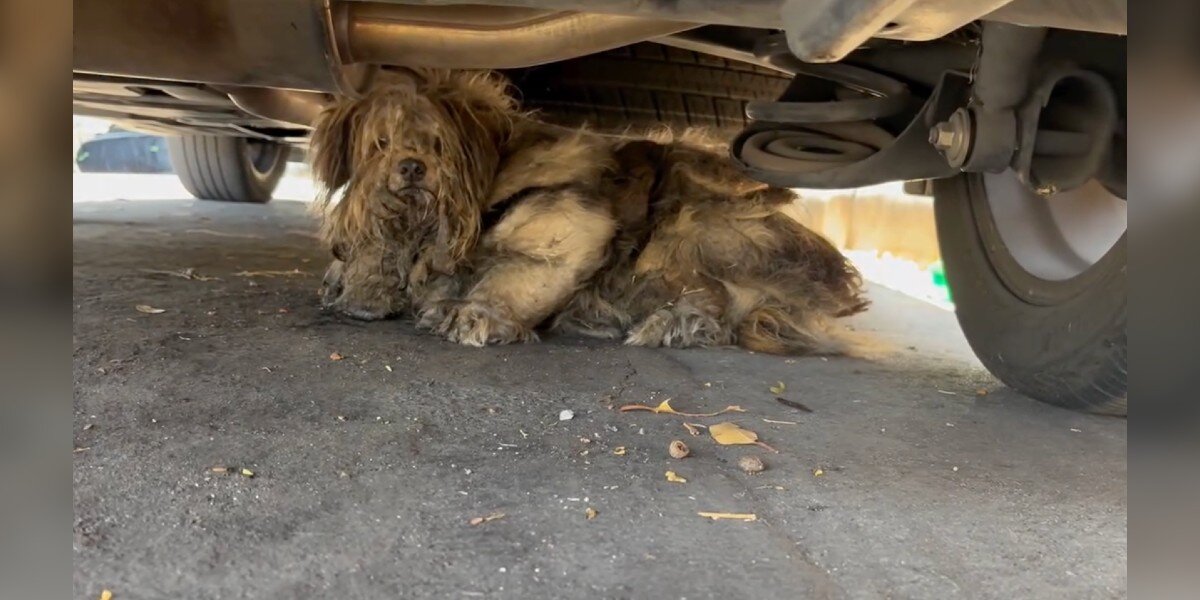
JIN was hiding under a parked car in the June heat of Los Angeles County, his body so matted that rescuers couldn't tell what breed he was — or whether he was a boy or a girl.
It was a sweltering day in Los Angeles County in June when a small dog was spotted hiding under a parked car. The people who found him could see he was alive. They could see he was suffering. What they could not immediately make out — because it had been obscured by what appeared to be years of total neglect — was much else about him at all.
The weight he had been carrying
Matting in dogs is not a cosmetic problem. A 2019 clinical study at the ASPCA's Manhattan hospital examined 27 dogs with strangulating hair mats — the kind that encircle a limb like a tourniquet, cutting off blood supply. In every case, the dog had deep soft tissue injury. In some, the bone itself was damaged. All 27 were small breeds; Shih Tzu-types were overrepresented, because certain long-coated dogs have a prolonged hair-growth cycle and almost no ability to self-groom their way out of extended neglect.
Severe matting also disables a dog's ability to regulate its own temperature. Dogs cool primarily through panting, but the skin surface dissipates heat too — and a dense mat seals that route shut. In June in Los Angeles County, where temperatures push past 90°F, JIN's coat was not just painful. It was a physiological trap.
Dora and Arturo Flores were the first to see him. They contacted Suzette Hall of Logan's Legacy 29, a rescue operation Hall has built through years of working the hardest cases in Southern California. Hall came. She looked at the dog under the car. She understood immediately what she was looking at.
Hiding under a car in the unbearable heat, suffering in silence.
— Suzette Hall, Logan's Legacy 29
A name that belonged to someone else
The dog had a microchip. The chip had a name: Lucky. It also had a registered contact number. Hall and her team called. Nobody answered. Nobody called back. It is the specific despair of rescue work — the evidence of a prior life, of a person who once cared enough to register a chip, and then the silence on the other end. Lucky became a dog without a claimant.
He has a microchip. Nobody is calling back.
— Suzette Hall, Logan's Legacy 29
The rescue team gave him a new name: JIN. It suited him better than a word meaning fortunate. There was nothing about his circumstances that suggested luck had been on his side.
Hours under anesthesia
At Camino Pet Hospital, JIN went under anesthesia. What followed was not a simple grooming appointment. The matting covering his body was so extensive that the work of removing it took hours — careful, slow work that required the dog to be fully sedated, because the pulling and cutting involved would have been unbearable awake. When they finished, the dog that emerged looked almost nothing like the animal they had brought in.
The entire body was covered in dense, years-old matting so thick that the team could not initially determine his breed, or even his sex.
What the vet found underneath
The vets estimated JIN was approximately 11 years old. They found a fatty lump that would need monitoring. His eyes had issues requiring ongoing attention. The prognosis, despite all of it, was good — he was alive and stable, and the injuries from the matting were treatable. What the team also found was something harder to put in a chart: a dog who had been carrying this weight, possibly for his entire life, and had never had a single person look after it.
I still can't believe what this sweet soul has endured. It appears he may have never had a haircut in his entire life.
— Suzette Hall, Logan's Legacy 29
The before-and-after images that Hall shared after the procedure showed the full measure of what had changed. The matted shape that had been hiding under the car — difficult to identify as a dog, let alone a specific animal with a face and a personality — and then JIN after: slight, elderly, clean, revealed.
Learning to be touched
JIN went into foster care after the hospital stay. The transition was not instant. A dog who has lived without human touch — or who has learned that touch brings pain — does not immediately understand that hands approaching him mean something different now. He was scared. He stayed scared for a while.
He was so scared of human touch, but now he is loving every minute of it.
— Suzette Hall, Logan's Legacy 29
What JIN still needs
JIN is currently in foster care through Logan's Legacy 29. According to ASPCA data, senior dogs carry a 25% adoption rate — against 60% for younger dogs and puppies. The gap has real consequences: in shelters, older dogs can wait up to four times longer than younger ones, and are disproportionately represented among animals that run out of time. At 11, JIN falls squarely into the category that rescue workers know is the hardest sell.
Senior dogs like JIN come with a different kind of return on investment — not years of puppyhood and training firsts, but the specific gratitude of an animal who has known what it is to have nothing and now knows what it is to be held. His name is JIN now. He is learning what it feels like to let someone get close. It is, for an 11-year-old dog who may never have had a haircut, a late start. But it is a start.