When your golden's fear of the vacuum cleaner is written in the same DNA as your own anxiety
Doges Editorial · 2026-05-13 · 5 min read
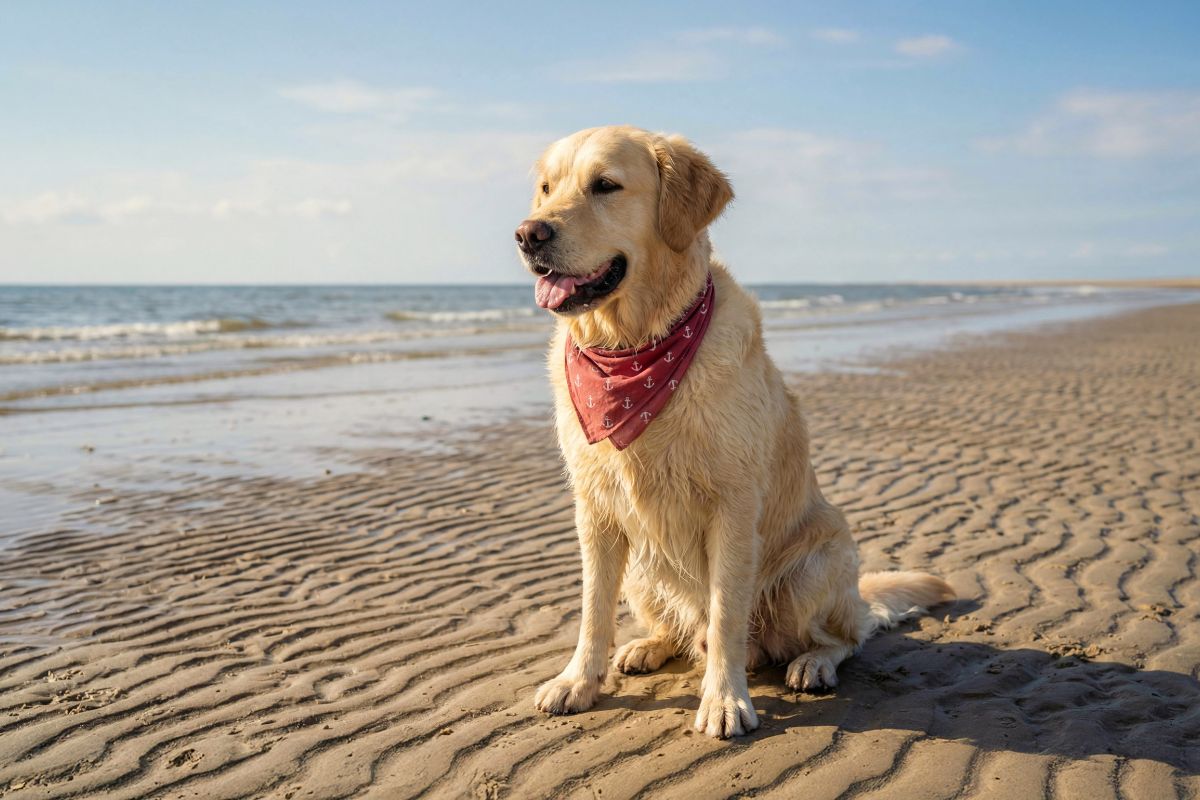
A Cambridge University study of 1,343 golden retrievers, published in the Proceedings of the National Academy of Sciences, found twelve genes that shape dog behaviour also influence human emotions — including anxiety, depression, and the capacity to learn.
She sees the bus rounding the corner and her whole body changes. The head dips, the tail slows, the weight shifts back. If you didn't know her, you might wonder what she did to deserve this fear of a large orange vehicle moving at fifteen miles per hour. But if you've read the new research out of the University of Cambridge, you might look at her differently — not as a poorly socialised dog, but as an animal carrying a genetic signature that your own anxious brain may recognise.
A study published this spring in the Proceedings of the National Academy of Sciences found that at least twelve genes associated with behaviour in golden retrievers are also linked to emotional traits in humans — including anxiety, depression, intelligence, and emotional sensitivity. It is the first research to demonstrate this kind of genetic overlap at this scale, and it has quiet, practical implications for everyone who has ever wondered why their dog reacts the way they do.
A study built on 1,343 dogs and 73 behaviours
The research drew on the Golden Retriever Lifetime Study, a long-running project established in 2012 by the Morris Animal Foundation. Dogs enrolled are between three and seven years old, and their owners complete detailed questionnaires covering 73 distinct behaviours — from how a dog responds to strangers, to how quickly they learn new commands, to whether they startle at household sounds. The questionnaires are grouped into 14 behavioural categories designed to quantify specific temperament traits.
The Cambridge team, led by Dr. Eleanor Raffan in the Department of Physiology, Development and Neuroscience, combined those behavioural profiles with blood samples from all 1,343 dogs and ran a genome-wide association study — scanning the full genome for markers that appeared more frequently in dogs showing specific behavioural patterns. When a genetic variant keeps showing up in dogs who are, say, fearful of unfamiliar people, that repetition is a signal worth following.
Twelve genes, two species
The analysis identified twelve genetic regions with significant associations to eight different behavioural traits in dogs. When the researchers then compared those canine findings with large-scale human genetics databases, something striking emerged: many of the same gene regions had already been linked to emotional traits and cognitive abilities in people.
Two genes stood out in particular. PTPN1: in golden retrievers, it was associated with aggression toward other dogs. In humans, the same gene has been connected to both intelligence and certain depressive disorders — a pairing that doesn't map cleanly onto any simple story, but suggests the gene is involved in something fundamental about emotional processing across species. ROMO1: in dogs, this gene was linked to trainability — how readily a dog learns and responds to instruction. In humans, it's associated with emotional sensitivity and intellectual performance.
Even the subtler findings reward attention. Dogs that showed non-social fear — being frightened of vacuum cleaners, buses, loud household noises rather than living beings — shared a genetic variant that, in human studies, is linked to irritability, emotional sensitivity, and anxiety-related complaints. Dogs fearful of other dogs shared a variant connected to the human tendency to dwell on embarrassing experiences. The genetic architecture of discomfort, it turns out, crosses a significant species boundary.
Not fate — biology
It is important to be clear about what these findings don't mean. The genes identified don't 'cause' fearful or aggressive behaviour the way a faulty fuse blows a light. They influence broader biological systems — the ones that regulate mood, process threat, and shape behavioural responses. Every dog is also the product of their early experiences, their socialisation, their training, and the specific texture of their daily life.
What the genes seem to do is tune the dial on sensitivity. The same rain falls on every dog. But some dogs are built to hear it as thunder.
Some dogs may be genetically predisposed to find the world more stressful, and that stressful experiences can intensify behaviors people may interpret as 'bad,' even when the animal is distressed.
— Enoch Alex, study first author, University of Cambridge
That reframe — distressed rather than difficult — is one of the most useful things this research offers. A dog who shuts down at the dog park, or who braces against strangers on the pavement, may not be failing at socialisation. They may be working harder than it looks just to stay composed.
What this means for training
The trainability finding carries particular weight. If ROMO1 — which influences learning ability in dogs and emotional sensitivity in humans — varies meaningfully across individual animals, that changes how we should think about why some dogs grasp a new cue in two sessions and others need twenty. The difference may not be stubbornness or intelligence in any simple sense. It may be that some dogs' nervous systems make the process of learning feel riskier — that the effort of attention itself is harder to sustain under elevated stress.
Understanding a genetic tendency toward sensitivity and anxiety may help owners respond with more empathy when a dog reacts fearfully to everyday triggers.
— Dr. Anna Morros-Nuevo, co-author, University of Cambridge

Dogs as a window into our own minds
The study's broadest implication is one the researchers touched on carefully: dogs may be genuinely useful models for studying certain human psychiatric conditions. Not because they're convenient, but because the genetic overlap suggests something deeper — that some of the same biological machinery underpins emotional regulation across species.
Dogs share not only people's environments but may also share some psychological challenges associated with modern life, making them valuable models for studying certain human psychiatric conditions.
— Professor Daniel Mills, specialist in problem animal behaviour, University of Lincoln
That line has layers. Dogs and humans have co-evolved for tens of thousands of years — they didn't just move into our houses, they started to live something like our lives. Busy, loud, stimulus-rich lives filled with unfamiliar sounds and strangers and machinery. If some of their emotional reactions mirror ours, it may be because some of the same genetic hardware is running in both of us, tuned slightly differently but shaped by the same evolutionary pressures of living close to one another.
What you might notice on tomorrow's walk
None of this requires a DNA test to act on. The research's practical takeaway is simpler: the dog who digs in at a certain corner every morning, or who can't quite relax at the dog park, or who takes three weeks to warm to a new person — that dog may not be failing at anything. They may be exactly themselves, wired a certain way, navigating a world that occasionally feels like too much.
On a walk, that might just mean slowing down. Letting the bus pass before you cross. Giving them the extra moment to decide, on their own terms, that the recycling lorry is not a threat. It's a small thing. But for a dog who's been working hard not to show you how loud the world feels, that pause might be everything.