Before Gaja could visit, Poland needed a law
Doges Editorial · 2026-07-01 · 5 min read
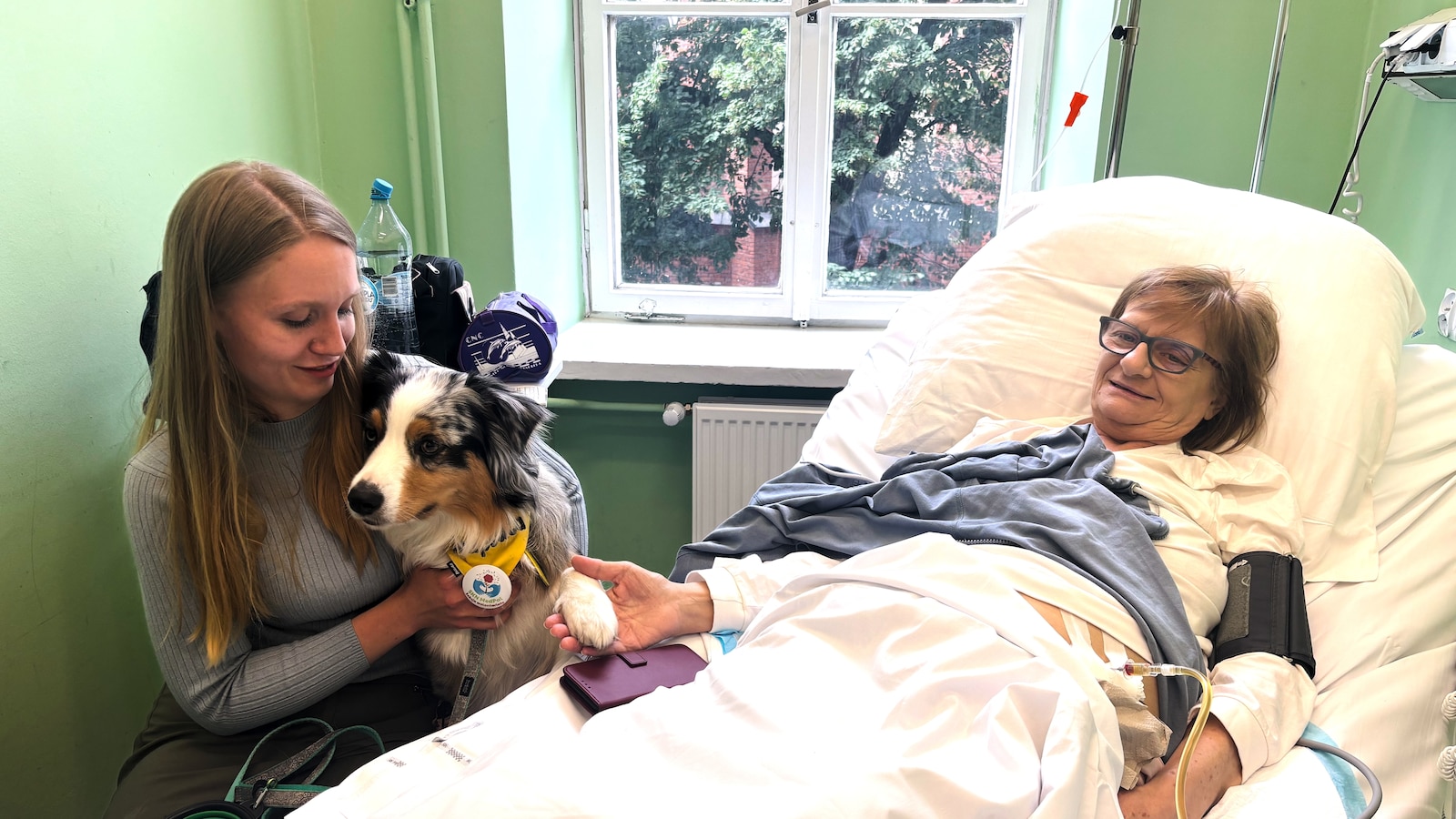
When Ewa Lutka-Krawczyk was admitted to a palliative ward in Warsaw with gallbladder cancer, her shelter dog stopped eating at home. Now a physician at the Medical University of Warsaw is asking Parliament to make sure no dying patient has to be separated from their pet.
Ewa Lutka-Krawczyk was 70 years old and lying in a hospital bed in Warsaw, a draining tube attached to her abdomen, when she talked about her dog. Not about the cancer. Not about what came next. About Gaja, the shelter dog she had taken in three years earlier, who was at home with her husband, barely eating.
She is waiting for me.
— Ewa Lutka-Krawczyk, from her bed in the palliative ward, Medical University of Warsaw
This is where the story begins — not with legislation, not with a parliamentary committee, not with the data on loneliness in end-of-life care. It begins with a dog at home who had stopped eating, and a woman who knew exactly why.
An epidemic of loneliness
Dr. Tomasz Dzierżanowski, director of the Palliative Medicine Clinic at the Medical University of Warsaw, has spent years watching what happens to patients when they arrive in his ward. Some have families who visit every day. Others have outlived their friends, or built their closest connections in the era of virtual life — relationships that don't always translate into someone present in the room.
He calls it an epidemic of loneliness, and he encounters it in both directions: older patients who have simply outlasted the people they knew best, and younger patients who grew up in a world of screens and had not built the kind of friendships that earlier generations often had by middle age. Both groups arrive in palliative care facing the end, and sometimes facing it alone.
A 2022 review published in BMC Palliative Care found that 92.6 percent of palliative care professionals reported perceiving loneliness among their terminally ill patients — and 86.8 percent observed it in the patients' own family caregivers. Loneliness at end of life correlates with significantly higher rates of pain and depression: one analysis found that lonely patients reported pain at nearly 30 percent compared to 20 percent for patients with regular social connection.
We make sure that no patient dies alone. When someone is suffering, it is important that someone is there for them. Ideally, that should be another human being. Sometimes, however, there is no one.
— Dr. Tomasz Dzierżanowski, director of the Palliative Medicine Clinic, Medical University of Warsaw
Waldemar and his two cats
The moment that set Dr. Dzierżanowski's campaign in motion came from a patient named Waldemar, who was seriously ill with cancer. Waldemar was not afraid for himself. He was afraid for his two cats. He worried about what would happen to them. He wanted to see them one more time.
Dr. Dzierżanowski arranged for the cats to be brought into the ward. What happened next — Waldemar's tears, the cats' reaction, the response of other patients and hospital staff who witnessed the reunion — convinced him that this couldn't stay a case-by-case accommodation. It had to become a right.
The proposal he developed was introduced to the Polish parliament by Katarzyna Piekarska, a lawmaker in Prime Minister Donald Tusk's centrist party. As of June 2026, it is in parliament's health committee.
What the law would actually do
Pet visits already happen in many Polish clinics — Dr. Dzierżanowski allows them in his ward when conditions permit, which is how Ewa Lutka-Krawczyk learned she will be able to have Gaja visit. But there is no universal right under current law. A patient in one hospital can see their dog. A patient three floors down, or across the city, may not be able to.
In reality, animals in hospitals are already there anyway. That's why it needs to be regulated in the law.
— Katarzyna Piekarska, lawmaker, Polish parliament
The legislation would standardize what is currently a patchwork. Patients in hospices and palliative care wards would have the explicit right to be visited by their own pets — not as a favor, not as an exception granted by a sympathetic doctor, but as something guaranteed.
Kluska the dumpling
When the AP visited the ward, a therapy dog named Kluska — an Australian shepherd whose name translates as dumpling — was making her rounds with her owner, Małgorzata Brzozowska, a medical student. Kluska moved between rooms and beds. Patients reached for her. A patient named Wojciech Zelik, 58, admitted with a tumor, propped himself up to watch her perform tricks.
She has such lovely fur to pet, so fluffy.
— Wojciech Zelik, patient, Medical University of Warsaw
In the hallway, nurses crouched down to pet Kluska between patients. The cook slipped her slices of ham. Brzozowska noted that therapy dog visits help relieve the stress of staff who tend to terminally ill patients all day — not only the patients themselves.
What the dog knows
Brzozowska made an observation that is easy to dismiss and difficult to shake. When a patient's own dog visits — not a therapy dog, but the dog that belongs to them, that has slept in their house, that knows their schedule — something different happens. The dog's behavior changes. It calms down.
The dog isn't as stressed. We interpret this as meaning that he simply knows what's happening, that he knows where the owner, who was always there before, has disappeared to.
— Małgorzata Brzozowska, medical student and therapy dog handler
Whether that interpretation is exactly right is a question for researchers. What is not in question is what it looks like: a dog who has been anxious, restless, waiting — settling into the room where its person is. Recognition, not distress.
The science behind those moments is increasingly specific. A 2024 scoping review published in BMC Palliative Care found that animal-assisted therapy consistently reduces pain, anxiety, and depression in palliative patients, partly because touching an animal triggers the release of oxytocin, endorphins, and serotonin — compounds that quiet the stress response at the biochemical level. A 2018 clinical study found salivary cortisol fell significantly within a single 30-minute dog therapy session in palliative care patients. Crucially, research suggests a patient's own dog produces stronger physiological effects than a therapy animal: the familiar scent, the shared history, the dog's specific recognition of that person creates something closer to a reunion than a visit.
Gaja's visit
Ewa Lutka-Krawczyk found out she would be able to see Gaja while still in the ward. When she learned of it, she was pleased. The dog at home who had stopped eating — the one waiting — would be allowed in.
This is what the legislation is trying to make universal: not the grand gesture, not the philosophical argument about human-animal bonds or the science of cortisol and touch. Just this — a woman in a hospital bed, a dog at home barely eating, and the simple fact of letting them be in the same room again before the time runs out.
On an ordinary morning, a dog waits by the door while you get your shoes on. They know your schedule better than you do — when you leave, what time you typically come back, the difference between a short errand and a long absence. That attentiveness is usually a small, daily thing. In a hospital room in Warsaw, it turns out to be something else entirely.