What Hadley the hospital dog does that medicine cannot
Doges Editorial · 2026-05-27 · 5 min read
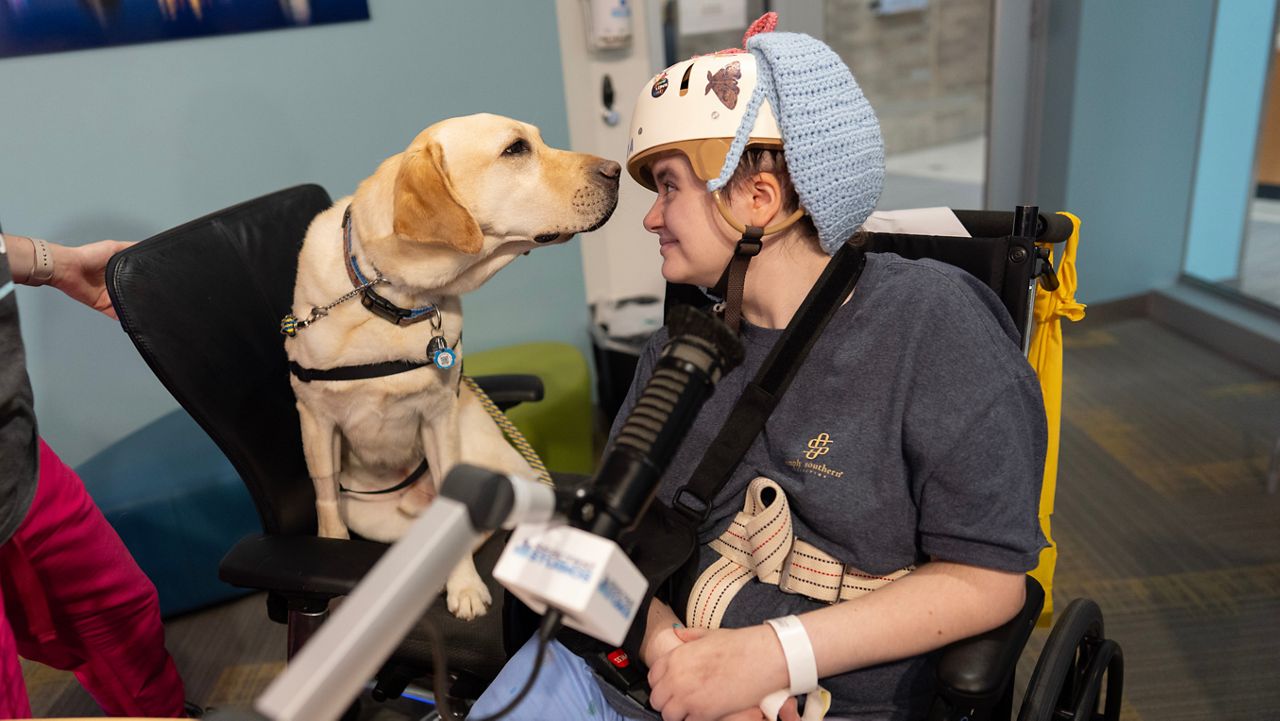
At children's hospitals across the United States, full-time facility dogs are joining pediatric care teams — and the results are measurable. An AP investigation shows how a single throw of a ball changed everything for a five-year-old who hadn't been outside in a month.
Calvin Owens is five years old. He has a rare, severe form of childhood arthritis, and he'd just come through a bone marrow transplant. The first time he went outside in more than a month was on a hospital patio in Cincinnati — tethered to equipment, still wired up, in a wheelchair — but there was a dog on the other side of the patio. A Labrador named Hadley. Calvin stood up near his chair — stood, for the first time in weeks — and threw her a ball.
She ran for it. He smiled. The caregivers watching started to cheer.
Look how good you're doing!
— Schellie Scott, Hadley's handler
That moment — small and enormous at once — captures what is happening at children's hospitals across the United States right now. An AP report published in May 2026 documented the quiet expansion of what healthcare professionals call facility dogs: full-time, specially trained working dogs embedded in pediatric care teams. Not visiting as volunteers. Not dropping by on weekends. Working, daily, in some of the hardest rooms in medicine.
Not a therapy dog — something fundamentally different
The distinction between a facility dog and a therapy dog matters more than it might first appear. Volunteer therapy dogs visit hospitals on a schedule. They offer comfort, they are warmly received, and then they leave. Facility dogs like Hadley are something else entirely. They live with their handlers. They show up every morning already bonded to a person patients trust. And they have access to areas volunteer dogs never see: oncology units, behavioral health wards, child protection programs.
Hadley is one of four facility dogs at Cincinnati Children's Hospital, all placed by Canine Companions — a nonprofit that breeds, raises, and trains working dogs for hospital environments, then places them with designated staff handlers. The arrangement is deliberate: Canine Companions retains ownership, the handler provides the daily relationship, and the dog returns each morning already calibrated to the rhythms of the floor. Johns Hopkins Children's Center in Maryland introduced its first two facility dogs in March 2026. Attendance at a national Facility Dog Summit nearly doubled between 2024 and 2025.
What the research actually shows
The evidence base is now substantial. Research conducted across 17 children's hospitals has documented that even brief interactions with facility dogs improve children's overall well-being, measurably decrease self-reported pain, and reduce physiological markers of stress — cortisol levels and blood pressure among them. The mechanism operates partly through neurochemistry: contact with a dog raises oxytocin in both species and depresses cortisol. But researchers suggest the effect goes beyond simple biochemistry.
These dogs are making a real difference. They can provide a little bit of normalcy, a little bit of comfort, in a really stressful, sterile environment that kids might not feel comfortable in.
— Kerri Rodriguez, director of the Human-Animal Bond Lab, University of Arizona
Rodriguez's framing is worth staying with. A hospital is one of the least psychologically familiar environments most children will ever encounter: unfamiliar smells, unfamiliar procedures, pain, uncertainty, and very little that resembles ordinary life. A dog does not know any of that. It knows that someone might want to play. In a children's ward at 10 in the morning, that is sometimes exactly the medicine required.
"She helps me exercise more"
Eleven-year-old Bethany Striggles had just finished a round of chemotherapy for bone cancer when Hadley came to sit at the foot of her bed. Bethany is eleven — old enough to understand some of what is happening to her body, young enough to still need the world to also contain a dog with a ball.
She helps me exercise more. She's energetic and happy.
— Bethany Striggles, patient, Cincinnati Children's Hospital
That sentence deserves a moment. For a child on a cancer unit, physical movement is medically critical and often brutally difficult — pain, fatigue, and the slow recovery from treatment all work against it. A dog transforms the context. A trip to the patio with a dog is not the same as a mandatory walk. Another patient, Aspen Franklin, described Hadley's presence more quietly: "She has a calming presence. That is a comfort to me." In a room that may contain, on any given day, fear and the particular loneliness of being sick away from home, that calm presence is not a small thing.
The hygiene question, answered
The reasonable concern about bringing dogs into wards full of immunocompromised children has a rigorous answer. Hadley is bathed at least twice a month because she works the cancer and blood disease floors, where some children have essentially no immune defense. She receives additional cleanings — wipe-downs with medical-grade products — whenever she may have been near a pathogen source. The equipment she uses is designed for easy sanitization. Everyone who touches her washes their hands before and after.
Facility dogs do not operate on goodwill. They operate on protocols. That discipline is part of what has made their expansion defensible in the most medically sensitive environments — and part of why programs keep growing rather than being curtailed as hospitals learn more.
In the rooms where it matters most
At St. Louis Children's Hospital, a facility dog named Opal divides her time between the pediatric behavioral health unit and the child protection program — the hospital unit that works with children who have experienced abuse. In those rooms, the presence of a calm, warm, nonjudgmental animal can offer something that even skilled therapy may not provide in its earliest stages: simple, embodied proof that something in this world is still safe to reach toward.
More than 80 facility dogs have been placed in children's hospitals through the Canine Assistants program alone. The numbers are growing. This is becoming a standard of care, not a novelty. When a 2026 summit on facility dogs attracted nearly double the previous year's attendance, the message was clear: the hospitals that have tried this are not removing it. They are expanding.
Something we already know from the morning walk
The clinical research on facility dogs is careful and precise, as clinical research should be. What it's describing, though, is something most people who live with dogs already carry in their bodies — the knowledge that on a difficult morning, the walk still happens, and the dog is part of why, and it helps in a way that is real and not entirely explainable.
What the research in children's hospitals is showing — in cortisol levels, blood pressure readings, and pain scores across 17 hospital sites — is that this effect holds at the very edges of what medicine can reach. In cancer wards. In the room where a child has not been outside in thirty days. In a building full of the hardest things people have to face.
Calvin Owens stood up and threw a ball. Hadley ran for it. He smiled. For a moment, on that hospital patio, he was just a kid and a dog, and the wires and tubes and everything they meant receded a little into the background. That is what Hadley does. That is what the research keeps confirming.