The Dogs Fighting Bone Cancer — and the Children They're Helping Save
Doges Editorial · 2026-06-06 · 5 min read
DOGES
For forty years, osteosarcoma has beaten every treatment doctors threw at it. Now a $15 million research partnership is betting that dogs hold the key to finally cracking the code.
There's a quiet cruelty in osteosarcoma. It strikes fast, it strikes young, and for the past four decades, medicine has had almost nothing new to offer. A child diagnosed with the most common form of primary bone cancer today receives largely the same treatment their parents would have received in the 1980s — and the survival rate has barely budged. The same is true for dogs. But that parallel, it turns out, is the key to unlocking something new.
A Disease That Hasn't Changed in Four Decades
Osteosarcoma is the most common primary bone cancer in both children and dogs. In the United States, fewer than 1,000 children are diagnosed each year. In dogs, that number climbs above 25,000. The survival odds are brutal in both cases: even with the current standard of care — surgery followed by chemotherapy — most patients, human and canine, face a very high chance of recurrence within two years. For forty years, this has not meaningfully changed.
Dr. Heather Gardner, a pediatric oncologist at Tufts Medical Center, has spent her career watching this disease devastate young lives. She describes it with a visceral directness that cuts through clinical language.
Osteosarcoma is relentless. The cancer chews away at the bone, and our treatments haven't kept pace.
— Dr. Heather Gardner, pediatric oncologist, Tufts Medical Center
Why Dogs Are Better Models Than Mice
Most cancer research relies on mouse models — lab animals whose tumors are induced artificially under controlled conditions. The problem is that mice are not great stand-ins for humans. Their tumors develop differently, their immune systems respond differently, and the drugs that work spectacularly in mice fail with dispiriting regularity in human trials.
Dogs are different. When a dog develops osteosarcoma, it happens naturally — the same spontaneous, messy biological process that produces the disease in people. Dogs have intact immune systems. Their tumors carry genetic signatures remarkably similar to human pediatric osteosarcoma. And because the disease progresses faster in dogs — often proving fatal within one to two years — researchers can study the full arc of the illness, and test potential treatments, in a fraction of the time a human clinical trial would require.
Veterinary oncologists and pediatric cancer researchers have known for years that dogs could serve as uniquely powerful research partners. What has been missing is the scale and coordination to actually act on it.
Scale and Coordination Matter
That gap is now closing. A $15 million grant from Break Through Cancer — a philanthropic initiative that funds ambitious, collaborative cancer research — has brought together more than 20 researchers across eight institutions, including Dana-Farber Cancer Institute, Memorial Sloan Kettering Cancer Center, Johns Hopkins, MD Anderson Cancer Center, and Tufts University's Cummings School of Veterinary Medicine.
Scale and coordination matter when it comes to making breakthroughs. This kind of partnership — where human oncologists and veterinary oncologists are working side by side from the very beginning — is genuinely new.
— Dr. Cheryl London, veterinary oncologist, Tufts Cummings School of Veterinary Medicine
A $15 Million Bet on a Four-Legged Breakthrough
The research program pairs pet dogs who develop osteosarcoma naturally with human pediatric patients, studying both populations in parallel. By tracking how the disease behaves across both species simultaneously, researchers hope to identify new biological targets and test new therapeutic approaches far faster than either field could manage alone.
For pet owners whose dogs are diagnosed with osteosarcoma, this also creates real opportunities to access cutting-edge clinical trials. Dogs enrolled in the study receive treatment they wouldn't otherwise have access to — and in return, they contribute data that could benefit the children who come after them.
What This Means for Your Dog
Large breed dogs are disproportionately affected by osteosarcoma. Breeds like Great Danes, Irish Wolfhounds, Rottweilers, Greyhounds, and Saint Bernards face elevated lifetime risk. If you own a large breed dog, particularly one approaching middle age or beyond, it's worth having a conversation with your vet about what to watch for: limping that doesn't resolve, swelling near a joint, reluctance to bear weight on a limb. Early detection matters, and veterinary oncology centres associated with this research partnership may have clinical trial options worth exploring.
Two Patients, One Disease, One Fight
There's something that stops you in your tracks when you really sit with the numbers: 25,000 dogs diagnosed each year, fewer than 1,000 children, the same disease, the same stubborn lack of progress for forty years. And now, for the first time in a generation, a serious coordinated effort to change that — using the very connection between dogs and humans that has defined our shared history.
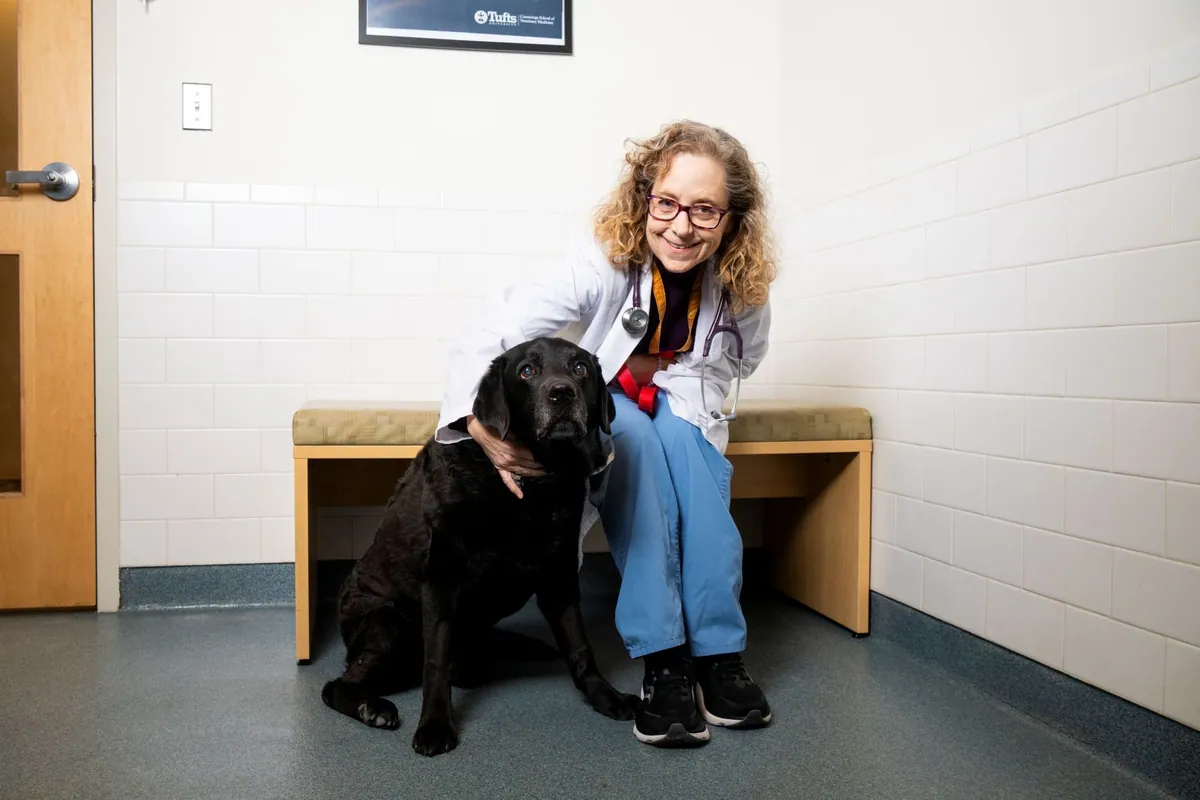
Oscar, a black Labrador who has become something of an unofficial ambassador for the research program at Tufts, sits calmly beside Dr. London in photos from the lab. He looks, as good dogs do, like he's just happy to be there. He has no idea that dogs like him might be the ones who finally break a forty-year stalemate. But the researchers working alongside him do.