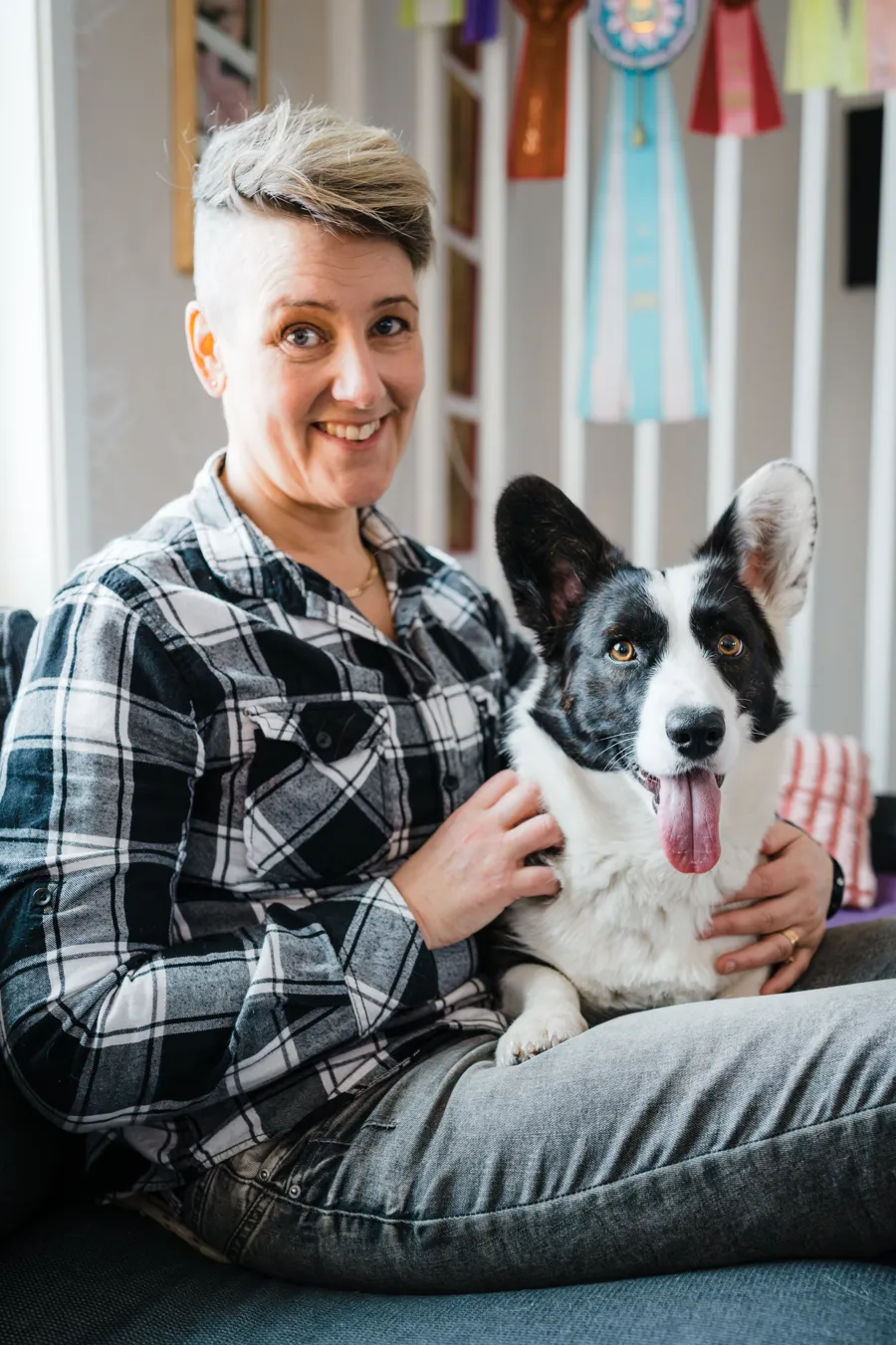
Tug-of-war does what training can't
Doges Editorial · 2026-06-09 · 5 min read

A peer-reviewed study from Linköping University found that interactive play — tug-of-war, chasing, hide-and-seek — strengthened the emotional bond between dogs and owners in ways that extra training sessions couldn't replicate.
Think about the last time you really played with your dog — not a training session, not a ball thrown across the yard while you checked your phone, but actual play. Chasing each other. A game of tug where neither of you had anywhere else to be. A study published in April 2026 in the journal Royal Society Open Science found that exactly this kind of interaction — mutual, attentive, physically unpredictable — builds the emotional bond between dog and owner in a way that training, for all its value, cannot replicate. After four weeks of structured play, owners reported a statistically significant improvement in how close they felt to their dogs. The training group, which added extra food-based sessions over the same period, did not.
What the researchers tested
The study — by Per Jensen, Caisa Persson-Werme, and Lina S.V. Roth, all ethologists at Linköping University in Sweden — enrolled 1,667 dog owners across Sweden and split them into two groups. One group was assigned to increase their play time with their dogs; the other was asked to add extra food-based training sessions. Of those who met the analysis criteria — which included showing a meaningfully increased time of play for at least eight days — 408 owner-dog pairs generated usable data. The paper was published as Royal Society Open Science Vol. 13, Article 252294, DOI 10.1098/rsos.252294.
The play group was not simply asked to throw more balls. The researchers specified the kinds of interaction they wanted: tug-of-war, rough-and-tumble, chasing each other around the yard, hide-and-seek, peekaboo, and what Roth describes as teasing the dog lightly with your fingers — the low-stakes, attentive back-and-forth where both participants are actively watching each other and responding in real time. The point was mutual social engagement, not physical exercise.
What changed in four weeks
At the end of the four weeks, owners in the play group reported a statistically significant improvement in their emotional bond to their dogs. The training group did not. Both groups had increased their time and engagement with their dogs — only one produced this particular effect. Notably, the change appeared to run in both directions: owners in the play group reported that their dogs seemed to view them more positively and took more initiative for play themselves. The difference was not how much time was spent with the dog, but what that time looked like.
Today, many dogs change homes in the middle of their lives. With rescue dogs, you don't have the advantage of growing up with your dog. This means that you miss the so-called socialisation window early in your puppy's life, which is important for relationship building. And then play can be a very good way to build a new good relationship even with adult dogs.
— Lina Roth, senior associate professor of ethology, Linköping University
Why throwing a ball doesn't count
Roth is specific about what constitutes useful play. Fetch — the standard image of dog-and-owner recreation — doesn't fit the definition. When you throw a ball and the dog retrieves it, the dog is doing work; you're mostly waiting. The interaction is real, but it's not mutual in the same sense. The games that appeared to build the emotional bond were the ones where both dog and human were actively attending to each other: reading each other's body language, responding in real time, genuinely uncertain about what comes next.
Just throwing a ball isn't enough. As we were after the social interaction between dog and human, the games we proposed in the study were for example tug-of-war, rough and tumble, chasing each other, hide-and-seek, peekaboo or teasing the dog a little with your fingers. You don't have to keep at it for long, it's more about paying attention to your dog's behaviour. A few minutes every now and then seems to make a big difference.
— Lina Roth, Linköping University
This is a great result that you can only dream of! It turned out that the play group improved their emotional bond to the dog in just four weeks with a few minutes of extra play a day.
— Lina Roth, Linköping University
What the dog experiences in play
In a training session, the dog is working toward a known outcome: perform the behavior, receive the reward, move on. The feedback loop is tight and useful. In a game of tug-of-war or hide-and-seek, there is no defined outcome — only the game itself, the other player's attention, the uncertainty of what happens next, the shared physical language of predator-and-prey play that domesticated dogs carry in their body memory from long before training was a concept. The emotional quality of that experience is, apparently, the thing that shifts the relationship.
The rescue dog question
One of the most practically useful dimensions of Roth's work concerns adult dogs who have changed homes. A puppy who grows up with a family accumulates years of experience — the first weeks when everything about the new human was strange and gradually became safe, the long socialization window that researchers mark as critical for attachment formation. A dog adopted at three, or five, or eight, doesn't have that history with you. The early imprinting happened somewhere else. The new owner is starting from scratch with an adult animal who may have learned, in various ways, to be careful with trust.
Play, the study suggests, accelerates that process — not by replacing what was missed, but by creating something functionally similar. A companion 2024 study by Roth's group, published in Frontiers in Animal Science (Sulonen et al., DOI: 10.3389/fanim.2024.1384155), found that dogs relinquished to shelters can develop bonds with new owners as strong as — and in several measures stronger than — those reported by owners who raised their dogs from puppies. Shelter dogs, the researchers noted, appear to form attachments to unfamiliar humans unusually quickly. The mutual attention of a game of hide-and-seek, the back-and-forth of tug-of-war, the low-stakes repetition of being chased and doing the chasing: these appear to build the kind of connection that the socialization window builds in puppies, just on a different timeline and starting from a different place.
Training and play are not the same job
The practical implication is not that training is without value — training builds skills and reliable communication and makes life with a dog safer and more predictable for both parties. The implication is that if you want your dog to feel emotionally close to you, training alone may not get you there. Play requires something training doesn't: your full, reactive, present attention. You're not trying to produce a behavior. You're just in it together. And apparently, across 408 pairs of dogs and owners studied over four weeks in Sweden, that is the thing that changes how the relationship feels.
The study found the effect across the full range of breeds, ages, and lengths of ownership in the sample. You don't need a young dog or a new dog or a particularly boisterous one. You need a few minutes of genuine mutual attention, repeated. On a trail, in a yard, in a living room with a knotted rope. That is the research. The rest is up to you and whoever is waiting on the other end of the leash.