The dog named for the girl she once helped
Doges Editorial · 2026-06-20 · 5 min read
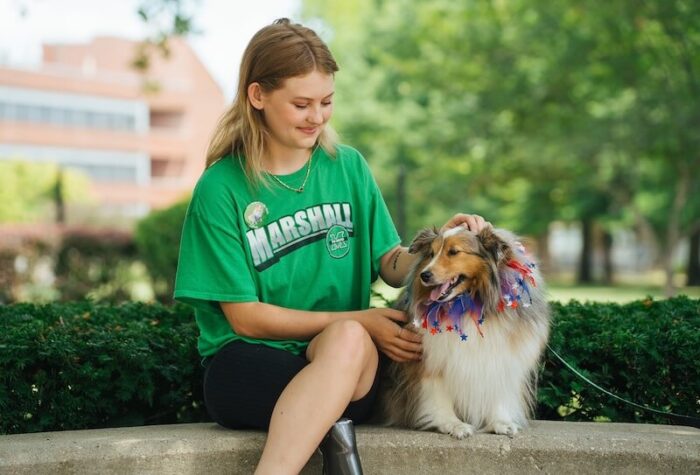
At 8, Bella Masters spent months in a West Virginia hospital, comforted by therapy dog visits from a woman named Robin Ash. Years later, as a Marshall University freshman, she walked into the campus library and found a therapy dog named after her — walked in by the same handler.
At 8 years old, Isabella "Bella" Masters was a patient at Cabell Huntington Hospital in Huntington, West Virginia, counting the days between chemotherapy cycles for osteosarcoma — a bone cancer in her right leg. The hospital room was long and fluorescent and smelled of antiseptic. Then a woman named Robin Ash would arrive with a golden dog named Angel, and for the next half hour or so, the room became something else entirely.
Bella would go on to survive, ring the bell that marks the end of treatment, walk out of the hospital on a prosthetic leg that would eventually lead her to study biomedical engineering. Robin would keep walking into hospital rooms, one after another, for decades — armed with a leash, a wagging tail, and a quiet understanding of what a dog can do in a place where time moves strangely.
What a dog does in a difficult room
Robin Ash has been bringing therapy dogs to hospitals, hospice centers, and nursing facilities for longer than most people have been paying attention to it. Angel was her dog at the time of Bella's treatment. The visits were brief — ten or fifteen minutes in a pediatric ward — but that doesn't mean they were small.
I absolutely remember Robin and her wonderful puppies. It always helped to see those pups.
— Isabella "Bella" Masters, Marshall University student
This is what therapy dogs do that no medication can replicate: they make the room feel inhabited again, connected to the world of tail wags and cold noses and the smell of morning walks. A 2018 multisite randomized controlled trial enrolled 106 newly diagnosed children aged 3 to 17 across multiple pediatric oncology centers, pairing them with weekly therapy dog visits of ten to fifteen minutes. Children in both groups experienced significant reductions in state anxiety over four months of treatment. But parents in the therapy dog group showed a statistically significant decrease in parenting stress that parents in the control group did not. The dog is not just helping the child in the bed. It is also helping the adults standing next to it.
Bella completed her treatment, rang the bell, and appeared alongside Robin and Angel in a commercial for Cabell Huntington Hospital. The cameras stopped. Years passed. Bella moved into recovery and rehabilitation and eventually into college applications. Angel eventually passed away. Robin, still walking into rooms that needed her, got a new dog.
The name she couldn't set down
When Robin found herself choosing a name for the new dog, something settled in her quietly. The child in the hospital bed. The bell. The commercial. A series of small moments that had accumulated into one clear decision. "We have to name her Isabella," she remembered saying.
It was a total joy. I think it was shortly after she had rung the bell to be cancer free.
— Robin Ash, therapy dog handler and Marshall University alumna
And so Isabella — the dog — began her own career of service. She joined Robin on visits to Cabell Huntington, to hospice centers, and eventually through Marshall University's PAWS program, where she arrives on campus with what seems like a permanent grin installed on her face. She inherited the same mission: show up, be calm, let people feel less alone.
A library, a friend, and a familiar name
Bella Masters arrived at Marshall University in Huntington as a freshman, studying biomedical engineering. The choice of major wasn't arbitrary — it traced directly back to the prosthetic leg she wears every day, and her determination to work on the technology she already knows from the inside out.
A friend mentioned there was a therapy dog on campus. The dog's name was Isabella. "I put two-and-two together and decided I had to see her before the semester was over," Bella recalled. She walked into Drinko Library. And there, sitting in the middle of a university building fifteen years after a hospital room in the same city, was a dog named after her — walked in by the same woman.
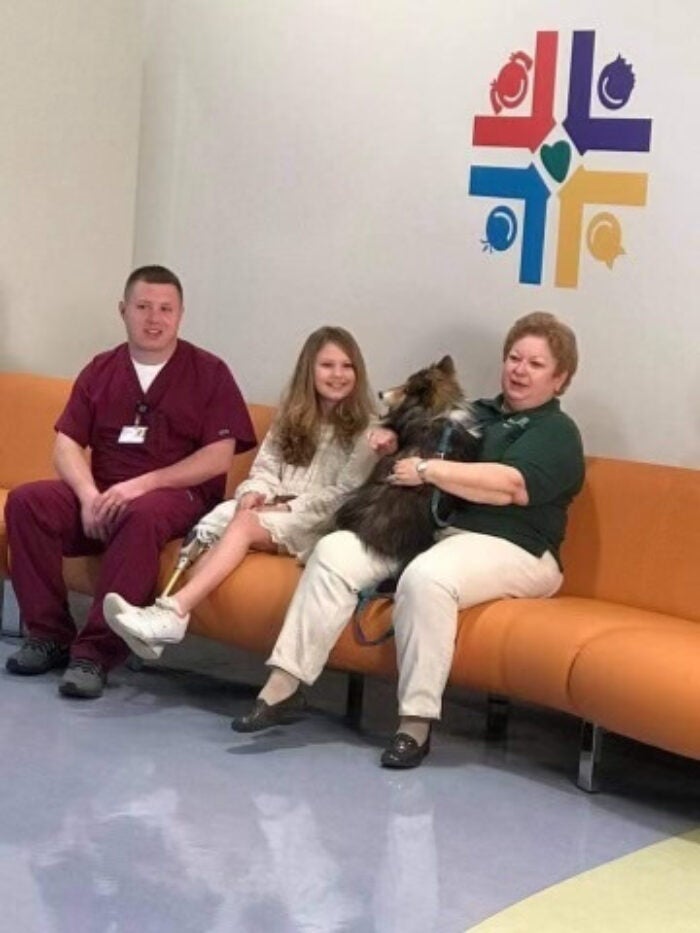
The moment Robin recognized her
Robin had recognized more than just the name. She recognized Bella herself — the girl from the commercial, the one who had rung the bell. The reunion in the library lasted only a few minutes, but it closed a loop that neither of them had fully known was open.
I thought I was going to start crying. It's overwhelming to see that connection, whether it's a patient or their family — it's overwhelming.
— Robin Ash, therapy dog handler
Robin has watched this play out hundreds of times in her decades of work: the moment a dog walks into a difficult room and something invisible loosens. In Drinko Library that afternoon, she watched it happen to a person she had first met when the difficult room was a children's ward — and who had, in the years between, walked out of it and built a life.
A dorm assignment nobody could have planned
The reunion didn't end with the library. Through Marshall's Paws in the Halls program, Robin and Isabella were assigned to visit the specific residence hall where Bella lived during her freshman year. What began as a chance encounter became a scheduled presence — a dog named after her stopping by her building on the program's regular rotation.
Bella is now preparing for her senior year and living off campus. The weight of those visits — both the ones in the pediatric ward and the ones in the dormitory hallway — has stayed with her in some form that is hard to name precisely but easy to feel.
What the tail still says
Therapy dog research has built up, over the past two decades, into a fairly specific picture. A 2025 randomized clinical trial published in JAMA Network Open enrolled 80 children at a pediatric emergency department and found that just ten minutes with a therapy dog doubled the rate of measurable anxiety improvement: 46 percent of children in the dog group showed decreased anxiety scores, versus 23 percent of those receiving standard care alone. The need for anxiety medication also dropped. In a pediatric oncology ward — where the ordinary rhythms of childhood have been suspended by treatment schedules and IV lines — a dog's complete indifference to all of that, its simple interest in getting its ears scratched, functions as something no prescription quite fills on its own.
Robin has been providing that anchor, one visit at a time, for longer than most people have been paying attention to animal-assisted therapy. Isabella carries the same mission now, padding through library stacks and dormitory hallways, stopping for whoever needs stopping for. For owners of calm, well-socialized dogs, organizations like Pet Partners and the Alliance of Therapy Dogs certify handler-dog teams for exactly this kind of work — assessing the animal's temperament under clinical stress and the handler's technique in unfamiliar rooms. Robin was doing this long before the certifications existed. The certifications exist now.
I am a childhood cancer survivor and advocate. It's uplifting to be in an environment where everyone is determined and ready to reach their own goals.
— Isabella "Bella" Masters, Marshall University student
Bella walks her campus on a prosthetic leg, studies the mechanics of the devices that let people move through the world after injury or illness, and has — at least once a week, when Isabella visits her building — a name twin with warm ears and a permanent grin who checks in without being asked. Some connections don't need much explaining. They just need someone to walk through the door.