Near the hospital bed, a dog may change the odds
Doges Editorial · 2026-06-15 · 5 min read
The largest matched study of its kind reports a hazard ratio of 0.36 — a 64 percent relative risk reduction in five-year cancer mortality. Among 55,000 matched patients, 95 percent with dog contact were alive at five years, versus 87 percent without.
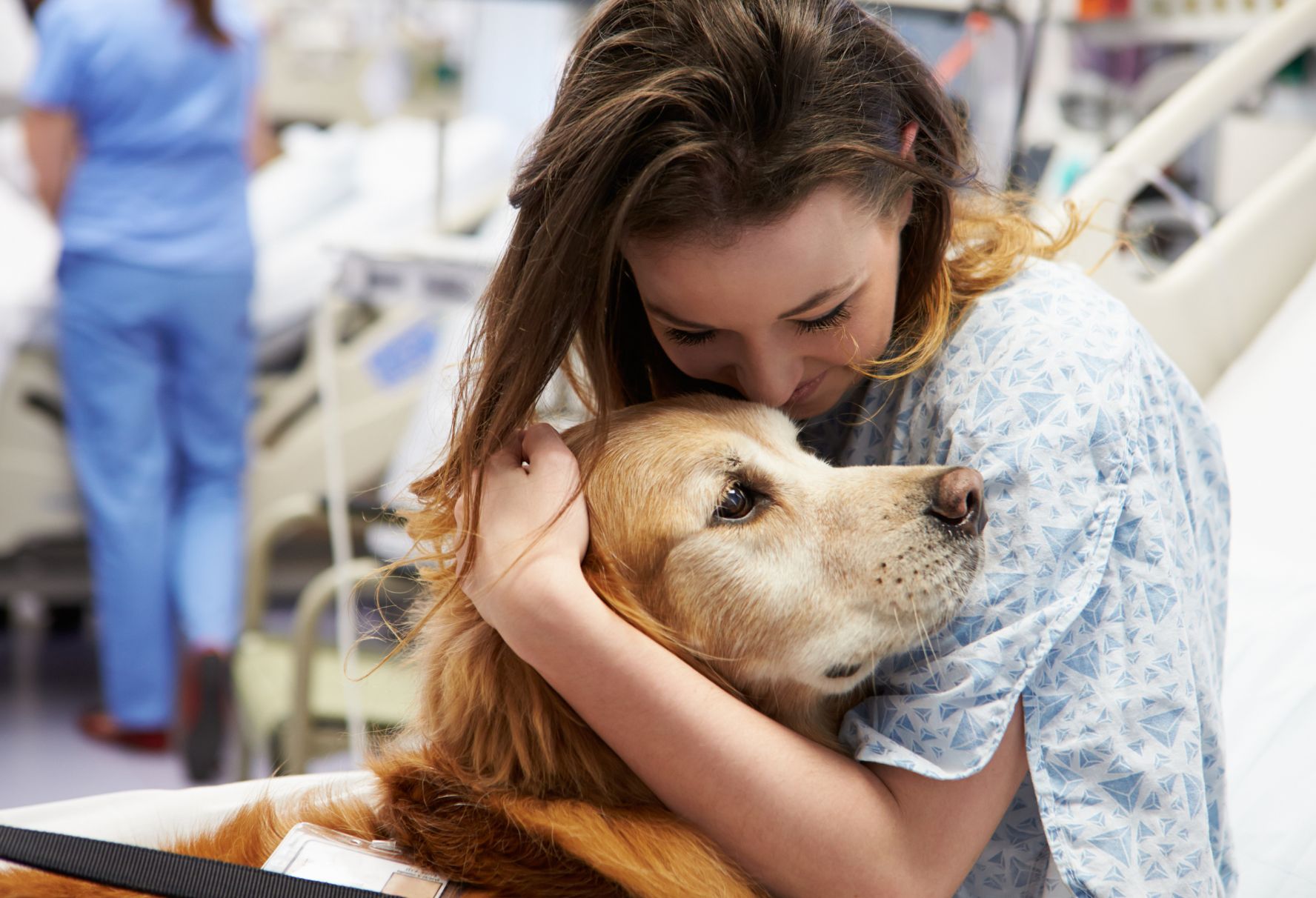
The woman in chair three doesn't look up when the dog comes through the door. She's connected to a drip. The session takes four hours, and this is her fourth Tuesday in a row. When the golden retriever crosses the linoleum and rests his chin on her knee, something in her shoulders drops.
Moments like that have been happening in cancer wards for decades. Trained therapy dogs visit patients in hospitals across the world, offering warmth that machines and protocols cannot. What medicine has struggled to show — until recently — is whether that warmth leaves a trace in the data.
A new epidemiological study, published in Scientific Reports by Preissner and colleagues in February 2026, has produced a number worth sitting with. Among more than 55,000 matched cancer patients — roughly 27,000 with documented dog contact, 27,000 without — those with dog contact survived five years at a rate of nearly 95 percent. Among those without, the figure was 87 percent. The study's hazard ratio was 0.36, meaning dog contact was associated with a 64 percent relative risk reduction in five-year cancer mortality (pubmed.ncbi.nlm.nih.gov/41703109).
What the researchers measured
The study drew from an international health records database. Researchers matched the two groups by age and sex, then compared five-year survival. Dog contact was identified through a standardized medical code in patient records — which is both the study's strength and one of its limits. A code confirms that a dog was present. It cannot say how often, or for how long, or whether the patient walked it every morning before the sun was fully up.
A hazard ratio of 0.36 is not a modest finding in cancer survival terms. The authors describe it as an association rather than a proven cause — observational data cannot go further — but they note this is the largest matched study of its kind to date.
The evidence is building that the bond between people and their dogs reaches further into health outcomes than previously understood — and that understanding it fully will require input from both human and veterinary medicine.
— AAHA Trends, June 2026
Three possible reasons the gap is there
The researchers offer three pathways. The first is exercise. Cancer patients who walk a dog — even a short loop around the block — are more likely to meet basic physical activity guidelines. Consistent movement during and after treatment is linked to better outcomes and tolerance for chemotherapy. A dog doesn't check the forecast. The leash still goes on.
The second pathway is psychological. Loneliness, depression, and social isolation are each independently associated with worse cancer outcomes, and all three are areas where dog companionship has demonstrated measurable benefit in earlier research. The structure of caring for an animal — feeding at seven, walk at eight, a nose under the hand at midnight — may help patients stay engaged with their treatment through what can be a long and frightening process.
The third possibility is more speculative: the microbiome. People who live closely with dogs share microbial exposures with their pets, and those differences may carry immune-related benefits. Because inflammation and immune function both play roles in cancer progression, the researchers flag this as a direction worth investigating — while noting the current data cannot say more than that.
A number from a very old question
One 2020 systematic review in Integrative Cancer Therapies analyzed 32 studies on therapy animals in cancer care and found consistent improvements in mood, oxygen saturation, and patient satisfaction with their care. A 309-patient survey in the Journal of Cancer Education found that 45 percent of pet owners reported feeling healthier because of their animal — and 48 percent said their pet helped them manage the stress of diagnosis.
What patients feel and experience matters. The research points to a clear pattern — the emotional and psychological benefits of interacting with animals are well established. This new study takes that a step further, linking dog contact to actual survival.
— AAHA Trends, June 2026
What this kind of evidence can and cannot say
The study's limits are real, and the authors are transparent about them. The population skews toward older adults. The data come primarily from hospitalized patients, which may not represent outpatient treatment — where most cancer care now happens. And there is the harder question that any observational study must sit with: are patients with dog contact simply healthier to begin with? More socially connected, more active, more financially stable? Any of those factors could improve survival independent of the dog.
The researchers acknowledge this directly. Seriously ill patients may have less dog contact not because the dog is absent, but because they are frail. The only way to settle the causal question is a controlled trial. No such trial has yet been run.
The pattern it joins
This study doesn't arrive in isolation. A 2019 meta-analysis in Circulation: Cardiovascular Quality and Outcomes — pooling data from more than 3.8 million people across ten studies — found that dog owners had a 24 percent reduced risk of dying from any cause and a 65 percent reduced risk of death following a heart attack (heart.org/en/news/2019/10/08/heres-more-evidence-your-dog-might-lengthen-your-life). The benefit was strongest for people living alone, as if the dog compensates for something that social isolation removes.
Cancer is where this line of research has been slowest to develop, which makes these numbers notable. Whether the mechanism is the morning walk, the emotional routine, the warmth of a head on a knee during a four-hour drip — the data keeps pointing in the same direction. For now, that is not a prescription. It is an accumulating signal.
The woman in chair three is petting the dog now. Her session has two hours left. The dog doesn't know any of this. It just knows she's there, and it knows she needs him.