What actually lowers your dog's risk of cancer
Doges Editorial · 2026-06-04 · 6 min read

Six million dogs are diagnosed with cancer every year in the US. The experts behind the Dog Aging Project and Purina's 14-year lifespan study say the most effective protection is also the most obvious — and most overlooked.
Before you knew your dog's name, before you had decided on the bed or the collar or the vet, there was an implicit agreement. You would try to give them as many good years as possible. The researchers behind some of the largest canine aging studies ever run have been working on the same agreement, at scale, and what they are finding is both sobering and unexpectedly actionable.
Cancer is the number one cause of death in dogs across all breeds. More than six million dogs in the United States are diagnosed with it each year, according to the National Cancer Institute — and more than four million die from it. For context: that is roughly the population of Los Angeles, counted in dogs, dying of cancer every year.
What's actually killing them
Matthew Kaeberlein is the founder and co-director of the Dog Aging Project, a longitudinal study that has enrolled nearly 55,000 dogs in an effort to understand how they age, what protects them, and what makes them sick. He has spent years thinking about canine mortality, and his answer to the question of what kills dogs is worth hearing in its specificity.
Cancer is first. Heart disease — driven mostly by degenerating heart valves and weakening heart muscle — is second. Trauma and accidents are third. After that, Kaeberlein says, the picture fills in with degenerative, age-related conditions that accumulate quietly over years.
The rest is largely made up of degenerative, age-related diseases. Infectious diseases do occur, but they're relatively uncommon in dogs that receive routine veterinary care and appropriate vaccinations.
— Matthew Kaeberlein, co-director, Dog Aging Project
Which is to say: the biggest threats to your dog's life are not exotic or unforeseeable. They are chronic. They build. And they respond, measurably, to the choices made in the years before they appear.
The weight problem
Dr. RuthAnn Lobos, senior veterinarian at Purina, calls obesity the "biggest threat" to a dog's lifespan. She points to Purina's 14-year dog lifespan study — one of the most extensive dietary studies ever conducted on companion animals — as the evidence base for just how seriously this matters.
In that study, scientists tracked Labrador Retrievers from puppyhood into old age. Dogs fed lean meals throughout their lives lived nearly two years longer than dogs that were less carefully fed — almost 25 percent more lifespan, derived almost entirely from the discipline of not overfeeding. Two years, in a dog who might otherwise live ten or twelve. That is not a rounding error.
A multitude of research has demonstrated and reinforced that, including Purina's groundbreaking 14-year dog lifespan study.
— Dr. RuthAnn Lobos, senior veterinarian, Purina
Obesity connects to cancer through several pathways — inflammation, metabolic disruption, hormonal imbalance — and it is also a contributing factor in heart disease and age-related joint disease. The number on the scale is not just an aesthetic question. It is a prognostic one.
Exercise is not optional
Kaeberlein's prescription is direct: don't overfeed, limit highly processed human foods, and prioritize regular exercise. He notes that a recent study found dogs who got more exercise had significantly lower rates of cognitive decline — a finding that echoes decades of human research on the same connection.
The mechanism matters here. Movement isn't just about burning calories. It protects the cardiovascular system, reduces chronic inflammation, supports joint function, and — increasingly, researchers believe — helps maintain the neural architecture that lets an aging dog stay sharp. An arthritic 11-year-old who still goes for a slow 20-minute walk every morning is doing something genuinely protective.
Lobos adds that for senior dogs — those roughly seven and older — low-impact options like a walk in the park, light fetch, or a swim are ideal. The goal is sustained movement, not intensity. It is not about miles. It is about showing up, most days, for something that gets the body going.
The mouth, and why it matters more than you think
The finding most likely to surprise dog owners: oral health has systemic consequences that reach far beyond bad breath. Kaeberlein describes periodontal disease as a genuine risk factor for metabolic disease, cardiovascular disease, cognitive decline, and possibly cancer. The mouth and the rest of the body are in constant conversation, and an infected gum line is not a localized problem.
Taking care of a dog's mouth isn't just about the teeth. It appears to have whole-body benefits.
— Matthew Kaeberlein, co-director, Dog Aging Project
Lobos adds a practical caution: at-home dental cleaning and groomer brushings can miss major problems, creating a false sense of security. Professional veterinary dental cleanings — which require anesthesia and which many owners delay as long as possible — are the only way to fully assess what's happening below the gum line.
Dogs feel what we feel
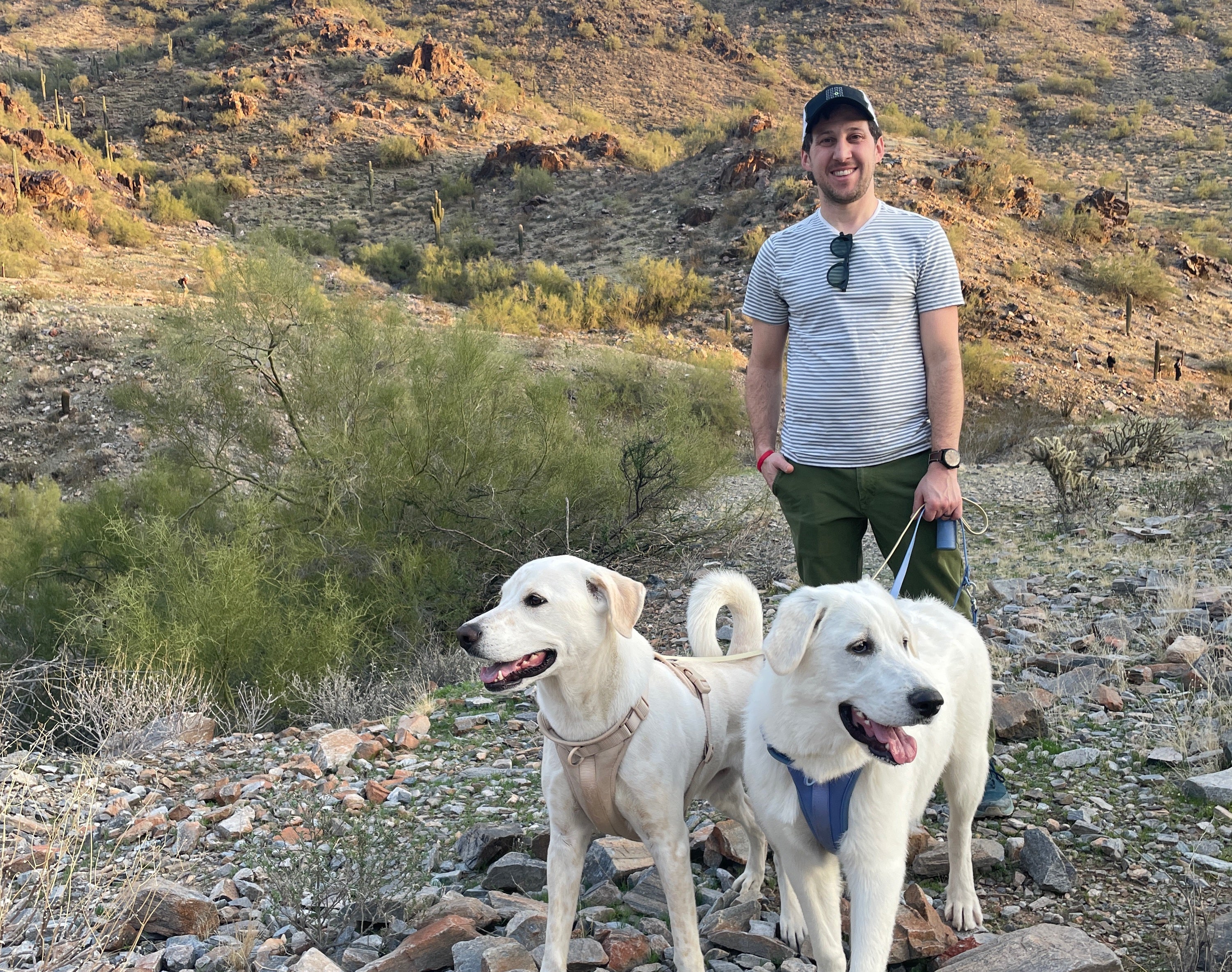
Noah Snyder-Mackler, an assistant professor at Arizona State University who owns a Great Pyrenees mix named Homer and a Great Pyrenees named Juno, studies how social environments affect dog health. His findings carry an uncomfortable implication.
Stressors in the home — arguments, instability, emotional turbulence — appear to measurably affect a dog's rate of disease and survival. Dogs are not passive residents of their households. They are participants in the emotional climate, and their bodies register what they experience in ways that show up in health outcomes.
Dogs are sort of as sensitive to their social environments as humans are, in very similar ways.
— Noah Snyder-Mackler, assistant professor, Arizona State University
What the research is really asking
Daniel Promislow, Kaeberlein's co-director on the Dog Aging Project, offers a perspective that reframes the whole enterprise. Because dogs age roughly ten times faster than humans, they are, in a sense, a fast-moving model for the same processes that play out in us over decades. Discoveries made in dogs can point researchers toward human risk factors years before a human longitudinal study could arrive at the same conclusions.
What the Dog Aging Project is building, dog owner by dog owner, across its enrollment of nearly 55,000 animals, is a dataset large enough to identify the environmental and behavioral variables that protect against age-related disease in a species that is genetically similar to us, lives in our homes, eats food not entirely unlike ours, and breathes the same air.
The number worth remembering
Kaeberlein puts it this way: with the interventions that already exist — lean diet, regular movement, preventative veterinary care, attention to dental health, reduced exposure to household chemicals and pesticides — humans may be able to extend their dog's healthy lifespan by 20 to 30 percent. "And potentially more is within reach," he says, "if we commit the resources to do the science properly."
Twenty to thirty percent. On a 12-year lifespan, that is two to three and a half more years. More mornings, more walks, more time in whatever chair your dog has quietly claimed as its own. The interventions are not glamorous. They are not novel pharmaceuticals or gene therapies, though those are coming. They are: feed less, move more, go to the vet, clean the teeth, and pay attention to what your dog is living inside.
The next walk you take together is not nothing. The researchers are increasingly clear about that.