The dog who ran back to the one voice she trusted
Doges Editorial · 2026-06-23 · 6 min read
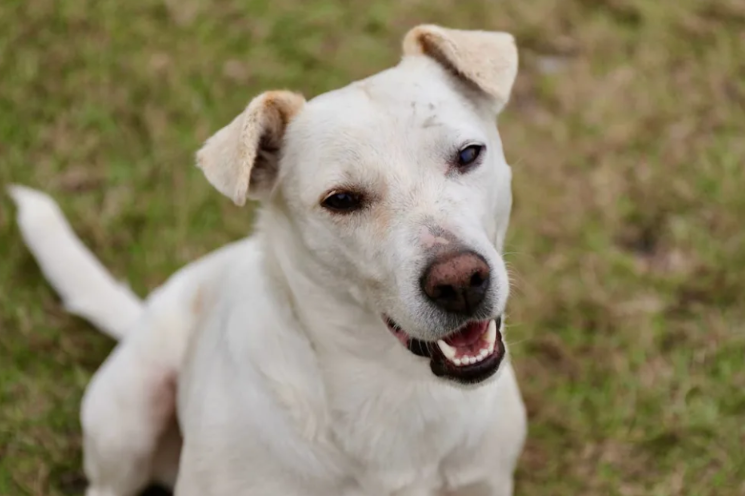
Three days after adoption, Coconut slipped her harness and vanished into the woods. Her new family gave up. Then her foster mom came looking — alone, calling her name into the trees.
The woods were quiet. Danielle stood at the tree line with nothing but her voice and whatever trust three months of fostering can build into a dog. Coconut had been gone for three days. Her new adopters had given up, called the shelter, told them to list her as surrendered if she turned up alive. Danielle wasn't ready to do that.
A white dog, a new home, and a harness that didn't hold
Coconut came from a shelter. Before her adoption, she had spent weeks in Danielle's foster home — that in-between place that rescue dogs pass through before they find their permanent family. Foster arrangements are designed to be temporary. The foster parent feeds them, trains them, learns them, then lets them go. Danielle had done this before. She knew the shape of the goodbye. In Coconut's case, it seemed like a good one: a family had chosen her, papers had been signed, and Coconut had gone home with them three days earlier.
Then the harness slipped. Somewhere outside, in some ordinary moment — a morning walk, a gate left open — Coconut bolted and disappeared into the trees. She was gone. Her new family searched. They called the shelter. After a few days, they made the call that felt pragmatic: they weren't able to keep looking, and if the dog was found, they wanted to surrender the adoption.
Her adopters gave up. Her foster mom did not.
That's where the story could have ended. A lost dog. An exhausted family. A shelter notation. Instead, Danielle got in her car and drove to the woods. She wasn't on a formal search team. She didn't have a rescue vest. She went alone, calling Coconut's name into the trees, not knowing if the dog was close enough to hear or if she'd answer even if she was.
My foster dog Coconut got adopted... a few days after being adopted, she slipped out of her harness and ran to the woods. Her adopters gave up looking and told the shelter they wanted to surrender her if she was found. So [I] went out searching for her myself, calling her name and hoping for the best. Watching her come running back to me is something I'll never forget.
— Danielle (@just_another_sahw), foster mom, via Instagram
Into the trees, calling her name
There's something about a foster parent's voice that a dog memorizes early. Before the adopters came, before the new house and the new smells and the harness that didn't fit quite right — there was Danielle's voice, steady and daily. In the morning with food. At the door in the evening. At the end of a leash on a hundred ordinary walks. Rescue dogs often arrive brittle and uncertain. The foster home is where they learn that specific human voices mean safety.
In the woods, Danielle kept calling. And then Coconut came running. White ears flying, feet churning through the underbrush, closing the distance like she had been waiting for exactly this — the right voice saying the right name. Someone had a camera. The video was thirty seconds long and immediately overwhelming.
A 2024 study from Budapest's ELTE Department of Ethology, published in Animal Behaviour, gave this a scientific basis for the first time. Researchers asked 31 dogs to match pre-recorded voices to one of three equally familiar family members — owners seated silently side by side, no gestures, no movement, just sound through a loudspeaker. Every dog succeeded. The acoustic features that made it possible are the same ones humans use to identify each other: fundamental frequency (roughly pitch) and jitter, the fine irregularity in vocal vibration that gives a voice its specific texture. Three months of daily interaction with a foster parent builds exactly that acoustic map.
![Coconut with Danielle after her three days lost in the woods. [source-body-img]](https://themorningtails.com/wp-content/uploads/2026/06/coconut1.png)
1.27 million hearts
By June 2026, Danielle's Instagram post had gathered more than 1.27 million likes. The comments filled with people who seemed surprised by how hard a thirty-second video hit them. Viral dog content usually runs on pure delight — a puppy falling asleep in a bowl, a Labrador's operatic reaction to an empty treat bag. Coconut's video went differently. It moved people because it had weight: the question of whether a dog had been deliberately abandoned, and the fact that someone chose to go back anyway.
This shattered my heart. They 100000% dumped her. I can't thank you enough for CARING and going back to look for her. Sweet angel, you're safe again.
— Viewer comment, via Instagram
The comment threads split, as they do, between people who were angry at the adopters and people who simply couldn't stop watching Coconut run. Both reactions pointed at the same thing: this video had a moral structure. It wasn't just a dog being happy to see someone. It was a sequence — adoption, escape, surrender, search, return — that tracked almost exactly the shape of a betrayal and a refusal. Danielle's caption didn't name any villains. She just laid out what happened, in order, and let the thirty seconds of footage carry the rest.
What three months in a foster home builds
Dog trainers and shelter behaviorists talk a lot about the decompression period — the weeks a dog needs to settle after a big transition. Foster homes are where much of that happens. A dog who came in scared and shutdown learns, gradually, that the person who fills the bowl also sits on the couch and doesn't move suddenly and says the same good-morning words every day. That pattern writes itself deep. It's not loyalty in the cinematic sense. It's familiarity made physical. A specific voice becomes the sound of safety.
A January 2026 study from Virginia Tech followed 84 shelter dogs through week-long foster stays, tracking stress with activity monitors and over 1,300 urine samples. Cortisol fell significantly during foster care — an effect twice the size of what shorter overnight stays produced. Dogs rested more in homes. When they returned to the kennel, their cortisol didn't spike above where it had been before they left. The researchers called it a chance to rest and recharge. Coconut had three months of that, not one week.
Coconut had spent three months building that map with Danielle. Then, in less than a week, it was tested. The new house, the new people, the malfunctioning harness — all of it was disorienting. The woods were disorienting too. But Danielle's voice wasn't.
She came running back to me
After the search, the shelter listed Coconut as still needing a permanent home. Danielle had her back. The foster arrangement, technically temporary, had survived a small crisis and produced something stronger than before. Whatever Coconut makes of any of this, her behavior in the woods suggests she had already decided, at some point during those three months, that one specific voice was worth running toward.
Somewhere out there, Coconut will find a permanent family — one with a harness that fits. She'll decompress into a new house, learn a new yard, memorize a new set of footsteps. But if you've watched the video, you know what the baseline is now: a white dog closing fifty yards of woods at full sprint toward a single voice. That's the starting point for whoever ends up with her. Not a scared shelter dog. A dog who already knows, in her bones, that she can trust a human to come back.
That's the thing about dogs and fostering that the paperwork doesn't capture: the attachment isn't conditional on the official arrangement. A dog doesn't know she's supposed to be temporary. She just knows who calls her name like they mean it.