The rescue dog who beat 57 others — and went to work for the people who need her most
Doges Editorial · 2026-06-06 · 4 min read
DOGES
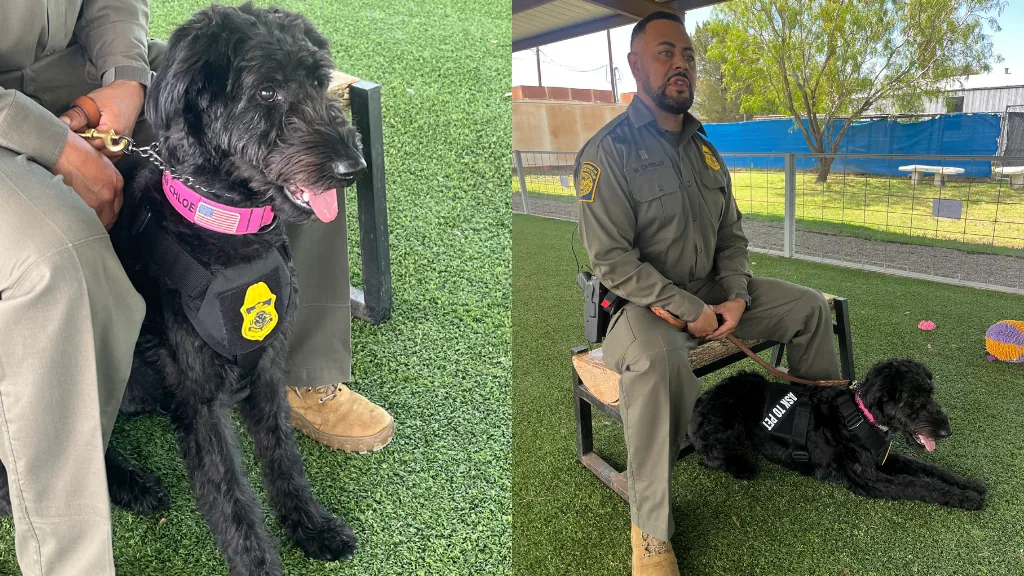
Out of 58 candidates, only one dog made it through the U.S. Border Patrol's new Critical Incident Response K9 program. She came off the streets of El Paso. Her name is Chloe.
There's a moment in every rescue story that happens before the rescue — the moment of being alone in the middle of something dangerous. For Chloe, it was a street in El Paso, Texas: a two-and-a-half-year-old dog with no collar, no record, no one looking for her. Running loose the way stray dogs run when they've been at it long enough to stop hoping.
That was before the U.S. Border Patrol started looking for a dog like her. Reported by KVIA on June 4, 2026, her story is the kind that's difficult to explain without mentioning odds.
Fifty-eight dogs entered. One made it through.
The U.S. Border Patrol's Critical Incident Response K9 program was designed for a specific kind of work. Not drug detection, not suspect apprehension — this program trains dogs to provide emotional support and comfort to Border Patrol agents and their families during the hardest moments of the job: trauma, grief, loss, crisis. It's a welfare role. The people this dog visits aren't criminals. They're colleagues who've watched something terrible happen and need an anchor.
Fifty-eight dogs entered the training pipeline at the USBP Canine Academy. The program runs ten weeks. Fifty-seven dogs didn't finish. Chloe — a former stray, adopted through the El Paso Rescue League — was the only one who did. As of June 4, she holds the first certification of its kind: the first rescue dog ever to earn the U.S. Border Patrol Critical Incident Response K9 designation.
A different kind of working dog
What separates a critical incident response dog from other K9 roles is temperament more than training. The work requires a dog that can hold still in a room charged with grief. That can walk alongside someone who has just experienced something terrible without flinching or crowding or demanding attention. That can simply be present — warm, available, undramatic — while everything around them is difficult.
The ability to pass a ten-week training program is one thing. The emotional constitution required to do this work reliably — with agents who are sometimes barely holding together — is something different. It's the kind of capacity that's almost impossible to breed for deliberately. Sometimes you find it in a dog who learned to read humans out of necessity.
For me, it was love at first sight.
— Agent Miguel Carrillo, USBP K9 handler
Agent Miguel Carrillo was assigned as Chloe's handler for the ten weeks of training and beyond. He spent that time learning to move alongside her, to read her signals, to position her correctly in difficult rooms. The bond that forms in that kind of program is built from accumulated trust — you learn to rely on each other under conditions that don't allow for second-guessing.
On the frontlines of something quiet
To think that she was once running the streets, abandoned, and now she's on the frontlines supporting our people. That's wonderful.
— Agent Miguel Carrillo, USBP K9 handler
The work Chloe does doesn't look like most people's idea of a K9 job. There's no perimeter to clear, no scent trail to follow. The frontlines she operates on are hospital waiting rooms and conference rooms and the parking lots of fire stations after a bad shift. Her job is the most human thing a dog can do: stay.
Before KVIA published her story this week, Chloe had already made her first major deployment — a youth grief-support camp in Louisiana, working with children processing loss. She was there at the end of May, weeks before the news broke nationally. Fifty-eight dogs, ten weeks, one certification. And her first real assignment was a room full of kids who needed something to hold on to.
Why rescues sometimes make the best working dogs
There's an instinct in high-stakes K9 programs to favor purpose-bred dogs — German Shepherds from working bloodlines, Belgian Malinois with known pedigrees. The logic is that you can trace what you're getting. But what Chloe's story suggests is that certain qualities — social intelligence, the ability to stay calm under emotional weight, a finely tuned sensitivity to human moods — are sometimes most developed in dogs who had to rely on them to survive.
Street dogs navigate human social dynamics continuously. They learn which body language signals a threat and which signals safety. They develop an almost professional sensitivity to human emotional states — not because they're trained to, but because reading people correctly is how they stay safe. These are not skills that a training program instills from scratch. They're skills that a training program can build on.
What she does now
Chloe now has her own Instagram account — @chloesk9onduty — where Agent Carrillo documents her deployments and daily work. It's a useful window into a role that's otherwise nearly invisible. Most of what she does happens in closed rooms, in moments that are private by necessity. The account offers a way to show the world what a grief-support K9 actually looks like, who she visits, how she moves through spaces that most working dogs never enter.
What the story so far suggests is that the qualities that kept Chloe alive on the streets of El Paso turned out to be exactly what was needed.
The training no shelter taught her
There's probably a version of this quality in your own dog — the way they press close when they sense something is off, the way they settle without being asked on the days you most need something calm nearby. That sensitivity isn't random. It's been built over thousands of years of living alongside humans and learning to read what we need.
Chloe just happens to be doing it officially now. Somewhere this week, in a room somewhere between here and Louisiana, she's doing what she's always known how to do. The paperwork finally caught up with the dog.