The five rescue teams it took to bring Chester home
Doges Editorial · 2026-06-02 · 5 min read
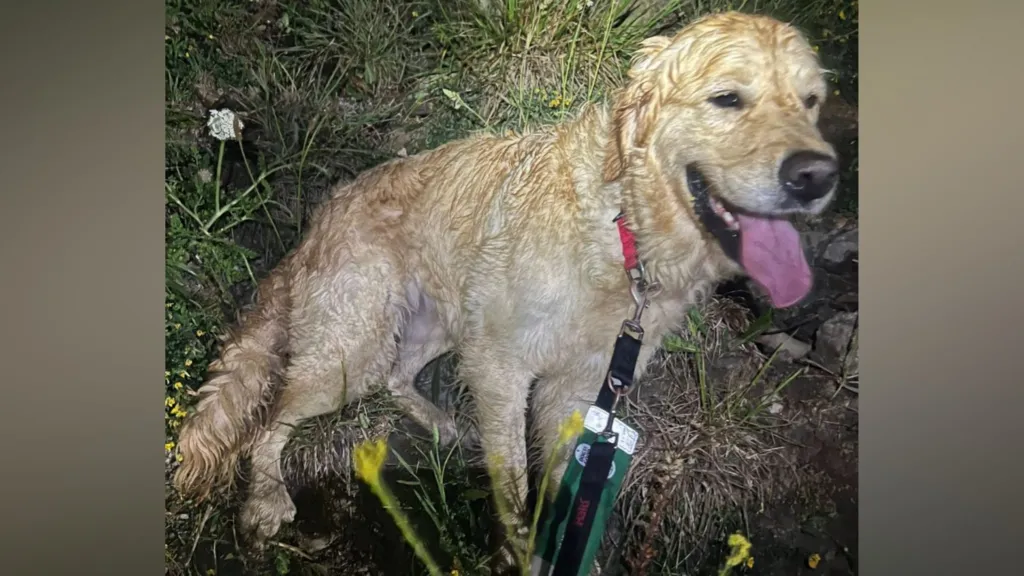
A golden retriever named Chester fell 80 feet down a Dorset cliff in the early hours of Thursday morning. Five agencies, an RNLI lifeboat, and a specialist rope unit spent five and a half hours getting him back — through an electrical storm, and despite Chester escaping the rescue bag twice.
Somewhere below the coastal path at Peveril Point, in the dark hours before a Dorset dawn, a golden retriever named Chester was standing on a narrow ledge eighty feet above the sea. He'd been walking with his family minutes before. Then something spooked him — no one knows what — and he ran, and the chalk gave way.
That Chester survived the fall at all is the first of this story's quiet miracles. The second is what happened next: one by one, five separate rescue teams gathered at the top of that cliff and began the five-and-a-half-hour process of coaxing a frightened dog to trust them. Via BBC News, June 1, 2026.
The call goes out
Dorset and Wiltshire Fire and Rescue Service arrived first, followed by Swanage Coastguard and St Albans Coastguard Rescue Team. Then came the Tech Rescue specialist unit from Poole. An RNLI lifeboat, returning from an unrelated callout, spotted Chester on the ledge below and stayed — its crew providing what the Coastguard later called "vital illumination" as the weather turned.
Five agencies. Five sets of training, radio frequencies, and equipment. All of them looking down at one frightened dog who had fallen 80 feet and was now standing on a ledge with a significant drop below — and who had no way of knowing they were there to help.
The storm arrives
There is a specific quality to a coastal rescue at night that anyone who has walked Peveril Point in bad weather will understand. The chalk headland is dramatic in daylight. In the early hours, in rain, with a large electrical storm moving in from the sea, it becomes something else entirely.
The storm, the Swanage Coastguard spokesperson said, made everything harder. But the primary challenge wasn't the weather. It was trust. Gaining the trust of a dog who had just survived an 80-foot fall, was now trapped in the dark on a narrow ledge, and had every reason to believe that the shapes moving around above him were a threat — not a rescue.
The first challenge was gaining Chester's trust, which was made even harder as the weather deteriorated with heavy rain and a large electrical storm moving in.
— Swanage Coastguard spokesperson
The dog who wouldn't be rescued
Rescue teams brought a specially designed dog rescue bag — a piece of equipment built for exactly this scenario. Chester escaped it. They tried again. Chester escaped his collar too.
There is something both frustrating and completely understandable about this. A dog who has just fallen 80 feet, is soaking wet in a storm, and is now being approached by strangers with an unfamiliar piece of equipment — that dog is not going to cooperate out of good manners. He is going to do the thing his instincts are telling him, which is to get away from the thing being put around him.
A specialist rope rescue team and technician eventually found an approach that worked — "carefully handling" Chester down the cliff face and out via a zig-zag path to the shore. When they reached the beach, Chester was described as "frightened and scared but unharmed." His owners, who had spent the entire five and a half hours above on the cliff, were described as "equally distressed."
This was an outstanding example of multi-agency teamwork coming together to safely reunite a much-loved family dog with his owners.
— Swanage Coastguard spokesperson
The coastguard's message for dog walkers
Peveril Point is not a remote or especially dangerous walk. It is the kind of headland that appears in every Dorset walking guide: good views, clean air, paths that cut above the chalk cliffs toward the sea. Dogs have walked it thousands of times. Chester walked it the night before without incident.
What the coastguard wants walkers to take from this is something specific and practical: coastal paths are different from inland walks, particularly after dark. Scents and sounds blow in from directions that don't exist inland. Dogs bolt. Chalk crumbles. The gap between the path and the edge is sometimes smaller than it looks.
We'd like to remind dog owners to keep their dogs on a lead, especially when near the cliffs — and to never attempt a rescue yourself.
— Swanage Coastguard spokesperson
What five and a half hours looks like
Chester's story is, on one level, about a very bad night and a very good outcome. But it is also about the scale of what gets mobilised when a dog needs help — the specific human refusal to leave an animal on a ledge just because it's dark and raining and there's lightning. Five agencies. A lifeboat crew that stayed when they could have gone home. A specialist unit from Poole. Hours of patience, in the rain, with a dog that kept escaping.
Chester got home. Frightened and scared but unharmed — which, after an 80-foot fall onto a Dorset cliff ledge in an electrical storm, is the only outcome that matters.
The lead and the ledge
Most morning walks don't end like this one. The familiar routes — the park, the riverside path, the usual circuit before work — are known ground, and the chances of a 80-foot drop are low to none. But there is something in this story that is worth carrying into any walk, even a gentle one: the understanding that dogs have their own geography of the world, built from smells and sounds, and that it does not always match ours.
Chester knew something was out there, on the edge of the cliff, in the dark. He just didn't know where the edge was. Whatever your morning route looks like today, Chester's would probably appreciate a few extra seconds on the lead near any kind of drop.