The dogs who crossed the graduation stage too
Doges Editorial · 2026-05-25 · 6 min read
At a Buffalo university, dogs and their student trainers just crossed the stage together — and the ten-week partnership changed both species for the better.
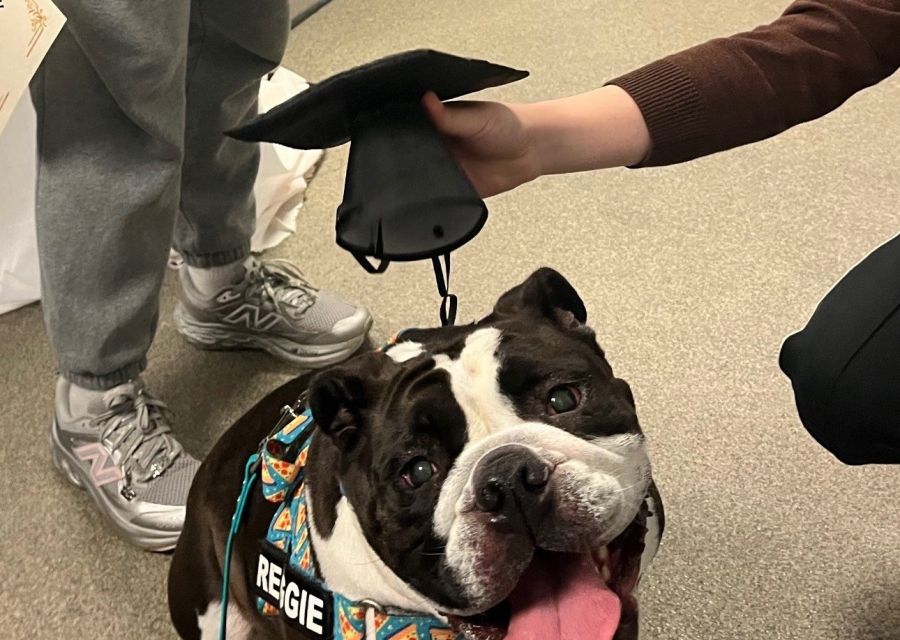
Reggie the English Bulldog wasn't expecting much from graduation day. He showed up in a tiny mortarboard, accepted his diploma with the gravity of a tenured professor, and then — presumably — looked around for snacks. The humans clapping around him had just finished ten of the most interesting weeks of their college careers, and the small bulldog in the hat was a big part of why.
The Course That Changes Both Species
At Canisius University in Buffalo, New York, a course called Applied Behavior and Education for Companions — ABEC 320/320L — has been quietly running a small-scale experiment every spring. Students are paired with real dogs brought in by their actual owners, and for ten weeks they practice the kind of hands-on, adaptive learning that no amount of reading about dog behavior can replicate.
The dogs aren't a prop or a demonstration. They are the curriculum. Each student works with a specific dog on behavior modification goals set at the start of the term — greeting manners, focus exercises, anxiety management, or whatever that particular dog most needs. The students propose plans, watch what unfolds, revise their thinking, and try again. The dogs, meanwhile, get ten weeks of careful attention from someone who is genuinely trying to understand them.
At the end of the semester, both species graduate. The dogs receive diplomas. The mortarboards come out. And a room full of people who came to learn about animal behavior leaves knowing something quieter and more durable: what it actually feels like to be paid attention to by a dog, and to pay attention back.
No One-Size-Fits-All Dog
The course's instructor, Dr. Maura Tyrrell, built it around one central truth that professional trainers spend careers learning to internalize: there is no universal dog. What motivates a confident Labrador may mean nothing to a nervous rescue. What works as a reward for one dog is irrelevant to another. The training plan that produced a breakthrough last week may stop working this week for reasons that require careful observation to understand.
Every dog is different. Every dog has a unique learning history, different motivations and different preferences. Rather than using a one-size-fits-all approach, students learn how to adjust training plans based on the dog in front of them.
— Dr. Maura Tyrrell, ABEC course instructor
That kind of adaptability is harder to teach than it sounds, because it requires students to resist the pull of certainty. They must hold their hypotheses loosely, watch what the dog's body is communicating, and be willing to scrap a plan that isn't working without getting frustrated at the dog for not cooperating. It's clinical thinking applied to an animal who communicates almost entirely through posture, pace, and small behavioral choices that happen dozens of times a minute.
A Full-Circle Moment for Reggie
Emma Schiedel graduated from Canisius in 2022 and came back this spring as an owner-volunteer, bringing her three-year-old English Bulldog Reggie to participate in the course. She spent the semester watching students work through real training challenges using her dog — the animal who is, by her own description, a huge part of her daily life and her sense of home.
Reggie is such a huge part of my life, so being able to participate in something connected to the university while also helping students gain hands-on experience was meaningful to me. It felt very full circle.
— Emma Schiedel, Canisius Class of 2022
For Schiedel, the semester offered something that alumni rarely get: a reason to walk back into the institution that shaped her and contribute to what happens there. For Reggie, it offered something dogs rarely get from strangers — sustained, curious, non-judgmental attention. He wore the mortarboard at the end. He did not object.
![Charlotte the Goldendoodle celebrates with a graduation cupcake. [source-body-img]](https://www.canisius.edu/sites/default/files/styles/1_scale_x_small/public/images/CharlotteCupcake.jpg)
When the Pattern Game Worked
Teaching assistant Megan Greenberg is finishing her senior year as a dual major in ABEC and psychology, and she came to the role with a specific memory from her own time as a student in the course. The dog she'd been paired with struggled badly with greetings — the sight of a new person sent her into a spiral of excitement that made calm hellos essentially impossible, no matter what the student tried.
When I was a student, the dog I worked with struggled with polite greetings because she became so excited around new people. We tried several approaches with little progress until we used a pattern game to maintain her focus while someone approached. The progress was immediate.
— Megan Greenberg, ABEC/psychology student and teaching assistant
A pattern game — a simple, predictable, repeating sequence that gives a dog something structured to do with her brain in a high-arousal moment — turned a years-long greeting problem into something manageable within a single session. The technique mattered, but so did the lesson underneath it: that a dog who seems impossible to reach may just be waiting for the right approach, and the right approach is found through careful, patient detective work rather than force or repetition of the same failed method.
The Hidden Power of Scent Work
Beyond manners and greeting protocols, the course introduces students to enrichment activities that most dog owners never think to try. Scent work — hiding a specific smell and letting a dog hunt for it methodically — sounds like a novelty, but what it does to a dog's inner state is worth understanding carefully.
"Scent work builds confidence, promotes problem-solving and provides mental stimulation," Tyrrell says. "These activities improve overall well-being and can become an important part of behavior change plans." A dog who spends twenty minutes nosing through a room for a hidden odor isn't simply entertained — she's doing real cognitive work, making decisions, following evidence, and experiencing the specific satisfaction of a problem solved. That kind of mental exertion carries over: a well-scented dog is often a calmer dog for the rest of the day.
What Dogs Need Us to Know
Every dog owner has experienced the quiet frustration of the thing that won't work: the leash-pulling that persists through every correction, the door chaos that flares up at the worst moment, the reactivity that seems to come from nowhere. What Canisius students leave this course knowing — that behavior isn't a character flaw but a response to a specific history, context, and moment — is something any dog owner could stand to hear.
By May, the students have developed something harder to quantify than technique: they've learned to pay attention to a dog the way a good observer pays attention to anything — with patience, with the willingness to be wrong, and with genuine curiosity about what's actually happening rather than what they expected. The dogs leave having been understood, week after week, by someone who showed up wanting to learn their particular language. That quality of attention is rare, and both species are better for having practiced it.