What happens when you put 42 dogs with dementia in a training class
Doges Editorial · 2026-06-01 · 6 min read

A University of Adelaide trial enrolled 42 senior dogs with cognitive dysfunction into structured group classes and tracked outcomes with FitBark accelerometers. The disease didn't reverse. But sleep improved, activity calmed, and caregiver burden dropped — and the second finding may matter more than the first.
At 8 years old, about one in four dogs will show the first signs of canine cognitive dysfunction — the disorientation, the night pacing, the staring at walls. By age 15, roughly 70 percent will be affected. Until recently, the clinical toolkit was thin: a prescription drug, an antioxidant supplement, a wait. A study published in GeroScience in May 2026 has added something new to that toolkit, and its most useful finding may not be about the dogs at all.
What canine cognitive dysfunction looks like in a house
The clinical shorthand is DISHAA: Disorientation, altered Interactions, disrupted Sleep-wake cycles, House soiling, changes in Activity, and Anxiety. In practice it looks like this: a dog who used to greet you at the front door no longer does. A dog who has been reliable indoors for twelve years starts missing the mark. At 3 a.m., the same dog paces a loop around the kitchen and vocalizes in a way that's hard to describe — not barking, not whining, something in between.
Canine cognitive dysfunction shares its core pathology with human Alzheimer's: amyloid-beta plaques, tau tangles, brain atrophy, oxidative stress. Dogs age faster than humans, which means the disease progresses faster too. Families caring for a dog with CCD tend to describe the experience in the same vocabulary as families caring for a human with dementia: exhausting, isolating, punctuated by moments of pure connection that make it impossible to give up.
The 2026 University of Adelaide trial
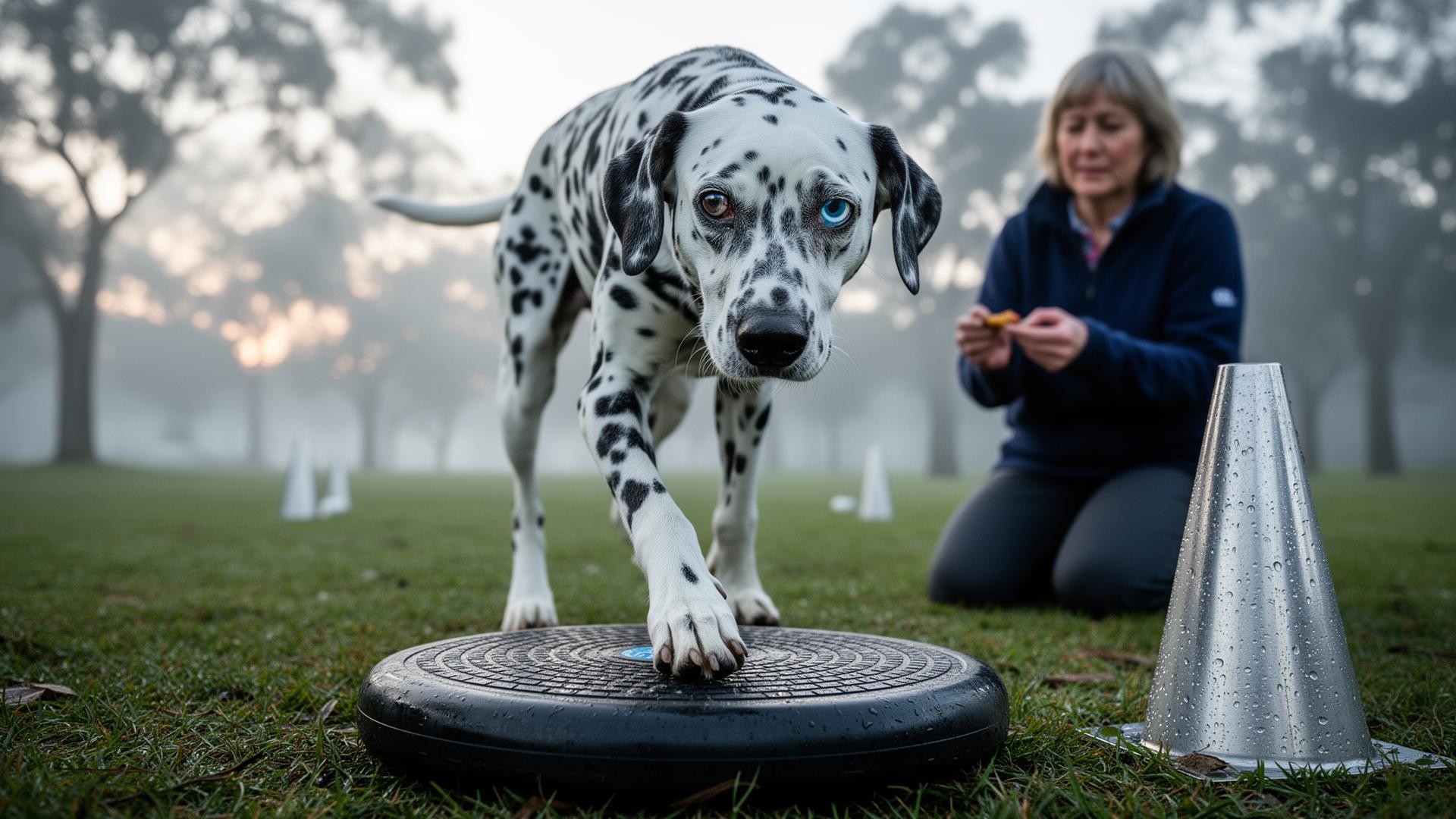
Researchers enrolled 42 senior dogs — all aged 8 or older, all with confirmed mild-to-moderate CCD — in a five-week program. Dogs were randomized into two groups. The first did scent-based training: structured nosework, olfactory enrichment, hide-and-seek tasks using cardboard boxes and cups. The second did physical structured training: low-impact balance work, body-awareness exercises, simple obedience tasks rebuilt from the ground up.
The measurement tools were deliberate. Cognitive severity was scored using CADES — the Canine Dementia Scale — a validated instrument that takes about ten minutes to administer. Activity and sleep were tracked objectively using FitBark accelerometers: the same kind of small wearable that dog owners clip to collars to track daily steps, sleep quality, and rest patterns. Caregiver burden was measured using scales borrowed directly from human dementia research.
What the data showed — and what it didn't
The headline finding is important to state clearly: CADES scores did not improve in either group. Five weeks of structured training does not reverse amyloid pathology. The disease was not cured. The authors are explicit about this, and anyone reading the study should be too. Stabilization in a progressive disease is itself meaningful — but nobody should read this as a cure.
Beyond that stable plateau, the effects on daily life were real. Dogs in the physical training group showed significant improvements in their FitBark sleep scores over the five weeks. The 3 a.m. pacing and vocalization — both correlated with poor sleep metrics — appeared to diminish for dogs who had been doing balance and body-awareness exercises twice a week. The scent-based training group showed a different benefit: reduced morning and evening activity peaks, the bimodal spikes that often correlate with anxious behavior. Their days got calmer at the edges.
The finding about caregiver burden
Both groups showed significantly reduced caregiver burden by the end of the five weeks. This deserves its own heading. The dog owners who attended those classes — watching their senior dogs do nosework, running through balance drills with a dog who used to sprint up stairs without thinking — reported feeling substantially less worn down. Not because the disease had changed, but because they were doing something about it, in community.
Caring for a dog with CCD is consistently rated as more burdensome than caring for a healthy age-matched dog — disrupted sleep, vocalization, and toileting accidents all stack onto the human. The 2026 trial showed that simply showing up in a room with other people going through the same thing dropped burden scores meaningfully.
— Taylor TL et al., GeroScience, 13 May 2026 — as summarized in PawPulse
There is a parallel in human dementia-caregiver research that the authors draw explicitly. Peer support and shared activity are among the most consistent interventions for reducing caregiver stress — more consistent, in many studies, than formal psychological services. Showing up in a room with other people who understand what it is to watch someone they love become, incrementally, a different version of themselves, and building a routine around a shared practice: that is itself therapeutic, independent of the clinical outcome.
The case for objective tracking
The trial's use of FitBark accelerometers was not incidental. The researchers chose objective measurement precisely because owner perception of sleep is unreliable when the owner is also losing sleep to the dog's 3 a.m. vocalization. A daily sleep score — a number that trends up or down over weeks — turns "I think he's sleeping better" into something a vet can act on.
The study suggests that for any owner whose senior dog is showing CCD signs, an activity tracker is no longer a nice-to-have. It is how you know whether anything is working. The dogs in this trial wore their wearables through five weeks of twice-weekly classes; their data told a story that owner reports alone could not.
What this means for a dog over eight
The practical workflow the trial suggests: first, rule out other causes of CCD-like symptoms — pain, vision or hearing loss, thyroid dysfunction, dental disease — all of which can look like dementia in an older dog. Then score with CADES. Then layer interventions. Supplements remain part of the evidence base. So, now, do structured group classes.
The point is structure and consistency, not intensity. Five-minute sessions that happen are infinitely better than 30-minute sessions that don't.
— Adelaide trial protocol summary — Taylor TL et al., GeroScience, 2026
The authors flag the study's limits honestly: 42 dogs is a meaningful but small sample, there was no untreated control group, and self-selected caregivers willing to enroll in a class are not a random sample of dog owners. A larger multi-site trial is the obvious next step.
The part that isn't about science
The best version of a training class for a dog with CCD is not purely therapy for the dog. It's a couple of hours a week where an owner sits with other people who understand what it is to sleep lightly, to manage the late-night pacing, to grieve an animal who is still right there beside them. Where the task — teach this dog to step over a pole, find a treat hidden in a box — is small enough to succeed at, and the success matters more than it should.
The 2026 GeroScience trial doesn't promise to reverse canine dementia, and it shouldn't. What it offers is something more honest: evidence that a senior dog with cognitive dysfunction, given structure and company and a reason to use their nose twice a week, tends to sleep better at night. And that the person who loves that dog tends to feel, by the end of five weeks, slightly less alone.