Bruce's first howl, and why his family barked back
Doges Editorial · 2026-06-16 · 7 min read
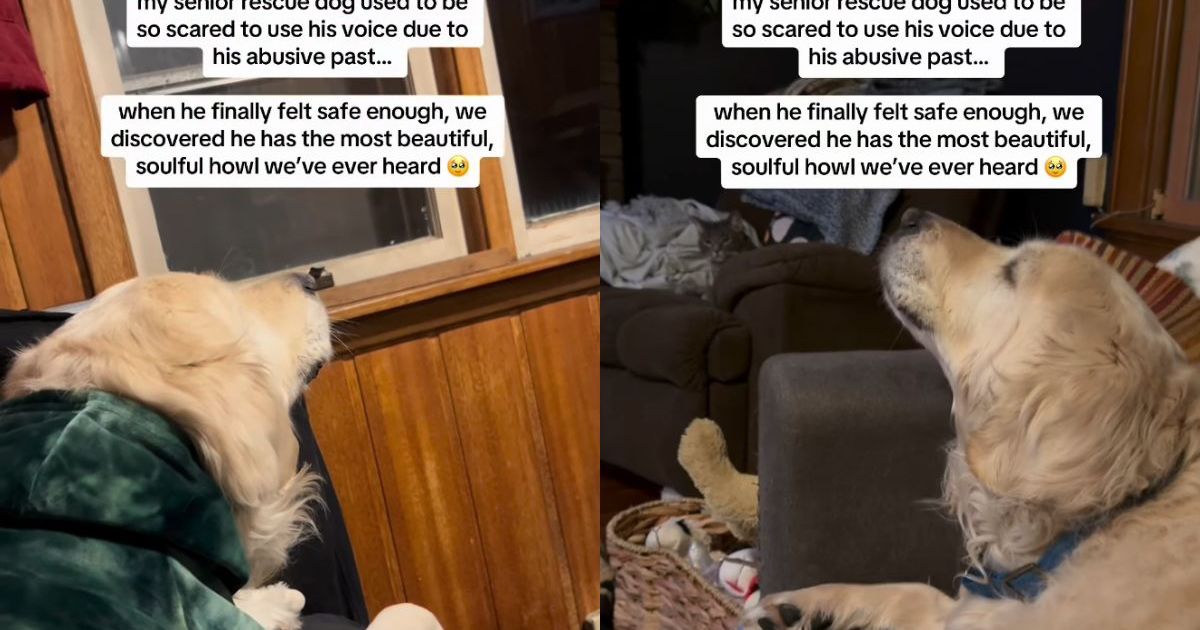
Bruce is a ten-year-old golden retriever with puppy mill scars on his muzzle from where his mouth was kept tied shut — and for years he never made a sound except during nightmares. Then one afternoon he tilted his head back, howled from the couch, and turned to check if that was allowed.
A 2011 landmark study in Applied Animal Behaviour Science examined 1,169 rescued puppy mill dogs — all living in adoptive homes for an average of two years — and found their likelihood of scoring in the highest fear ranges was still six to eight times greater than that of typical pet dogs. That is what a puppy mill does, measured. Bruce is ten years old, a golden retriever with scars around his muzzle from where his mouth was kept tied shut. He spent his first years in a cage. Then, one afternoon on the couch, he tilted his head back and howled.
The video is forty-seven seconds long. Bruce is lying on the couch when something moves in him and he lets out a low, tentative howl. Then he stops. He turns his head and looks at his family. Checking. As if the noise he just made might be the kind of thing that gets him in trouble.
Bruce came from a puppy mill. The evidence is still on him: scars around his muzzle from where his mouth was kept tied shut. He spent his early years in a cage, producing litters, never taught that his voice belonged to him. His family adopted him as a senior dog. For years, he was silent — no barking, no whining, nothing — except during nightmares, when sounds escaped that were a different category of noise entirely.
What a puppy mill does to a dog's voice
Puppy mills run on suppression. Dogs that bark attract attention, disturb neighbors, create liability. The solution in mills that don't prioritize animal welfare — which describes most of them — is physical restraint. A muzzle tied shut can't make noise. The Humane Society of the United States estimates there are roughly 10,000 puppy mills operating in this country, selling approximately two million puppies annually.
Over enough time, the animal learns at the deepest level that vocalization is dangerous. Veterinary behaviorists describe this through the lens of conditioned suppression: a behavior that has been consistently punished — directly or through anticipatory fear — becomes inhibited even after the original constraint is removed. The dog stops trying. Bruce learned to be legible without his voice: through his tail, through proximity, through the weight of his body leaning in. His family could see the absence clearly. He didn't bark at the mail carrier, didn't whine at mealtime, didn't make the excited sounds at the door that golden retrievers are somewhat famous for.
The numbers behind the damage
The McMillan study drew on 1,169 former breeding dogs representing 76 breeds, all assessed after an average of two years in adoptive homes. The results were not marginal. The dogs were 30 to 60 percent more likely than typical pet dogs to display stranger-directed aggression, separation anxiety, and heightened sensitivity to touch. The chance of scoring in the highest fear ranges was six to eight times greater.
This study gives us strong evidence that the dogs kept in these large-scale breeding facilities don't just suffer while they're confined there, but carry the emotional scars out with them for years, even when they're placed in loving homes.
— Dr. Franklin McMillan, lead author, Applied Animal Behaviour Science 2011 (as told to USA Today; cited in HSVMA Veterinary Report on Puppy Mills)
Recovery is possible but slow. The ASPCA's Behavioral Rehabilitation Center enrolled 441 extremely fearful dogs — most from puppy mills and hoarding situations — between 2013 and 2020. Eighty-six percent completed the program, which averaged 96 days in residence and 78 individual treatment sessions per dog. Of those who graduated, 99% were adopted. The road from mill to couch is genuinely long. What Bruce's story shows is that it ends.

The couch, the howl, the turn
Nobody in the family knows exactly why it happened when it did. Bruce was ten years old — elderly for a golden retriever. He had been with his family long enough to know their rhythms, their voices, the specific texture of what safety feels like in a particular house with particular people. This is what safety accumulates into: not one thing but hundreds of small ordinary things that stay the same. Something shifted. He lay on the couch one afternoon, tilted his head back, and howled.
Owners of puppy mill survivors frequently describe the same arc: a period of extreme wariness, followed by gradual softening, followed — sometimes, not always — by a moment when the dog seems to discover what it's like to be a dog. Some learn to play late. Some learn to trust laps. Bruce learned, at ten, to howl.
His voice is music to my ears.
— Bruce's owner, @seniorboybruce on Instagram
Why they barked back
Here is the part the comment sections noticed most: when Bruce howled, his family howled back. When he barked — experimentally, testing — they barked too. Not to tease him. Not as a game. Because they understood what was happening: he was learning that his voice was allowed. The way you confirm that for an animal is through response. You use your own body to show that sound is safe. They answered him.
What the barking back also communicated is that the family was paying attention. They noticed the howl. They understood its significance. They answered it in kind. For a dog who spent years in an environment where that loop was broken entirely, this responsiveness is its own kind of language. Bruce spent years in an environment where nothing he communicated produced a safe response. His family closed that loop.
Golden retrievers are not typically quiet dogs. The breed talks — with barks, whines, grumbles, sighs, the whole range. What Bruce's years of silence communicated, to anyone who knew his history, was the depth of the damage. What his howl communicates now is harder to name. Not healing exactly — healing implies the wound is closed. Something more like evidence. Proof that the years his family gave him have accumulated into something real.
What 1.4 million likes are telling us
The video went viral the way dog videos go viral: it made people feel something they recognized. But the specific thing it made people feel was more particular than usual. It wasn't just a dog being cute. It was the turn. That moment when Bruce looks back to check whether making noise was okay — that specific gesture, of a creature checking for permission to exist out loud — landed somewhere precise in the people who watched it.
The account, @seniorboybruce, posts a senior dog living his life: naps, slow walks, the unhurried dignity of an old dog who has decided the couch belongs to him. The puppy mill backstory is always there, always part of what viewers bring to what they see. But the account isn't really about the mill. It's about what came after.
Ten years old. Scars on his muzzle. A family who learned to bark back. He earned his sense of safety slowly, over years, in the accumulative way that trust is built — not in one gesture but in thousands of ordinary moments that added up to something. The howl was just the first time it was loud enough to hear.