The organization that spent 20 years saving two lives at once — and now needs saving itself
Doges Editorial · 2026-05-24 · 5 min read
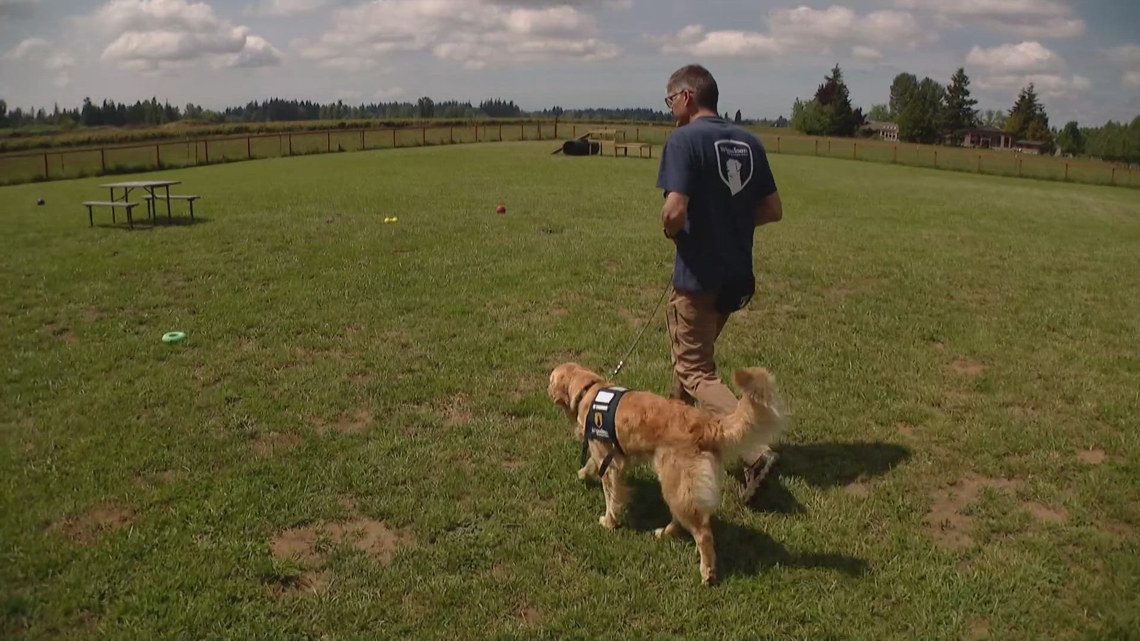
Brigadoon Service Dogs in Bellingham has spent two decades pairing veterans and people with disabilities with trained animals. A federal funding cut just erased half its budget, and the clock is ticking.
Twenty years into the Navy, Michael Hooper knows the specific weight of a night sky when missiles are incoming. He spent those two decades in the middle of things that don't come out easily in conversation — convoys, incoming fire, the accumulated residue of a long career in service of something larger than himself. When he finally came home for good, he brought all of it with him.
Depression. Anxiety. The ordinary sounds that carry extraordinary weight. Hooper left the Navy five years ago and found, as many veterans do, that leaving the uniform behind doesn't leave the rest behind with it. Then he got Rusty — a service dog trained by Brigadoon Service Dogs in Bellingham, Washington — and something shifted.
I think we feel each other's vibes and energy. I think he can sense if something is going on with me.
— Michael Hooper, Navy veteran, via KING5
A dog trained to hear what you can't say
Brigadoon Service Dogs has operated in Bellingham for twenty years — in a city of grey salt air and ferries to Canada, tucked against the northern edge of Puget Sound. It is one of only five accredited service dog organizations in the entire state of Washington. Over those two decades it has trained and placed more than a hundred animals, not just for veterans like Hooper, but for wheelchair users, children navigating disability, and victims of crime who needed a calm, present creature beside them while they gave testimony at the Whatcom County Courthouse.
The dogs learn specific things. They learn to read shifts in breathing, to interrupt a spiral before it lands, to offer counter-pressure at the exact moment it's most needed. Each dog takes approximately two years to train. Each one costs roughly $50,000 to bring through to placement. Brigadoon has historically given half its dogs to veterans at no charge, because that was always the point.
There is also the dimension that rarely makes it into official program descriptions: the dog sees you on your worst days and doesn't recalibrate. It doesn't feel uncomfortable with the silence or need anything from you in those moments except to be in the room. For someone carrying twenty years of things that don't translate easily into words, that presence is not nothing. It is a great deal of something.
The $300,000 that disappeared
In spring 2026, the Trump administration eliminated a grant from the Wounded Warrior Project that Brigadoon had built its annual operations around. That single grant was worth $300,000 — approximately half of the organization's entire budget for the year.
Executive Director Carrie Murphree now spends part of each day fielding calls from the 51 active clients Brigadoon currently supports. They are veterans. People who use wheelchairs. Families whose children depend on a trained animal for daily safety and emotional regulation. They are, understandably, scared.
The phone keeps ringing from our current clients, scared, anxious. What can they do? What's gonna happen if we're not around?
— Carrie Murphree, Executive Director, Brigadoon Service Dogs
Fifty-one clients and thirty-nine more waiting
Beyond the 51 people currently in Brigadoon's care, another 39 are on a waiting list. Some have already been assessed, already been matched to dogs currently mid-training. For them, the closure of Brigadoon would not mean a delay. It would mean unraveling a process they have already invested in emotionally and practically, with the most hopeful outcome in sight.
To keep the doors open, Brigadoon needs to raise $250,000 by July 1, 2026. Without it, Murphree says the organization closes. The state would lose one of its five accredited service dog providers. The 51 active clients would lose their ongoing support. The 39 waiting would have to find another path — or wait longer in a system that is already stretched thin.
Murphree was careful in how she described what this would mean for those 39 people: "To have that rug pulled out would be really hard for those clients." The understatement carries its own weight. These are people who have already navigated health systems, assessments, waiting lists. They've done significant work just to arrive at the point where a match is possible. To have that suspended by a line-item cut to a federal grant is a particular kind of indignity.
The math behind a matched pair
There is something in Brigadoon's model worth understanding before it disappears. The dog that gets placed is almost always a rescue — an animal that would otherwise have cycled through a shelter. The person who receives them is someone for whom other kinds of support haven't been enough. Two lives that each needed a particular kind of saving find each other, and a two-year training investment is what makes the moment possible.
The $50,000 and two years of training that go into each placement are pointed at a precise thing: the moment a veteran like Hooper can walk through a crowded grocery store without needing to manage the anxiety himself, because Rusty has already been trained to know what to do before the moment fully arrives. The dog is not a comfort object. It is a precision tool built from years of work, given freely.
What we do makes such a big difference to people. To not have that, to lose that would be heartbreaking.
— Carrie Murphree, Executive Director, Brigadoon Service Dogs
What happens in the next few weeks
Murphree has made the ask public. Brigadoon's fundraising page is live at brigadoonservicedogs.ddock.gives, and the July 1 deadline is not a soft one. The organization has survived for twenty years because of a combination of grant funding, community support, and the specific kind of conviction that drives people to spend two years training a single dog for someone they may never meet. That model still works. What changed was one line in a federal budget.
Hooper and Rusty still go out every morning. The routes are familiar. Rusty does the work he was trained to do: pays attention, stays close, and notices before he's asked. For the 39 people on the waiting list, that morning walk is still a promise someone made to them. Whether that promise can be kept depends on what happens before July.