The Men Behind the Leash: Michigan Inmates Training Rescue Dogs for Veterans
Doges Editorial · 2026-06-07 · 6 min read
DOGES
Inside a Michigan prison, men serving long sentences are training rescue dogs to become service animals for veterans with PTSD — and the program is quietly changing everyone it touches.
Five-thirty in the morning inside a Michigan correctional facility is not a moment most people think about. But in one wing of this institution, it is when the real work begins. A man named Campbell rises — not exactly for himself, but because there is a dog that needs him. The dog, a rescue named Titan, has already learned this schedule. He probably lifts his head from his kennel the moment he hears the specific footstep pattern that means food, training, and the particular warmth of one person's attention. This is how a day inside the Blue Star Service Dog program starts: with something alive that needs something from you.
What Blue Star Actually Does
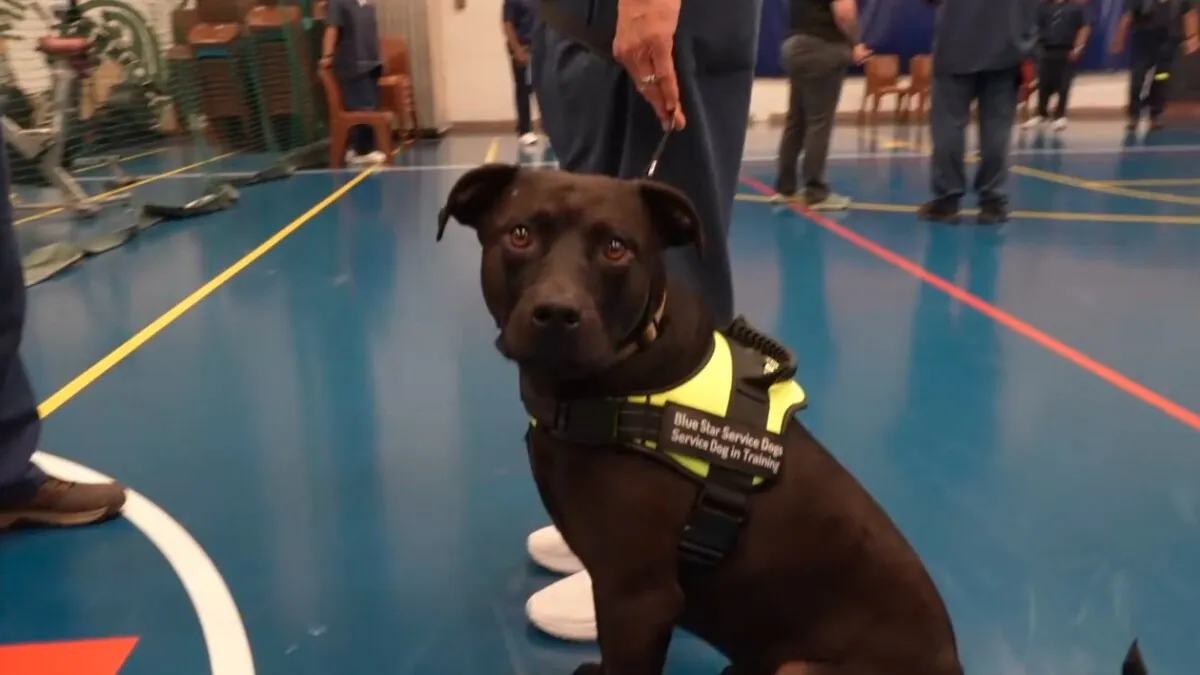
The Blue Star Service Dog program pairs Michigan prison inmates with rescue dogs trained to serve veterans and first responders living with PTSD, traumatic brain injury, and other service-related conditions. Dogs that might otherwise spend months in a shelter — or not make it out — enter the program and work with a full-time incarcerated handler who teaches them commands, socialization, and the specific tasks that make them medically useful. The program works because it is built for mutual benefit: people who need structured purpose get meaningful work, dogs who need training and attention get dedicated handlers, and veterans who need stability get a trained partner that becomes, for many, a genuine lifeline.
The Man Behind Titan's Training
Campbell has been incarcerated for 37 years. He is candid about what brought him here, and he says it without self-pity.
I've been incarcerated for 37 years. We broke rules. We broke laws.
— Campbell, Blue Star handler
The admission is context, not excuse. What follows it is the reason it matters. Campbell knows Titan the way only a full-time caretaker knows a dog — which commands land easily, which require repetition, how Titan reacts to sudden loud sounds in the facility, when he's tired, when he's sharp. That level of close observation changes a person. Whatever it does, it is visible on Campbell's face when he talks about the day Titan would leave.
To know that we can turn these dogs over to a deserving veteran who served our country — you can't put that into words.
— Campbell, Blue Star handler
On the Other Side of the Leash
The experience from the veteran's side illuminates why service dogs accomplish what clinical interventions sometimes cannot replicate. Veteran Cantrell received a Blue Star dog and described the daily dynamic with a precision that will land for anyone who has ever lived with a dog:
When that vest comes on, I have to treat him like a medical device. I may say I don't want to get out today, but the dog will say, I have to get out… because I'm a dog.
— Cantrell, Blue Star veteran recipient
This is the thing service dogs do that medications and therapy protocols often can't replicate: they insist. They are creatures of biological routine — they need walks, stimulation, contact, the outside world. They need you to show up for them, physically, every single day. For someone with PTSD whose symptoms can make leaving the house feel impossible, a creature that legitimately, physically needs the walk is a different kind of accountability than any clinical framework provides. The dog doesn't know about bad days. It knows it needs to go outside.
Titan Graduates
After months of daily training — sit, stay, brace, retrieve medication, deep pressure therapy during anxiety episodes, crowd navigation in public spaces — Titan completed his certification and was matched with his veteran partner. Campbell watched him go.
He's a special one for me. He'll always be a part of this program and a part of me.
— Campbell, Blue Star handler
The built-in heartbreak of the Blue Star model is that the dog you raised and trained leaves. Every handler knows this from the beginning — they are training for a graduation that is also a goodbye. The fact that they do it anyway, and then begin again with a new rescue, says something significant about what the work gives back to the people doing it.
From Rescue to Medical Partner
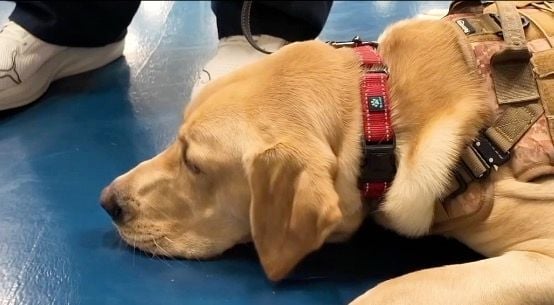
Titan started as a rescue — a dog who entered a system where the arc often ends at euthanasia. He moved from that to a correctional facility kennel to a veteran's home, where he now performs actual medical functions: interrupting anxiety spirals, alerting to panic attacks before they peak, providing physical grounding when his partner dissociates. The transformation is remarkable in its specificity. Program coordinator Naveen, reflecting on both the handlers inside and the veterans outside, put it simply:
Whether they're in here or out there, they're making a difference.
— Naveen, Blue Star program coordinator
What a Walk Means Here
For service dog teams, the daily walk is not a luxury — it is maintenance. Research on veteran-dog partnerships consistently shows that regular walking with a trained animal reduces cortisol, lowers blood pressure, and creates social openings that anxiety and PTSD would otherwise close off. Cantrell's dog insists on going out even on days when Cantrell doesn't want to. That biological insistence — that straightforward fact of a dog that needs a walk — is itself therapeutic. Not because the dog was trained to walk the veteran. Because it's a dog, and dogs need walks, and showing up for that need turns out to be healing in ways that are measurable and lasting.
Blue Star is a small program — one facility, a handful of handlers, dogs graduating one at a time. But small programs have outsized impact per unit when they're designed well. Titan is somewhere in Michigan today, wearing his vest, walking with a veteran who might not have gotten out of bed without him. Campbell is somewhere inside that facility, beginning again with a new rescue. And somewhere between those two facts, a program is quietly doing some of the most important work in the state.