They Were Found Alone on the Tracks. They Had Already Chosen Each Other.
Doges Editorial · 2026-05-09 · 8 min read
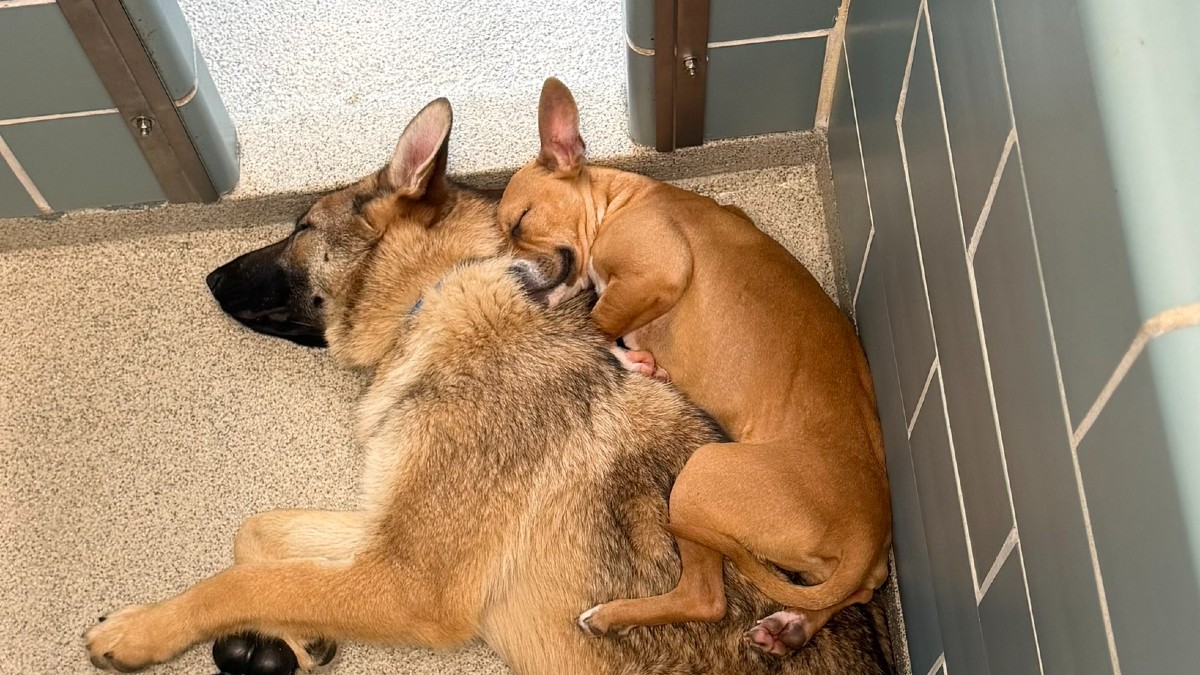
Two dogs turned up near a Chicago rail line with no collars, no history, and no interest in being separated. The shelter named them Bird and Dee — and the internet had thoughts.
Nobody knows where they came from. Nobody knows what they went through before they were found near the rail line on Chicago's north side — two dogs with no identification, no history anyone could trace, and no interest whatsoever in being separated from each other. The shelter staff at the Anti-Cruelty Society of Chicago gave them names: Bird and Dee. Then they watched as the dogs made their arrangement perfectly clear.
Bird is the smaller one. When shelter workers tried to house them in different kennels, even briefly, Bird would climb on top of Dee with the kind of determination that forecloses argument. Not upset, exactly. Not destructive. Just entirely clear about the terms. Dee, for his part, sat still beneath her — steady, patient, like a dog who had already made a decision and saw no reason to revisit it.
## Found on the Tracks
The rail line where they were found runs through one of Chicago's industrial corridors, a stretch of track cutting through neighborhoods in transition from manufacturing to mixed use. It is not the kind of place dogs typically end up by accident. Whether they were together before they were found there, or met in that liminal space and formed their bond in the absence of other options, is something the shelter cannot say. What is clear is that by the time anyone found them, the bond was already set.
The circumstances of their arrival speak of something that had been tested. Whatever they had experienced — exposure, disorientation, the particular stress of living without shelter — they had experienced it side by side. The Anti-Cruelty Society is one of Chicago's oldest and busiest shelters, processing thousands of animals each year. Staff there have seen bonded pairs before: littermates, dogs from the same home, companions that had lived together for years. Bird and Dee were something slightly different — two dogs who had apparently attached to each other out of necessity and then refused to let go.
## The Shelf Life of a Viral Shelter Post
The shelter posted about them on social media, as shelters do, with the hope that someone would recognize them or come forward to adopt. What happened instead was that the post caught. Shares multiplied. People who had never heard of the Anti-Cruelty Society of Chicago were suddenly invested in two specific dogs they had never met — a smaller dog named Bird who climbed on top of her companion, and a larger dog named Dee who simply endured it with what the shelter described as complete equanimity.
This is what shelter social media does at its best. It takes an abstraction — the large, systemic problem of pet homelessness — and narrows it down to two specific individuals with distinct personalities and a relationship you can understand in under thirty seconds. Bird and Dee were not a cause. They were characters. And characters have a way of traveling.
> "What they went through built a bond that didn't break when help finally arrived. Now they're looking for a home that will keep that bond intact, because they've already chosen each other." — Anti-Cruelty Society of Chicago
## Dee Doesn't Mind One Bit
The detail that made people stop scrolling was the one about Bird climbing on Dee. Not the finding near the rail line. Not the viral numbers. The image of a smaller dog positioning herself on top of a larger dog with unmistakable purpose — and the larger dog accepting this without complaint. It said something about the two of them that no amount of shelter copy could convey more efficiently.
> "Dee doesn't mind one bit. He just stays steady beneath her." — Anti-Cruelty Society of Chicago
Anyone who has lived with two dogs who have found each other — who have sorted out their dynamic and arrived at something that works for both of them — will recognize this. The tolerance isn't passivity. It's preference. Dee is not enduring Bird because he has no choice. He's settled into a posture that says he wouldn't have it otherwise.
## The Problem With Bonded Pairs
Bonded pairs are one of the more persistent challenges in animal rescue. They require an adopter with the space, resources, and willingness to take on two animals at once — which immediately reduces the pool of potential homes. Shelters face a real tension: separating bonded animals sometimes makes them individually more adoptable but at significant emotional cost. Keeping them together honors the bond but can mean longer shelter stays.
The Anti-Cruelty Society has been clear: Bird and Dee go together. The viral attention helps — it typically does, in the short term — but what they ultimately need is not a thousand people sharing their post. They need one household that can take both home and let them continue doing what they've clearly decided to do: stay close, stay steady, look after each other.
## What Attachment Looks Like
There's a question researchers have been exploring for decades: whether dogs form attachments to each other that parallel human attachment, or whether canine social bonds are more instrumental — based in shared territory, mutual advantage, shared routine. The working answer at this point seems to be: it depends on the dogs, and it depends on what they've been through together.
Bird and Dee are not a research dataset. They're two specific animals with a specific history no one can fully reconstruct. What is visible is behavior: Bird's deliberate positioning on top of Dee when separated, Dee's unruffled response, the way they navigate shelter life as a unit rather than as two individuals in proximity. If that's not attachment, it produces all the same effects.
## The Home That Keeps the Bond Intact
Bird and Dee have one advantage that many bonded pairs lack: a documented personality dynamic that is, frankly, irresistible. A dog who climbs on top of her companion when separated. A companion who considers this arrangement entirely satisfactory. The person who adopts them is not adopting an unknown quantity. They are adopting a relationship that has already been stress-tested under difficult circumstances and found to be solid.
Every morning walk with two dogs who have found each other is a different texture than a walk with one. There's a negotiation of pace, a navigation of who sniffs what and for how long, a rhythm that develops between two animals who know each other well. Bird and Dee have that rhythm already — built in a shelter kennel, under conditions not conducive to much that is warm. Whoever adopts them inherits something already made.