The best nose in Australian conservation just retired
Doges Editorial · 2026-05-29 · 5 min read
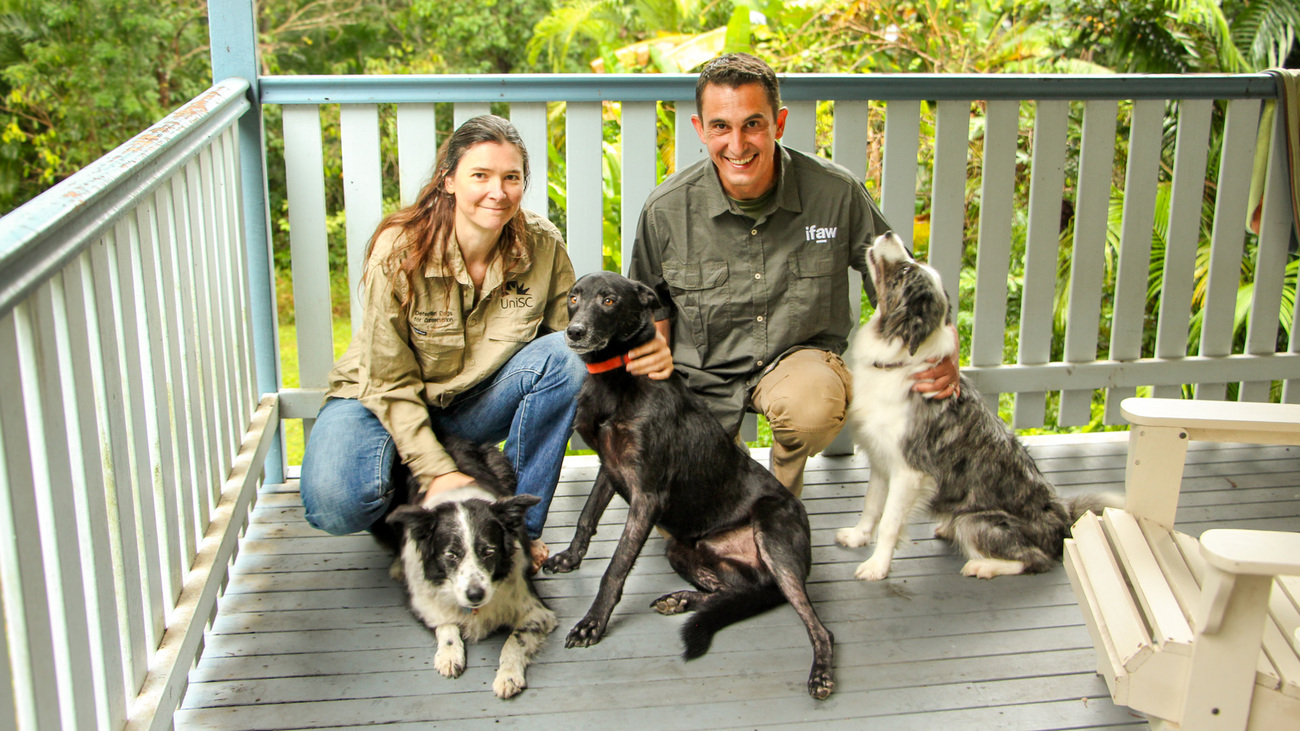
Bear the Australian koolie spent a decade sniffing out koalas through smoke-blackened bushland. Now he's retired, IFAW is looking for a rescue dog with the right obsessions to take his place.
Bear is retired now. He lives on the Sunshine Coast of Queensland, gets belly rubs, plays fetch. The small red boots he used to wear into smoke-scarred Australian bush — laced on to protect his paws from hot ash, broken glass, and wire hidden in rubble — are part of his past now. He is eleven years old and he has earned this.
But his job is still open. On May 20, 2026, IFAW and the organizations that trained Bear posted a vacancy notice. The role: koala detection dog. The candidate: a rescue pup, probably sitting in a shelter somewhere in Australia right now, not yet knowing what it was built for.
What Bear Did in the Burning Bush
The Australian bushfires of 2019 and 2020 — the Black Summer — burned through roughly 19 million hectares. Koalas were among the hardest-hit species: slow-moving, tree-dependent, unable to outrun the speed at which fire moved through the canopy. In the aftermath, rescue organizations fanned out across scorched country looking for survivors. The problem was scale. Blackened forest, collapsed trees, an animal that hides instinctively. Aerial surveys couldn't find them. Ground teams couldn't cover the terrain fast enough.
Bear could. Trained to detect the specific scent of live koala fur — not dead animals, not old scat, but living koalas hiding in hollows and high in damaged trees — he moved through burned bush in his red-booted paws, nose working, body angling upward at the critical moments when the scent trail pointed into the canopy above. Over the course of his career, he helped locate more than 100 koalas in need of rescue or veterinary care.
Bear set the gold standard for koala detection dogs. He's leaving very big boots to fill.
— Josey Sharrad, IFAW Oceania head of programs
An Australian Koolie With an Unusual Job Description
Bear is an Australian koolie — a herding breed better known for working livestock than for conservation fieldwork. His training came through a collaboration between IFAW (the International Fund for Animal Welfare), a nonprofit called Innovation for Conservation, and the University of the Sunshine Coast's Detection Dogs for Conservation program. Together they built something that hadn't existed before: a systematic approach to training dogs to locate a single endangered species by scent, in field conditions that no other search technology could adequately navigate.
The training is counterintuitive in a specific way. Koalas live in trees. To be useful in the field, Bear had to learn to orient upward — to read a scent trail that moved vertically rather than along the ground, and to communicate that signal to his handler. Teaching a dog whose every instinct runs along the horizontal plane to look up, reliably and on cue, is among the more complex challenges in detection dog work. Bear mastered it over years of deliberate training.
During the Black Summer, Bear's work attracted international attention. Tom Hanks mentioned him. Leonardo DiCaprio shared his story. The image of a small dog in red boots picking his way through burned Australian forest became one of the more enduring symbols of the conservation response to the fires. Bear, characteristically, did not appear to notice any of this.
The Job Posting
The position vacancy notice published by IFAW and Innovation for Conservation in May 2026 reads unlike most job ads. The candidate must be a rescue dog — not a breed dog, not a trained working dog acquired from a breeder, but an animal that has been surrendered to a shelter and is waiting there, probably being passed over by families looking for something more manageable. The candidate must be less than two years old. It must be obsessively toy-motivated — the kind of dog that will not drop the ball, that wants it back the moment you throw it, that makes a game last until your arm gives out.
It must also be indifferent to other dogs, unafraid of new environments, and — critically — must have zero prey drive. The new dog will spend its working life close to koalas and other native Australian wildlife. The instinct to chase, even at its mildest, would end a career before it began.
By only recruiting a rescue dog, it's a win-win — giving a dog the chance of a new life.
— Russell Miller, Innovation for Conservation director and Bear's handler
Why the Difficult Ones Make the Best Dogs for This
There's a counterintuitive principle at the center of conservation dog selection: the traits that make a dog nearly impossible to live with as a family pet are often exactly the traits that make it exceptional in the field. An obsessive fetch drive — the kind that keeps a dog returning the ball for an hour after every reasonable person would have stopped — becomes an inexhaustible fuel source in a training program built on reward-based repetition. An inability to settle in a quiet domestic environment converts to relentless focus on the track. What reads as a problem in a living room reads as a gift on a burned hillside in Queensland.
Frédéric Chappée, IFAW's director of canine units, spent more than two decades working with detection dogs — including time with the French army — before joining the conservation program. He describes what makes these dogs exceptional not as something innate or mysterious, but as the product of choices made at every stage of training.
The performance of a conservation dog is never a miracle. It's the result of hard work, strategy, and respect.
— Frédéric Chappée, IFAW director of canine units
A Rescue Dog Doing Rescue Work
Bear himself was a rescue dog. The program has always recruited that way — deliberately, as a matter of principle. An animal that no one quite knew what to do with, whose energy exceeded every domestic situation, gets a job that was designed for exactly that energy. The dog and the work grow into each other. What was a liability in one context becomes an asset in another.
For a decade, Bear's work was this: walk into burned and damaged Australian bush, follow a scent that no human could detect, orient toward the canopy, and find the animal hiding there. Then do it again. And again, for as many hours as the day had. He did it in red boots, in smoke, through ash-covered terrain, in conditions that would have turned back a less motivated animal.
Why the Next Bear Matters
Koalas were declared vulnerable to extinction in New South Wales and Queensland after the Black Summer fires drastically reduced population estimates. Conservation researchers believe the species could disappear from large parts of the country within decades without sustained, coordinated intervention. The Detection Dogs for Conservation program at the University of the Sunshine Coast represents one of the more practically effective tools available — not because a single dog can reverse the decline, but because the data and rescue work that dogs like Bear make possible adds up.
The next Bear is almost certainly in a shelter right now. It is probably returning a ball that no one has thrown, or pacing a run, or making itself difficult in exactly the right ways. Some shelter worker is trying to figure out what to do with it.
The answer, in at least one known case, is to train it to find koalas in burned Australian bush. And then let it run.
On your next morning walk — on whatever route your dog has memorized, every scent-marked corner and favored patch of grass — it might be worth noticing how much your dog is reading the world you can barely detect. Bear spent a decade turning that ability into one of Australia's most effective conservation tools. Somewhere in a shelter, another dog is waiting for someone to figure out the same thing.