The rescue dog who wore red boots and saved a hundred koalas has retired
Doges Editorial · 2026-05-26 · 5 min read
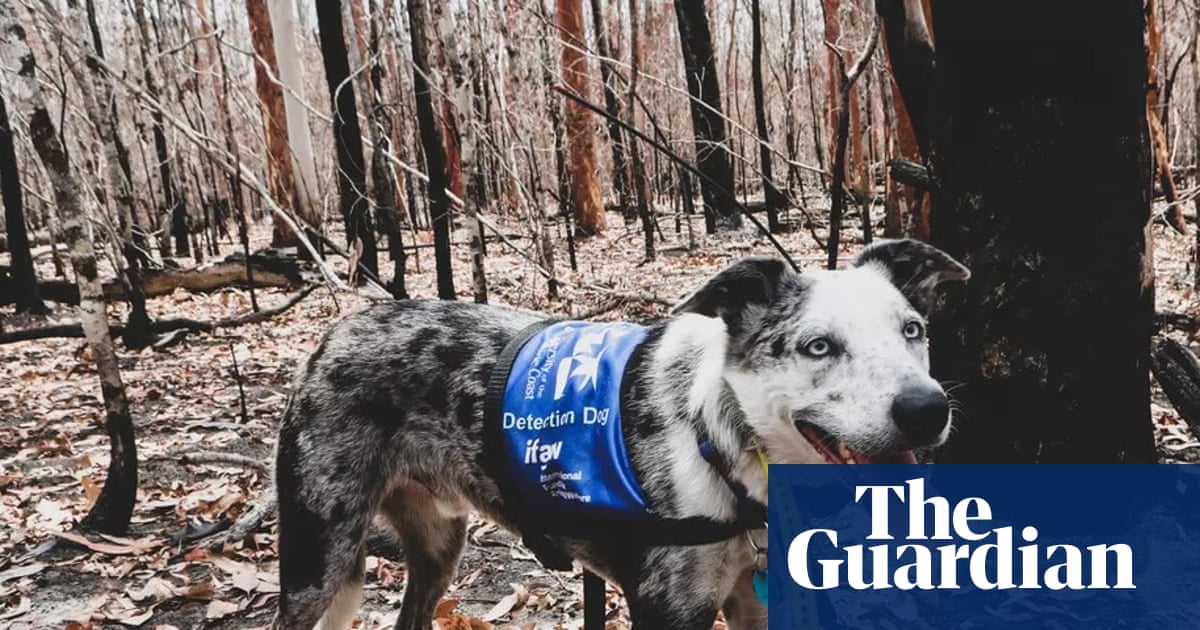
Bear, an Australian Koolie who once chewed through apartment walls from excess energy, spent a decade locating injured koalas in catastrophic bushfires. Now eleven, he's hung up his little red boots — and a conservation community is quietly scrambling for what comes next.
In the summer of 2019, what Australians call Black Summer, the smoke turned Queensland's sky the colour of old embers and the koalas panicked. They fled burning eucalyptus trees and stumbled into ash-grey scrubland — disoriented, many of them burned, most of them hidden where no human spotter could see. Infrared cameras swept the canopy. Drones buzzed overhead. And a black-and-white Koolie in little red boots walked methodically into the charred forest, nose lifted to the air, searching for a scent no technology had yet learned to read.
His name was Bear. He was a rescue dog nobody could keep — and, by the time he finished, one of the most celebrated working animals in Australia's conservation history. He is eleven now, and retired since March 2026. The Guardian reported on his exit and the search for his replacement on May 20, 2026.
A dog nobody could house
Bear's early biography was a succession of failed placements. His problem — if you could call it that — was intensity. Left alone in a Gold Coast apartment, he redirected his energy somewhere that made sense to him: the walls. "He literally ate the walls of his Gold Coast apartment in one home," said Josey Sharrad, the International Fund for Animal Welfare's Oceania programs director. Rehomed once, and then again, he cycled through families, each one unprepared for what he brought.
The trainer who eventually took him in recognised something the apartments had missed. Bear didn't have a behaviour problem. He had a capacity that hadn't found its application. His intense focus — the same trait that made him impossible to live with in a flat — made him ideal for the long, demanding hours of conservation detection work in dense Australian scrub.
Those dogs often don't make the ideal family pets, but Bear was born to be a detection dog.
— Josey Sharrad, IFAW Oceania programs director
Into the burning country
The 2019-20 Australian bushfires burned through more than 18 million hectares and killed or displaced an estimated three billion animals. For koalas — already struggling after decades of habitat loss — the fires were devastating. Injured animals hid in trees too high for spotters to see from below, and too thermally similar to the scorched canopy for infrared cameras to reliably separate them from the heat of the ground.
Bear walked into the aftermath when the cameras ran out. Unlike most koala detection dogs, which are trained to follow droppings on the forest floor, Bear had been trained on the scent of live animals — often thirty or forty feet overhead in a eucalyptus. "That's a bit of a tougher job than finding poo," Sharrad said, with characteristic understatement. His signal when he found a koala: a slow, deliberate lie-down beneath the tree. Then he'd look back at his handler and wait — patiently, precisely — for the yellow tennis ball that was his reward and, for a decade, apparently the only thing in the world he wanted.
They can smell what we can't see.
— Josey Sharrad, IFAW Oceania
Red boots and a global following
The red boots were practical — protection for his paws against the scorched, broken ground he walked through daily. But they made Bear immediately recognisable, and when photographs of him at work spread across social media in 2019, something in those images landed. In the middle of a climate catastrophe, there was a working rescue dog doing the thing only he could do: methodically, quietly, without drama.
Tom Hanks and Leonardo DiCaprio became admirers. When WeRateDogs posted about his retirement last week, the tweet gathered nearly 15,000 likes and nearly 190,000 impressions. Ecologist Romane Cristescu, who collaborated with Bear at the University of the Sunshine Coast, reflected on what he gave the humans around him: "Thanks to his personality — both cheerful and fun — he managed to brighten the darkest moments of many people's lives. We feel incredibly grateful and lucky to have had Bear as a companion in our work for koala conservation."
What he actually found
During the Black Summer fires alone, Bear helped locate more than 100 koalas — many of them in urgent need of veterinary care. He walked through landscapes that looked like the surface of another planet, the kind of terrain that turns normal detection work into something else entirely. He kept working.
The scent discrimination required for Bear's job — identifying a living koala in smoke-thick, fire-scorched air, from thirty feet below the animal — is still not fully understood by researchers. What's established is that dogs process scent at roughly 10,000 times the sensitivity of humans, and that Bear spent a decade refining a skill built on top of that baseline, in conditions that make most detection work look straightforward. He was, by every available measure, extraordinary at something no other technology could replicate.
The search for his replacement
Bear officially retired in March 2026 at eleven years old. A decade of field work in fire zones, flood terrain, and post-cyclone scrubland is more than a full career. His Instagram account confirmed that retirement looks like cuddles and tennis balls and, in his words, maybe a little mischief.
The search for his successor is underway. The ideal candidate: under two years old, medium-sized, ball-obsessed, physically fit, comfortable charging through dense bush, and — critically — without any prey drive or instinct to chase wildlife. Conservation groups are partnering with the University of the Sunshine Coast and Frédéric Chappée, a French canine expert who spent years leading military canine units before training anti-poaching dogs in Africa and Indonesia, to design the training program.
The best thing about these detection dogs is they have the best of both worlds — they're working during the day, and they're living the life of a pet for the rest of the time.
— Josey Sharrad, IFAW Oceania
Why it matters going forward
Koalas were listed as endangered along Australia's east coast following the Black Summer fires — a direct result of catastrophic habitat loss. Against a backdrop of increasingly frequent climate disasters, dogs like Bear fill a gap that drone cameras and thermal sensors cannot. The ability to walk into the aftermath of a fire or flood and find displaced, injured animals by nose is becoming more valuable, not less.
What Bear leaves behind is not just a conservation record but a template: a rescue dog who was too much for every apartment he ever lived in, finally turned loose into the thing he was actually built to do.
Tomorrow morning, somewhere on your usual loop, your dog will stop at a patch of ground you've walked past a hundred times. Something in the air has shifted. Something is new. They'll stay there a moment — nose working, reading a language you can't access — before you coax them on. Bear did this version, at scale, with purpose, across a decade of Australian disaster. The nose is the same instrument. We're still learning what it's capable of.